 Back
BackBody Structure and Organization: Medical Terminology Study Notes
Study Guide - Smart Notes
 Tailored notes based on your materials, expanded with key definitions, examples, and context.
Body Organization
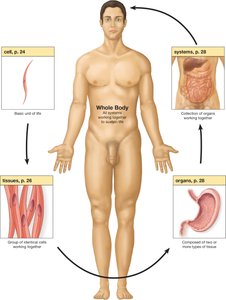
Levels of Body Organization
The human body is organized in a hierarchical structure, from the simplest to the most complex level. Each level builds upon the previous one, forming the complete organism.
Cell: The basic unit of life, capable of performing all vital functions.
Tissue: Groups of similar cells working together to perform a specific function.
Organ: Structures composed of multiple tissue types that perform specialized tasks.
System: Groups of organs working together to carry out complex functions.
Whole Body: The sum of all systems, organs, tissues, and cells.
Cells
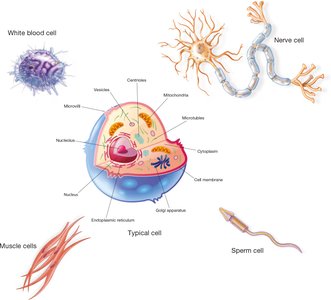
Cell Structure and Function
Cells are the fundamental units of all living organisms. They possess the ability to respond to stimuli, conduct metabolic activities, and reproduce. All tissues and organs are composed of cells, each specialized for particular functions such as reproduction, hormone secretion, energy production, and excretion.
Cell Membrane: The outer boundary that encloses the cell's contents.
Cytoplasm: The watery internal environment where cellular activities occur.
Nucleus: Contains genetic material (chromosomes) and controls cell activities.
Chromosomes: Structures made of DNA, containing genes that code for proteins.
Mutation: A change in the DNA sequence that can affect protein function.
Somatic Cells: Body cells with 46 chromosomes (23 pairs).
Gametes: Reproductive cells (sperm and ova) with 23 chromosomes.
Stem Cells: Undifferentiated cells capable of becoming any cell type.
Tissues
Types of Tissues
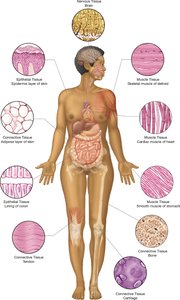
Tissues are groups of similar cells that work together to perform a specific function. The human body has four primary tissue types:
Muscular Tissue: Responsible for movement through contraction. Types include skeletal, smooth, and cardiac muscle.
Epithelial Tissue: Forms protective coverings and linings; involved in absorption, secretion, and excretion.
Connective Tissue: Supports and protects body structures; includes bone, cartilage, tendons, and adipose tissue.
Nervous Tissue: Composed of neurons; transmits electrical impulses throughout the body.
Organs and Systems
Major Organ Systems
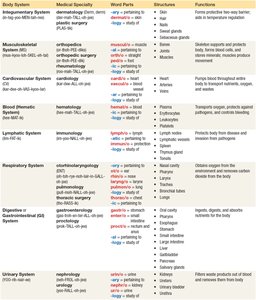
Organs are made of different tissue types working together for specific functions. Organ systems are groups of organs that coordinate to perform complex body functions. Each system has associated medical specialties and terminology.
Body System | Medical Specialty | Structures | Functions |
|---|---|---|---|
Integumentary | Dermatology | Skin, hair, nails, sweat glands | Forms protective barrier, regulates temperature |
Musculoskeletal | Orthopedics | Muscles, bones, joints | Supports body, produces movement |
Cardiovascular | Cardiology | Heart, blood vessels | Pumps blood, transports nutrients |
Blood (Hematologic) | Hematology | Blood cells, plasma | Transports oxygen, protects against disease |
Lymphatic/Immune | Immunology | Lymph nodes, spleen, thymus | Protects from disease, returns fluids to blood |
Respiratory | Pulmonology | Lungs, trachea, bronchi | Obtains oxygen, removes carbon dioxide |
Digestive | Gastroenterology | Stomach, intestines, liver | Digests, absorbs, and eliminates food |
Urinary | Urology | Kidneys, bladder | Filters waste, removes urine |
Female Reproductive | Gynecology | Ovaries, uterus | Produces eggs, supports fetus |
Male Reproductive | Urology | Testes, prostate | Produces sperm |
Endocrine | Endocrinology | Glands (thyroid, adrenal) | Regulates body functions via hormones |
Nervous | Neurology | Brain, spinal cord, nerves | Receives and interprets sensory input |
Special Senses | Ophthalmology, Otolaryngology | Eyes, ears | Vision, hearing, balance |
Anatomical Position
Definition and Importance
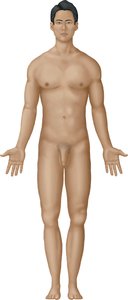
The anatomical position is the standard reference for describing the location and relation of body parts. The body stands erect, facing forward, arms at the sides with palms forward, and feet parallel.
Body Planes
Major Body Planes
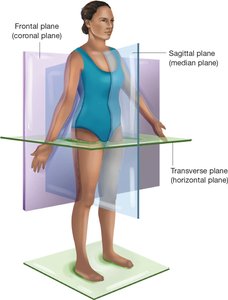
Body planes are imaginary lines used to divide the body for anatomical study and description:
Sagittal Plane: Divides the body into right and left portions. The midsagittal (median) plane divides it into equal halves.
Frontal (Coronal) Plane: Divides the body into anterior (front) and posterior (back) portions.
Transverse (Horizontal) Plane: Divides the body into superior (upper) and inferior (lower) portions.
Body Regions
Major Body Regions and Terminology
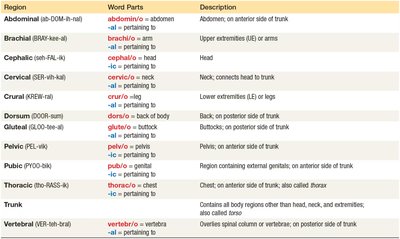
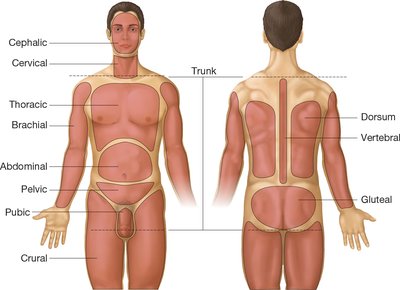
The body is divided into regions for precise anatomical reference. Each region has a specific name and associated word parts.
Region | Word Parts | Description |
|---|---|---|
Abdominal | abdomin/o, -al | Abdomen; anterior side of trunk |
Brachial | brachi/o, -al | Upper extremities (arms) |
Cephalic | cephal/o, -ic | Head |
Cervical | cervic/o, -al | Neck; connects head to trunk |
Crural | crur/o, -al | Lower extremities (legs) |
Dorsum | dors/o, -al | Back of body |
Gluteal | glute/o, -al | Buttocks |
Pelvic | pelv/o, -ic | Pelvis; anterior side of trunk |
Pubic | pub/o, -ic | Genital region |
Thoracic | thorac/o, -ic | Chest |
Trunk | — | Body excluding head, neck, extremities |
Vertebral | vertebr/o, -al | Overlies spinal column |
Body Cavities
Major Body Cavities and Their Contents
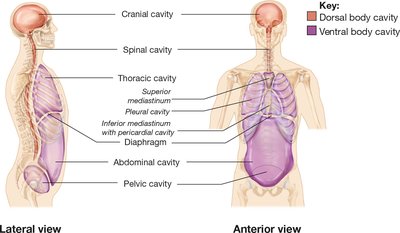
The body contains several cavities that house vital organs. These are divided into dorsal and ventral cavities:
Dorsal Cavities: Cranial cavity (brain) and spinal cavity (spinal cord).
Ventral Cavities: Thoracic cavity (lungs, heart, mediastinum), abdominopelvic cavity (digestive, excretory, reproductive organs).
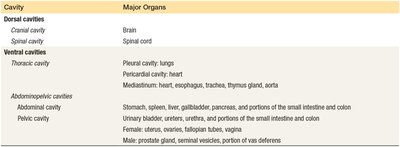
Cavity | Major Organs |
|---|---|
Cranial | Brain |
Spinal | Spinal cord |
Thoracic | Lungs, heart, aorta, esophagus, trachea, thymus |
Abdominal | Stomach, spleen, liver, gallbladder, intestines |
Pelvic | Bladder, reproductive organs, rectum |
Abdominal Divisions
Anatomical and Clinical Divisions
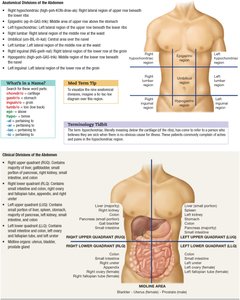
The abdominopelvic cavity is subdivided for clinical and anatomical reference. The anatomical method divides it into nine regions, while the clinical method uses four quadrants (RUQ, LUQ, RLQ, LLQ).
Directional Terms
Describing Body Locations
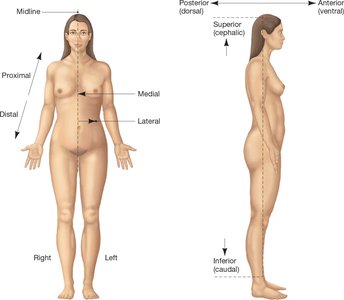
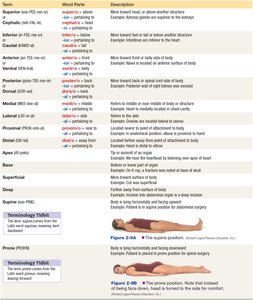
Directional terms are used to describe the positions of structures relative to each other. Common pairs include:
Superior (cephalic) / Inferior (caudal): Above / below another structure
Anterior (ventral) / Posterior (dorsal): Front / back of the body
Medial / Lateral: Toward / away from the midline
Proximal / Distal: Nearer / farther from the trunk or point of attachment
Superficial / Deep: Closer to / farther from the body surface
Supine / Prone: Lying face up / face down
Medical Care and Pathology
Key Terms in Medical Care
Medical terminology includes terms for disease processes, diagnosis, and treatment:
Etiology: The cause of a disease.
Pathogenesis: The development of a disease.
Pathology: The study of disease, including causes, development, and effects.
Disease: Abnormal functioning of body systems.
Disorder: Irregularity in normal function due to disease.
Syndrome: A group of signs and symptoms occurring together.
Diagnosis (Dx): Identification of a disease based on signs, symptoms, and tests.
Prognosis (Px): Expected outcome of a disease.
Therapeutic Procedures: Treatments to manage or cure disease.
Abbreviations
Common Medical Abbreviations
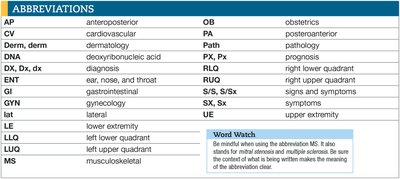
Medical terminology frequently uses abbreviations for efficiency. Examples include:
AP: Anteroposterior
CV: Cardiovascular
Dx: Diagnosis
Px: Prognosis
RUQ, LUQ, RLQ, LLQ: Right/Left Upper/Lower Quadrant
S/Sx: Signs and symptoms
MS: Musculoskeletal (note: can have multiple meanings)
