 Back
BackBody Structure: Foundations of Medical Terminology
Study Guide - Smart Notes
 Tailored notes based on your materials, expanded with key definitions, examples, and context.
Body Structure
Levels of Organization in the Human Body
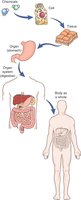
The human body is organized from the simplest to the most complex levels. Understanding these levels is essential for grasping medical terminology and the relationships between body parts.
Chemicals: The most basic level, including atoms and molecules essential for life.
Cells: The basic unit of living organisms, responsible for carrying out metabolism and energy production (ATP).
Tissues: Groups of similar cells performing a specific function.
Organs: Structures composed of different tissues working together for a common function.
Organ Systems: Groups of organs that perform related functions and work together to maintain homeostasis.
Organism: The complete living being.
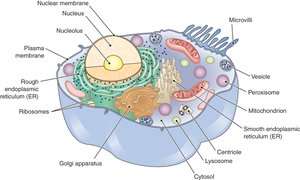
Cell Structure and Function
Cells are the fundamental units of life, each with specialized structures (organelles) that perform distinct functions necessary for survival and function.
Nucleus: Contains genetic material (DNA) organized into chromosomes; controls cell activities.
Nucleolus: Site of ribosome production.
Plasma Membrane: Regulates entry and exit of substances.
Ribosomes: Synthesize proteins.
Endoplasmic Reticulum (ER): Rough ER has ribosomes and synthesizes proteins; Smooth ER synthesizes lipids.
Golgi Apparatus: Modifies, sorts, and packages proteins and lipids.
Mitochondria: Produce ATP, the cell’s energy currency.
Lysosomes: Digest cellular waste.
Centrioles: Involved in cell division.
Key Term: The root cyt means "cell." The process of cell division is called mitosis.
Organic Compounds in Cells
Cells contain three main categories of organic compounds, each with specific roles:
Proteins: Serve as enzymes, hormones, and structural materials.
Carbohydrates: Main energy source (e.g., glucose, starches).
Lipids: Fats used for energy storage and cell membrane structure.
Example: Enzymes are proteins that speed up metabolic reactions.
Genetic Material
The cell’s genetic material is composed of DNA (deoxyribonucleic acid), which is organized into 46 chromosomes in most human cells (except sex cells). Genes are segments of DNA that control the formation of enzymes and other proteins.
Types of Tissues
The body contains four basic types of tissues, each with distinct functions:
Epithelial Tissue: Covers and protects body surfaces, lines organs, vessels, and cavities. - Simple: Single layer, facilitates absorption. - Stratified: Multiple layers, provides protection.
Connective Tissue: Supports and binds body structures (e.g., bone, blood, fat).
Muscle Tissue (my/o): Contracts to produce movement. - Types: Skeletal, cardiac, smooth (visceral).
Nervous Tissue (neur/o): Forms the brain, spinal cord, and nerves; transmits electrical impulses for coordination.
Membranes
Membranes are the simplest tissues, serving as linings and coverings:
Mucous Membranes: Secrete mucus, line passages open to the exterior.
Serous Membranes: Secrete watery fluid, line body cavities, and cover organs.
Fibrous Membranes: Cover and support organs.
Organs and Organ Systems
Organs are composed of multiple tissue types and are organized into systems that perform specific functions. All systems work together to maintain homeostasis (internal balance).
Directional Terms and Anatomic Position
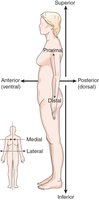
Directional terms describe the locations of structures relative to each other. The anatomic position is the standard reference: body upright, facing forward, arms at sides, palms forward, feet parallel.
Anterior (ventral): Front of the body
Posterior (dorsal): Back of the body
Superior: Toward the head
Inferior: Toward the feet
Medial: Toward the midline
Lateral: Away from the midline
Proximal: Closer to the point of attachment
Distal: Farther from the point of attachment
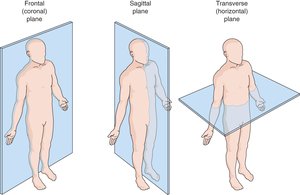
Planes of Section
The body can be divided along three main planes for anatomical study:
Frontal (coronal) plane: Divides the body into anterior and posterior parts.
Sagittal plane: Divides the body into right and left portions. If at the midline, it is called the midsagittal or medial plane.
Transverse (horizontal) plane: Divides the body into superior and inferior parts.
Body Cavities
The body contains two major cavities, each with subdivisions that house vital organs:
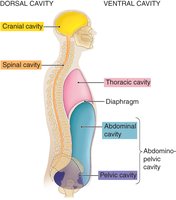
Dorsal Cavity: Contains the cranial cavity (brain) and spinal cavity (spinal cord).
Ventral Cavity: Contains the thoracic cavity (lungs, heart), separated by the diaphragm from the abdominopelvic cavity (abdominal and pelvic organs).
Abdominal Regions and Quadrants
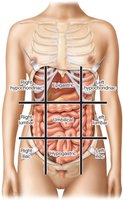
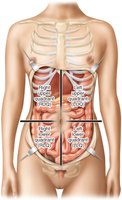
The abdomen is divided for descriptive and diagnostic purposes:
Nine Regions: Epigastric, umbilical, hypogastric (midline); right/left hypochondriac, lumbar, iliac (lateral).
Four Quadrants: Right upper, left upper, right lower, left lower.
Medical Terminology: Roots, Prefixes, and Suffixes
Understanding word parts is essential for analyzing medical terms:
Roots: Main part of the word, e.g., cyt (cell), my/o (muscle), neur/o (nerve).
Prefixes: Added to the beginning, e.g., supra- (above).
Suffixes: Added to the end, often indicating a procedure, condition, or disease.
Example: In "glucose," the root gluc means "sugar." Histology is the study of tissues; cytology is the study of cells.
Application: Health Professions
Radiologic technologists use imaging techniques to help diagnose medical disorders. Specializations include:
Bone densitometry
Cardiovascular interventional radiography
Computed tomography (CT)
Mammography
Magnetic resonance imaging (MRI)
Nuclear medicine
Quality management
Review Questions and Key Facts
The main categories of organic compounds in cells are proteins, carbohydrates, and lipids.
The process of cell division is called mitosis.
The study of cells is cytology.
The lungs and heart are located in the thoracic cavity.
The umbilical region is inferior to the hypogastric region (True/False: True).
The transverse plane divides the body into left and right halves (True/False: False; it divides into superior and inferior parts).
