 Back
BackHTEC 1050: Introduction to Medical Terminology – Midterm Study Guide
Study Guide - Smart Notes
 Tailored notes based on your materials, expanded with key definitions, examples, and context.
Cardiovascular System
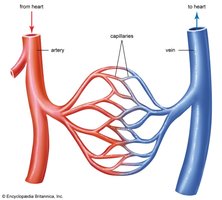
Blood Vessels: Artery, Vein, and Capillary
The cardiovascular system is responsible for transporting blood throughout the body. Understanding the differences between arteries, veins, and capillaries is essential for medical terminology.
Artery: Carries blood away from the heart, usually oxygen-rich except in the pulmonary artery.
Vein: Carries blood toward the heart, usually oxygen-poor except in the pulmonary vein.
Capillary: Tiny vessels where gas, nutrient, and waste exchange occurs between blood and tissues.
Pulmonary vs. Systemic Circulation
The heart pumps blood through two main circuits:
Pulmonary Circulation: Moves blood between the heart and lungs for gas exchange.
Systemic (Circulatory) Circulation: Moves blood between the heart and the rest of the body to deliver oxygen and nutrients.
Layers of the Heart
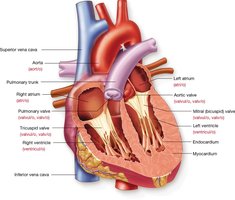
The heart wall consists of three main layers, each with a specific function:
Myocardium: The muscular layer responsible for pumping blood.
Endocardium: The smooth inner lining that reduces friction as blood flows through the heart.
Integumentary System
Skin Layers
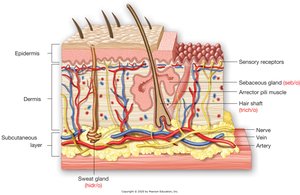
The integumentary system protects the body and regulates temperature. The skin is composed of three main layers:
Epidermis: The outermost, protective layer.
Dermis: Contains blood vessels, nerves, and hair follicles.
Hypodermis (Subcutaneous Layer): Composed of fat, provides insulation and cushioning.
Glands of the Skin
Sebaceous (Oil) Glands: Lubricate and waterproof the skin.
Sweat Glands: Help regulate body temperature through perspiration.
Key Terms
Hyperhidrosis: Excessive sweating.
Alopecia: Baldness or hair loss.
Dermatitis: Inflammation of the skin.
Melanoma: Cancer of pigment-producing cells (melanocytes).
Orthopedics
Functions of Bone
Bones serve several vital functions in the body:
Provide structural support.
Protect vital organs (e.g., skull protects the brain, ribs protect the heart and lungs).
Produce blood cells (hematopoiesis in bone marrow).
Store and regulate minerals such as calcium and phosphorus.
Joints & Movement
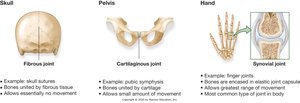
Joints connect bones and allow for movement. There are three main types:
Fibrous Joints: Immovable (e.g., skull sutures).
Cartilaginous Joints: Slightly movable (e.g., intervertebral discs, pubic symphysis).
Synovial Joints: Freely movable (e.g., knee, shoulder, hip, finger joints).
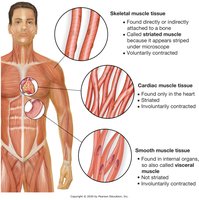
Muscles & Tendons
Muscle Types:
Skeletal: Voluntary, striated, attached to bones.
Cardiac: Involuntary, striated, found only in the heart.
Smooth: Involuntary, non-striated, found in internal organs.
Tendons: Connect muscle to bone.
Ligaments: Connect bone to bone, providing joint stability.
Body Cavities & Planes
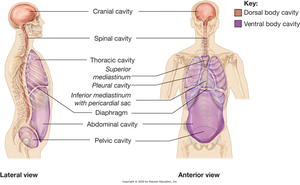
Body Cavities
The body contains several major cavities that house and protect organs:
Dorsal Cavity: Contains the cranial cavity (brain) and spinal cavity (spinal cord).
Ventral Cavities:
Thoracic: Heart, lungs, trachea, esophagus.
Abdominal: Stomach, liver, intestines, kidneys.
Pelvic: Bladder, reproductive organs, rectum.
Body Planes
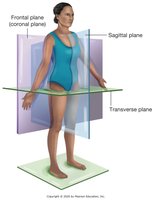
Body planes are imaginary lines used to divide the body for anatomical study:
Sagittal Plane: Divides the body into left and right portions.
Frontal (Coronal) Plane: Divides the body into anterior (front) and posterior (back) portions.
Transverse Plane: Divides the body into superior (upper) and inferior (lower) portions.
Abdominal Regions
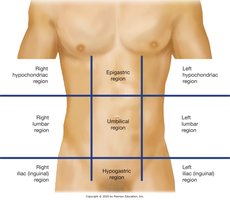
9-Region Grid
The abdomen is divided into nine regions for anatomical reference:
Top row: Right Hypochondriac, Epigastric, Left Hypochondriac
Middle row: Right Lumbar, Umbilical, Left Lumbar
Bottom row: Right Iliac (Inguinal), Hypogastric, Left Iliac (Inguinal)
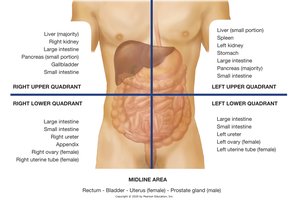
4-Quadrant System
The abdomen can also be divided into four quadrants, each containing specific organs:
Right Upper Quadrant (RUQ): Liver, gallbladder, part of small intestine
Left Upper Quadrant (LUQ): Stomach, spleen, part of pancreas
Right Lower Quadrant (RLQ): Appendix, cecum, part of small intestine
Left Lower Quadrant (LLQ): Descending colon, part of small intestine
Word Parts
Components of Medical Terms
Medical terms are constructed from word parts that convey specific meanings:
Word Root: Core meaning of the term (e.g., hepat = liver).
Prefix: Modifies meaning (location, number, time, status; e.g., hyper- = excessive).
Suffix: Modifies meaning (procedure, condition, disease; e.g., -itis = inflammation).
Combining Vowel: Connects root + suffix or root + root; never used between a prefix and root.
Examples:
Hepat/o + -itis = hepatitis (liver inflammation)
Hyper- + glycemia = hyperglycemia (high blood sugar)
Important Terms
Be familiar with the following medical terms and their meanings:
Term meaning enlarged heart: Cardiomegaly
Term meaning inflammation of a gland: Adenitis
Term meaning red skin condition: Erythroderma
Term meaning fatty tumor: Lipoma
Term meaning ruptured muscle: Myorrhexis
Term meaning slow movement: Bradykinesia
Term meaning nail biting: Onychophagia
Term referring to sole of foot: Plantar
Term meaning pertaining to the femur: Femoral
Term meaning pertaining to the upper jaw: Maxillary
Plurals
Singular | Plural |
|---|---|
Vertebra | Vertebrae |
Thorax | Thoraces |
Phalanx | Phalanges |
Rib | Ribs |
Biopsy | Biopsies |
Ovum | Ova |
Apex | Apices |
Nucleus | Nuclei |
Muscle | Muscles |
Appendix | Appendices |
Abbreviations
Abbreviation | Meaning |
|---|---|
RUQ | Right Upper Quadrant |
SOB | Shortness of Breath |
EKG | Electrocardiogram |
HSV | Herpes Simplex Virus |
C&S | Culture and Sensitivity |
AE | Above Elbow |
Bx | Biopsy |
Subcut | Subcutaneous |
Ortho | Orthopedics |
BPM | Beats Per Minute |
Prefixes
Prefix | Meaning |
|---|---|
Pachy- | Thick |
Mono- | One, single |
Brady- | Slow |
A-, An-, De- | Without, absence of, removal |
Dys- | Painful, difficult, abnormal |
Trans- | Across, through |
Inter- | Between |
Primi- | First |
Tachy- | Fast |
Auto- | Self |
Combining Forms
Combining Form | Meaning |
|---|---|
ventr/o, anter/o | Front, belly side |
sphygm/o | Pulse |
electr/o | Electricity |
orth/o | Straight |
hidr/o | Sweat |
ankyl/o | Stiff, bent |
derm/o, dermat/o, cutane/o | Skin |
cardi/o, coron/o | Heart |
my/o, muscul/o | Muscle |
spondyl/o, vertebr/o | Vertebra, spine |
Suffixes
Suffix | Meaning |
|---|---|
-pathy | Disease |
-iatric | Pertaining to medical treatment |
-er | One who |
-gram | Record or picture |
-rrhexis | Rupture |
-malacia | Softening |
-algia / -dynia | Pain |
-manometer | Instrument to measure pressure |
-itis | Inflammation |
-iasis / -osis | Abnormal condition |
Spelling (Very Important!)
Be able to recognize and correctly spell commonly misspelled medical terms. Examples include:
Angioplasty (not Angiplasty)
Basal cell carcinoma (not Basil cell carcinoma)
Fibrillation (not Fribillation)
Wheal (not Wheel)
Metacarpals (not Metacarpes)
Sphygmomanometer (not Sphigmomanometer or Sphygmamoneter)
Bradycardia (not Bradicardia)
Tachycardia (not Tackhycardia)
Myocardium (not Myocadium)
Pericardium (not Pericadium)
Endocardium (not Endocadium)
Dermatitis (not Dermatitus)
Adenitis (not Adenitus)
Osteoporosis (not Osteoperosis)
Hypogastric (not Hypogastic)
Umbilical (not Umbillical)
Epidermis (not Epidermous)
Sebaceous (not Sebacious)
Hyperhidrosis (not Hyperhydrosis)
Alopecia (not Alopicia)
Cardiomegaly (not Cardiomegly)
Electrocardiogram (not Electrocardiagraph)
