 Back
BackIntroduction to Medical Terminology: Foundations and Applications
Study Guide - Smart Notes
 Tailored notes based on your materials, expanded with key definitions, examples, and context.
Introduction to Medical Terminology
Overview of Medical Terminology
Medical terminology is the specialized language used by healthcare professionals to describe the human body, its conditions, procedures, and treatments. Understanding the structure and rules of medical terms is essential for clear communication in clinical settings.
Word Building: Medical terms are constructed from word roots, prefixes, suffixes, and combining vowels.
Key Components: Word root (foundation), prefix (beginning), suffix (end), combining vowel (usually 'o', links parts).
Example: pericarditis = peri- (around) + cardi (heart) + -itis (inflammation) → inflammation around the heart.
Word Roots
The word root provides the general meaning of a medical term, often indicating a body part or system, or sometimes an action.
Examples: cardi (heart), cis (to cut), oste (bone), arthr (joint).
Multiple Roots: Terms may combine more than one root, e.g., osteoarthritis (bone + joint + inflammation).
Combining Vowel/Form
Combining vowels (usually 'o') are used to link word roots to suffixes or other roots, making terms easier to pronounce.
Rule: Use a combining vowel if the suffix begins with a consonant; omit if the suffix begins with a vowel.
Example: arthroscope (needs combining vowel), arthritis (no combining vowel).
Between Roots: Combining vowels are typically kept between two roots, e.g., gastroenteritis.
Common Combining Forms
Combining forms are word roots with their combining vowels, used to build medical terms.
Examples: bi/o (life), carcin/o (cancer), cardi/o (heart), dermat/o (skin), hemat/o (blood), pulmon/o (lung).
Application: biology (study of life), carcinoma (cancerous tumor), dermatology (study of skin).
Prefixes
Prefixes are added to the beginning of terms to modify their meaning, often indicating location, number, or time.
Examples: a- (without), anti- (against), auto- (self), brady- (slow), hyper- (excessive), hypo- (below).
Number Prefixes: bi- (two), mono- (one), multi- (many), quadri- (four), tri- (three).
Example: bilateral (two sides), monoplegia (paralysis of one extremity).
Suffixes
Suffixes are attached to the end of terms to indicate conditions, diseases, or procedures. Every medical term must have a suffix.
Examples: -itis (inflammation), -algia (pain), -megaly (enlarged), -logy (study of), -cyte (cell).
Example: carditis (inflammation of the heart), erythrocyte (red cell).
Rule: If the suffix begins with a vowel, drop the combining vowel (e.g., mastitis not mastoitis).
Word Building and Interpretation
Medical terms are built by combining word elements. Understanding each part allows for interpretation of unfamiliar terms.
Strategy: Divide the term, define each part, and combine meanings.
Example: gastr/o/enter/o/logy = stomach, small intestine, study of.
Tip: Reading from the suffix back to the prefix and root can clarify meaning.
Pronunciation and Spelling
Correct pronunciation and spelling are crucial in medical terminology to avoid errors in patient care and documentation.
Pronunciation: May vary by region; always clarify if uncertain.
Spelling: Only one correct spelling; check medical dictionary if unsure.
Example: ileum (small intestine) vs. ilium (hipbone).
Singular and Plural Endings
Many medical terms follow Greek and Latin rules for forming plurals, which may differ from standard English.
Examples: vertebra → vertebrae, appendix → appendices, nucleus → nuclei.
Tip: Always check the correct plural form for medical terms.
Abbreviations
Abbreviations are used for efficiency but must be standardized to avoid confusion and errors.
Tip: Use only approved abbreviations; spell out terms if there is any risk of misunderstanding.
Application: Each body system chapter includes common abbreviations; a full list is provided in the appendix.
Body Organization and Medical Care
The Medical Record
The medical record is a comprehensive, legal document detailing a patient's hospital stay, treatments, and outcomes. It is essential for continuity of care and legal protection.
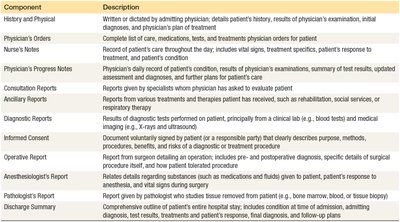
Components: Includes history, physician's orders, nurse's notes, progress notes, consultation reports, diagnostic reports, informed consent, operative reports, and more.
Electronic Medical Record (EMR): Digital storage and sharing of patient data improves efficiency and reduces errors.
Patient Identification: Every page must have reliable patient identifiers (name, date of birth, record number).
Component | Description |
|---|---|
History and Physical | Details patient's history, examination, initial diagnosis, and plan of treatment. |
Physician's Orders | List of care, medications, tests, and treatments ordered for patient. |
Nurse's Notes | Records of patient care, vital signs, treatments, and patient condition. |
Physician's Progress Notes | Updates on patient condition, results of exams, test results, and future plans. |
Consultation Reports | Reports from specialists who evaluate the patient. |
Ancillary Reports | Reports from therapies and services (rehab, social services, respiratory therapy). |
Diagnostic Reports | Results of diagnostic tests (lab, imaging). |
Informed Consent | Document verifying patient consent for procedures. |
Operative Report | Details of surgical procedures. |
Anesthesiologist's Report | Details of anesthesia and patient response. |
Psychologist's Report | Details of psychological assessment and treatment. |
Discharge Summary | Summary of hospital stay, diagnosis, treatment, and follow-up plans. |
Healthcare Settings
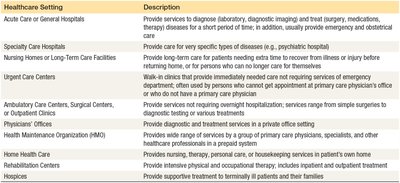
Medical terminology is used across a variety of healthcare settings, each with specific roles in patient care.
Acute Care Hospitals: Diagnose and treat diseases for short periods; provide emergency and surgical care.
Specialty Care Hospitals: Focus on specific diseases (e.g., psychiatric hospitals).
Nursing Homes/Long-Term Care: Provide long-term care for chronic illness or recovery.
Urgent Care Centers: Immediate care for non-emergency conditions.
Ambulatory/Surgical Centers: Outpatient services for minor procedures.
Physicians' Offices: Private practice diagnosis and treatment.
Health Maintenance Organizations (HMOs): Coordinated care by a group of providers.
Home Health Care: Medical and personal care in the patient's home.
Rehabilitation Centers: Physical and occupational therapy.
Hospices: Supportive care for terminally ill patients and families.
Healthcare Setting | Description |
|---|---|
Acute Care or General Hospitals | Diagnose, treat, and provide emergency care for short-term illnesses. |
Specialty Care Hospitals | Care for specific diseases (e.g., psychiatric). |
Nursing Homes/Long-Term Care | Long-term care for chronic illness or recovery. |
Urgent Care Centers | Immediate care for non-emergency conditions. |
Ambulatory Care Centers | Outpatient services for minor procedures. |
Physicians' Offices | Private practice diagnosis and treatment. |
Health Maintenance Organization (HMO) | Coordinated care by a group of providers. |
Home Health Care | Medical and personal care in the patient's home. |
Rehabilitation Centers | Physical and occupational therapy. |
Hospices | Supportive care for terminally ill patients and families. |
Confidentiality in Medical Care
Confidentiality is a fundamental principle in healthcare, ensuring that patient information is protected and only shared with proper authorization.
Legal and Moral Responsibility: Patient records are privileged and must be kept confidential.
HIPAA: The Health Insurance Portability and Accountability Act of 1996 sets federal standards for patient privacy, access, and control over health information.
Authorization: Only share information with proper patient consent and as authorized.
