 Back
BackMedical Terminology Concepts, Suffixes, and Prefixes Study Guide
Study Guide - Smart Notes
 Tailored notes based on your materials, expanded with key definitions, examples, and context.
Q1. Medical terminology is based mainly on Greek and Latin words. (True/False)
Background
Topic: Origins of Medical Terminology
This question tests your understanding of the historical roots of medical language, which is essential for recognizing and interpreting medical terms.
Key Terms:
Greek and Latin: The two primary languages from which most medical terms are derived.
Medical terminology: Specialized language used in healthcare.
Step-by-Step Guidance
Consider the origin of common medical terms (e.g., "cardiology," "nephrology," "arthritis").
Think about the language roots—are they Greek, Latin, or another language?
Recall that many anatomical and disease names are derived from these languages.
Try solving on your own before revealing the answer!
Final Answer: True
Most medical terminology is indeed based on Greek and Latin, which helps standardize communication in healthcare.
Q2. A suffix establishes a medical word’s basic meaning. (True/False)
Background
Topic: Structure of Medical Terms
This question tests your knowledge of how medical words are constructed and the role of suffixes.
Key Terms:
Suffix: A word part added to the end of a root to modify its meaning.
Root: The fundamental unit of a medical word, which provides the basic meaning.
Step-by-Step Guidance
Identify the root in a medical term (e.g., "cardi" in "cardiology").
Determine what the suffix adds to the word (e.g., "-ology" means "study of").
Ask yourself: Does the suffix provide the basic meaning, or does it modify the root?
Try solving on your own before revealing the answer!
Final Answer: False
The root establishes the basic meaning; the suffix modifies or adds to it.
Q3. The root cardi means “heart.” (True/False)
Background
Topic: Roots in Medical Terminology
This question tests your ability to recognize common roots and their meanings.
Key Terms:
Root: The main part of a word that provides its core meaning.
Cardi: A root commonly used in medical terms related to the heart.
Step-by-Step Guidance
Recall medical terms that use "cardi" (e.g., "cardiology," "cardiac").
Think about what these terms refer to in the body.
Check if "cardi" is associated with the heart or another organ.
Try solving on your own before revealing the answer!
Final Answer: True
"Cardi" is the root for "heart" in medical terminology.
Q4. Neur/o is an example of a compound word. (True/False)
Background
Topic: Word Parts in Medical Terminology
This question tests your understanding of what constitutes a compound word versus a combining form.
Key Terms:
Neur/o: A combining form meaning "nerve."
Compound word: A word formed from two or more roots.
Combining form: A root with a vowel added to aid pronunciation.
Step-by-Step Guidance
Identify if "neur/o" is made from two roots or a root plus a vowel.
Recall the definition of a compound word in medical terminology.
Compare "neur/o" to examples like "cardiovascular" (a compound word).
Try solving on your own before revealing the answer!
Final Answer: False
"Neur/o" is a combining form, not a compound word.
Q5. USA is an acronym. (True/False)
Background
Topic: Acronyms in Medical Terminology
This question tests your understanding of what an acronym is and how it is formed.
Key Terms:
Acronym: A word formed from the initial letters of a phrase.
USA: United States of America.
Step-by-Step Guidance
Recall the definition of an acronym.
Determine if "USA" fits this definition.
Think about other examples of acronyms (e.g., "MRI," "FDA").
Try solving on your own before revealing the answer!
Final Answer: True
"USA" is an acronym formed from the first letters of "United States of America."
Q6. The word cerebrospinal is a compound word. (True/False)
Background
Topic: Compound Words in Medical Terminology
This question tests your ability to identify compound words, which are formed from two or more roots.
Key Terms:
Compound word: A word formed from two or more roots.
Cerebrospinal: Formed from "cerebr/o" (brain) and "spin/al" (spine).
Step-by-Step Guidance
Break down "cerebrospinal" into its components.
Identify the roots: "cerebr/o" and "spin/al."
Determine if both are roots, making it a compound word.
Try solving on your own before revealing the answer!
Final Answer: True
"Cerebrospinal" is a compound word formed from two roots.
Q7. In the word pharyngitis, the suffix is -itis. (True/False)
Background
Topic: Suffixes in Medical Terminology
This question tests your ability to identify suffixes and their meanings in medical terms.
Key Terms:
Suffix: A word part added to the end of a root to modify its meaning.
-itis: A suffix meaning "inflammation."
Pharyngitis: Inflammation of the pharynx.
Step-by-Step Guidance
Identify the root in "pharyngitis" ("pharyng").
Look at the ending "-itis" and recall its meaning.
Determine if "-itis" is the suffix in this word.
Try solving on your own before revealing the answer!
Final Answer: True
"-itis" is the suffix in "pharyngitis," meaning inflammation.
Q8. Medical terminology varies greatly throughout the world. (True/False)
Background
Topic: Standardization of Medical Terminology
This question tests your understanding of the consistency and standardization of medical language globally.
Key Terms:
Medical terminology: The standardized language used in healthcare.
Standardization: The process of making something consistent across different regions.
Step-by-Step Guidance
Consider why medical terminology is standardized (e.g., for clear communication).
Think about whether terms like "cardiology" or "nephrology" change across countries.
Recall the importance of consistency in medical language.
Try solving on your own before revealing the answer!
Final Answer: False
Medical terminology is largely standardized worldwide to ensure clear communication.
Q9. The adjective for coccyx is coccyical. (True/False)
Background
Topic: Adjectives in Medical Terminology
This question tests your ability to form adjectives from anatomical terms.
Key Terms:
Coccyx: The tailbone.
Adjective form: The word used to describe something related to the coccyx.
Step-by-Step Guidance
Recall the correct adjective form for "coccyx."
Compare "coccyical" to "coccygeal."
Check if "coccyical" is used in medical terminology.
Try solving on your own before revealing the answer!
Final Answer: False
The correct adjective is "coccygeal," not "coccyical."
Q10. A suffix is a word ending that modifies a root. (True/False)
Background
Topic: Suffixes in Medical Terminology
This question tests your understanding of the function of suffixes in medical words.
Key Terms:
Suffix: A word part added to the end of a root to modify its meaning.
Root: The main part of a word.
Step-by-Step Guidance
Recall the definition of a suffix.
Think about examples like "-itis" in "pharyngitis."
Determine if the suffix changes the meaning of the root.
Try solving on your own before revealing the answer!
Final Answer: True
A suffix modifies the meaning of the root to which it is attached.
Q11. The suffix -ous means “pertaining to.” (True/False)
Background
Topic: Suffixes in Medical Terminology
This question tests your knowledge of common suffixes and their meanings.
Key Terms:
-ous: A suffix meaning "pertaining to" or "like."
Step-by-Step Guidance
Recall words ending in "-ous" (e.g., "nervous," "venous").
Think about what these words describe.
Determine if "-ous" means "pertaining to."
Try solving on your own before revealing the answer!
Final Answer: True
The suffix "-ous" means "pertaining to" or "like."
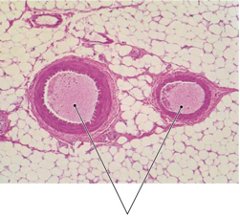
Q12. Look and Label: artery, lumen, vein
Background
Topic: Anatomy of Blood Vessels
This question tests your ability to identify anatomical structures in histological images, specifically blood vessels and their components.
Key Terms:
Artery: A blood vessel that carries blood away from the heart.
Vein: A blood vessel that carries blood toward the heart.
Lumen: The central cavity of a blood vessel through which blood flows.
Step-by-Step Guidance
Examine the histological image for circular structures—these are likely cross-sections of blood vessels.
Identify the thicker-walled vessel (usually the artery) and the thinner-walled vessel (usually the vein).
Locate the lumen, which is the open space in the center of each vessel.
Try solving on your own before revealing the answer!
Final Answer:
The thicker-walled structure is the artery, the thinner-walled structure is the vein, and the central cavity in each is the lumen.
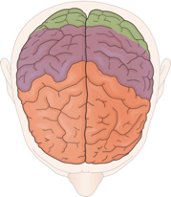
Q13. Look and Label: brain hemispheres and lobes
Background
Topic: Anatomy of the Brain
This question tests your ability to identify the different lobes and hemispheres of the brain.
Key Terms:
Hemisphere: One half of the brain (left or right).
Lobe: A region of the brain (frontal, parietal, temporal, occipital).
Step-by-Step Guidance
Examine the diagram for color-coded regions representing different lobes.
Identify the left and right hemispheres.
Label the lobes based on their position (frontal, parietal, temporal, occipital).
Try solving on your own before revealing the answer!
Final Answer:
The brain is divided into left and right hemispheres, each containing frontal, parietal, temporal, and occipital lobes.
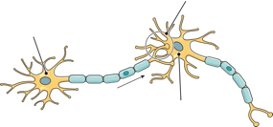
Q14. Look and Label: synapse, presynaptic cell, postsynaptic cell
Background
Topic: Neuroanatomy
This question tests your ability to identify the components of a synapse and the cells involved in neural communication.
Key Terms:
Synapse: The junction between two neurons where communication occurs.
Presynaptic cell: The neuron sending the signal.
Postsynaptic cell: The neuron receiving the signal.
Step-by-Step Guidance
Examine the diagram for two neurons connected by a gap (the synapse).
Identify the neuron that releases neurotransmitters (presynaptic cell).
Identify the neuron that receives the signal (postsynaptic cell).
Try solving on your own before revealing the answer!
Final Answer:
The presynaptic cell releases neurotransmitters across the synapse to the postsynaptic cell.
