 Back
BackMuscles and Joints: Structure, Function, and Pathology
Study Guide - Smart Notes
 Tailored notes based on your materials, expanded with key definitions, examples, and context.
Muscles and Joints
Muscles Overview
Muscles are essential for movement, posture, and heat production in the human body. There are over 600 muscles, each contributing to voluntary and involuntary actions necessary for life.
Support and Posture: Muscles maintain body posture through continuous, low-level contraction.
Heat Production: Skeletal muscle contraction generates significant body heat.
Types of Muscles
Muscle tissue is classified into three main types, each with distinct structure and function:
Skeletal Muscle: Attaches to bones, is voluntary, striated, and under conscious control. Many skeletal muscles work in pairs to produce movement.
Smooth Muscle: Also called visceral muscle, found in walls of hollow organs and tubes. It is involuntary, non-striated, and controlled by hormones and the autonomic nervous system.
Cardiac Muscle: Specialized, striated muscle forming the heart wall. It is involuntary and regulated by the autonomic nervous system.
Example: The biceps brachii (skeletal muscle) flexes the forearm, while the heart (cardiac muscle) contracts rhythmically without conscious thought.
Attachment of Muscles
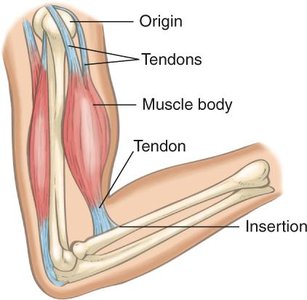
Muscles attach to bones and other structures via specialized connective tissues, enabling movement and force transmission.
Tendon: Connects muscle to bone.
Fascia: Sheets of fibrous connective tissue surrounding muscle fibers.
Point of Origin: Attachment to the less movable part of the skeleton.
Point of Insertion: Attachment to the more movable part of the skeleton.
Muscles of the Head and Neck
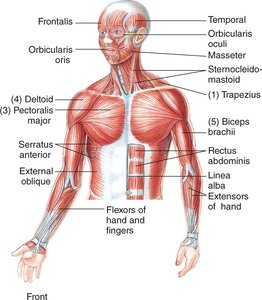
Several muscles in the head and neck facilitate facial expression, chewing, and head movement.
Buccinator: Located in the cheek; assists in whistling and smiling.
Temporal: Above the ear; aids in chewing.
Masseter: At the jaw angle; raises the mandible to close the jaw.
Sternocleidomastoid: Extends from the sternum to the mastoid process; bends and rotates the neck.
Muscles of the Upper Extremities
These muscles control movements of the shoulder, arm, and hand.
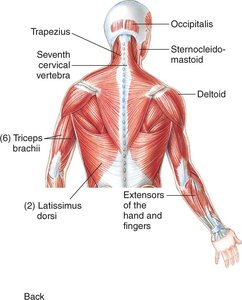
Trapezius: Triangular muscle across the back of the shoulder and neck; assists in shoulder elevation.
Latissimus dorsi: Large muscle of the lower back; enables arm movement such as swimming.
Pectoralis major: Fan-shaped chest muscle; allows arm adduction.
Deltoid: Covers the shoulder; allows arm abduction and is a common site for intramuscular injections.
Biceps brachii: Flexes the lower arm; originates from the scapula and inserts on the radius.
Triceps brachii: Extends the elbow; originates from the scapula and humerus, inserts on the ulna.
Muscles of the Lower Extremities
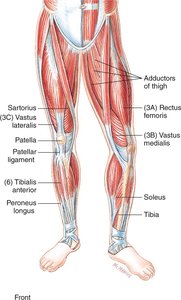
These muscles are responsible for movement and support of the hip, thigh, leg, and foot.
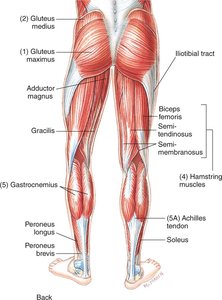
Gluteus maximus: Main buttock muscle; extends the thigh.
Gluteus medius: Above gluteus maximus; site for IM injections.
Quadriceps femoris: Four-muscle group on the anterior thigh; extends the leg.
Hamstring muscles: Three-muscle group on the posterior thigh; flexes the leg and extends the thigh.
Gastrocnemius: Calf muscle; plantar flexes the foot via the Achilles tendon.
Tibialis anterior: Front of the leg; dorsiflexes and inverts the foot.
Pathological Conditions: Muscles
Muscle diseases can affect movement, strength, and overall function.
Muscular Dystrophy: Genetic disorders causing progressive muscle weakness and degeneration without nerve involvement.
Polymyositis: Chronic disease with muscle weakness and atrophy, primarily affecting skeletal muscles.
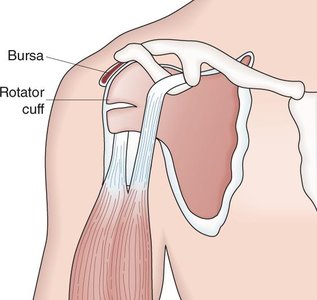
Rotator Cuff Tear: Tear in the shoulder muscles forming the rotator cuff, impairing arm movement and stability.
Diagnostic Techniques, Treatments, and Procedures: Muscles
Electromyography (EMG): Measures muscle contraction strength in response to electrical stimulation.
Muscle Biopsy: Removal and microscopic examination of muscle tissue to diagnose disease.
Joints Overview
Joints, or articulations, are points where two bones meet, allowing for varying degrees of movement.
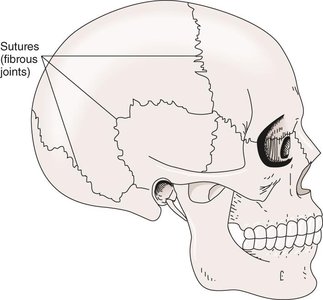
Suture: Immovable joint, such as those between skull bones, binding bones together.
Classification of Joints (Structural)
Fibrous Joints: Bones fit closely and are held by fibrous tissue; immovable (e.g., skull sutures).
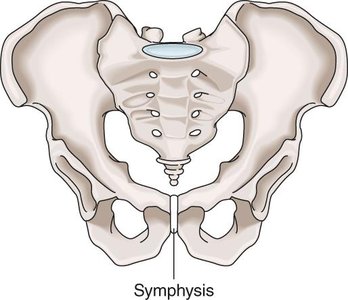
Cartilaginous Joints: Bones connected by cartilage; limited movement (e.g., pubic symphysis).
Synovial Joints: Bones separated by a joint cavity lined with synovial membrane, allowing free movement. Ligaments stabilize the joint.
Classification of Joints (Functional)
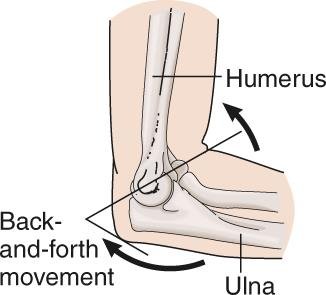
Hinge Joints: Permit back-and-forth motion (e.g., elbow).
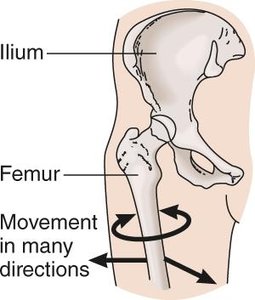
Ball-and-Socket Joints: Allow movement in multiple directions (e.g., shoulder, hip).
Movements of Joints
Joints enable a variety of movements essential for daily activities:
Flexion: Bending that decreases the angle between bones.
Extension: Straightening that increases the angle between bones.
Abduction: Movement away from the body's midline.
Adduction: Movement toward the body's midline.
Supination: Turning the palm up or forward.
Pronation: Turning the palm down or backward.
Dorsiflexion: Bending the foot upward at the ankle.
Plantar Flexion: Pointing the foot downward.
Rotation: Turning a bone on its axis.
Circumduction: Moving an extremity in a circular motion (possible in ball-and-socket joints).
Pathological Conditions: Joints
Adhesive Capsulitis (Frozen Shoulder): Stiffness, pain, and limited movement of the shoulder, often idiopathic or post-trauma.
Arthritis: Inflammation of joints, with several subtypes:
Ankylosing Spondylitis: Arthritis affecting the vertebral column, causing spinal deformities.
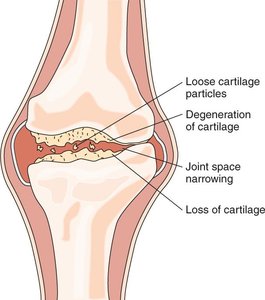
Osteoarthritis: Degenerative joint disease due to wear and tear, especially in weight-bearing joints.
Rheumatoid Arthritis: Chronic, systemic inflammatory disease affecting multiple joints, mainly small peripheral joints.
Gout: Acute arthritis from improper uric acid metabolism, often affecting the great toe.
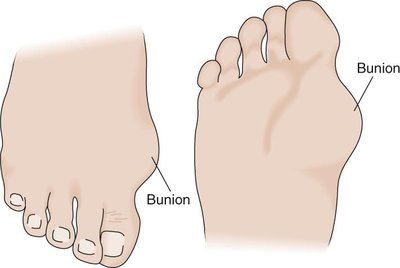
Bunion (Hallux Valgus): Enlargement of the joint at the base of the great toe.
Dislocation: Displacement of a bone from its joint, causing loss of function.
Ganglion: Cystic tumor on a tendon, often on the wrist.
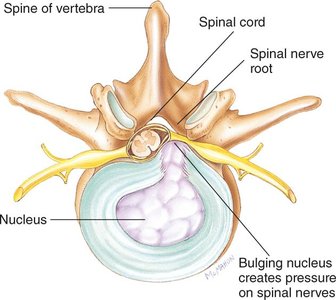
Herniated Disk: Rupture of the vertebral disk's central portion, causing nerve compression.
Sprain: Ligament injury from wrenching or twisting a joint.
Systemic Lupus Erythematosus: Chronic inflammatory disease affecting multiple organs, with a characteristic facial rash.
Diagnostic Techniques, Treatments, and Procedures: Joints
Arthrocentesis: Needle puncture of a joint to withdraw fluid for analysis.
Arthrography: X-ray imaging of a joint after injection of a contrast medium.
Arthroplasty: Surgical repair or replacement of a joint.
Arthroscopy: Endoscopic visualization of the interior of a joint.
Erythrocyte Sedimentation Rate (ESR): Blood test measuring inflammation by the rate at which red blood cells settle in a test tube.
Rheumatoid Factor: Blood test for antibodies associated with connective tissue diseases like rheumatoid arthritis.
