 Back
BackStudy Guide: Musculoskeletal System (Medical Terminology)
Study Guide - Smart Notes
 Tailored notes based on your materials, expanded with key definitions, examples, and context.
Musculoskeletal System
Overview
The musculoskeletal system is essential for movement, support, and protection of internal organs. It consists of bones, joints, muscles, and connective tissues. This chapter covers terminology, anatomy, physiology, and clinical aspects relevant to medical terminology students.
Skeletal System
Chiropractic and Podiatric Medicine
Chiropractic Medicine: Focuses on health problems related to the muscular, nervous, and skeletal systems. Treatments include adjustments, manipulation, massage, exercise, and nutrition. Doctor of Chiropractic (DC) does not prescribe medications.
Podiatric Medicine: Provides medical and surgical care for feet, ankles, and lower legs. Doctor of Podiatric Medicine (DPM) diagnoses, treats, sets fractures, prescribes medications, and performs surgery.
Key Terminology: Combining Forms, Suffixes, and Prefixes
Combining Forms: Used to build medical terms (e.g., oste/o = bone, arthr/o = joint, chondr/o = cartilage).
Suffixes: Indicate procedures, conditions, or diseases (e.g., -algia = pain, -itis = inflammation, -porosis = porous).
Prefixes: Modify meaning (e.g., a- = without, bi- = two, inter- = between).
Anatomy and Physiology of the Skeletal System
Each bone has its own blood supply, nerves, and lymphatic vessels.
Bone Marrow: Site of blood cell production.
Bones: Connect and form the framework of the body.
Joints: Where two bones meet, held together by ligaments.
Ligaments: Strong bands of connective tissue.
Bone Structure and Types
Ossification: Process of bone formation.
Cartilage: Flexible connective tissue found in joints, nose, ear, etc.
Osteoblasts: Immature bone cells; Osteocytes: Mature bone cells; Osteoclasts: Cells that break down bone.
Remodeling: Replacement of old bone with new bone (complete turnover every ten years).
Bone Categories:
Long Bones: Longer than wide (e.g., femur, humerus).
Short Bones: Cube-shaped (e.g., carpals, tarsals).
Flat Bones: Plate-shaped (e.g., ribs).
Irregular Bones: Irregular shape (e.g., vertebrae).
Bone Anatomy:
Diaphysis: Shaft of a long bone.
Epiphysis: Ends of a long bone.
Articular Cartilage: Covers bone ends, prevents friction.
Periosteum: Membrane covering bones.
Cortical/Compact Bone: Dense, hard exterior.
Cancellous/Spongy Bone: Found inside bones.
Red Bone Marrow: Manufactures blood cells.
Medullary Cavity: Contains yellow bone marrow (fat cells).
Bone Projections and Depressions
Projections: Head, neck, condyle, epicondyle, trochanter, tubercle, tuberosity (for muscle/tendon attachment).
Depressions: Sinus (cavity), foramen (opening), fossa (shallow depression), fissure (slit).
Skeleton Divisions
Axial Skeleton: Head, spine, chest, trunk; protects brain, heart, lungs.
Appendicular Skeleton: Upper and lower extremities, shoulder, pelvis.
Cranial and Facial Bones
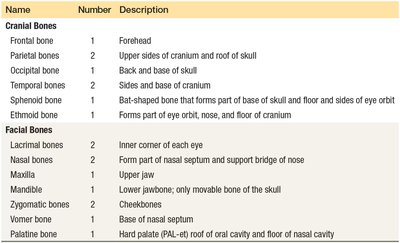
The skull consists of cranial and facial bones that protect the brain and sensory organs.
Name | Number | Description |
|---|---|---|
Cranial Bones | ||
Frontal bone | 1 | Forehead |
Parietal bones | 2 | Upper sides of cranium and roof of skull |
Occipital bone | 1 | Back and base of skull |
Temporal bones | 2 | Sides and base of cranium |
Sphenoid bone | 1 | Batt-shaped bone that forms part of base of skull and floor and sides of eye orbit |
Ethmoid bone | 1 | Forms part of eye orbit, nose, and floor of cranium |
Facial Bones | ||
Lacrimal bones | 2 | Inner corner of each eye |
Nasal bones | 2 | Form part of nasal septum and support bridge of nose |
Maxilla | 2 | Upper jaw |
Mandible | 1 | Lower jawbone; only movable bone of the skull |
Zygomatic bones | 2 | Cheekbones |
Vomer bone | 1 | Base of nasal septum |
Palatine bone | 1 | Hard palate (roof of oral cavity and floor of nasal cavity) |
Hyoid Bone
U-shaped bone suspended in the neck between the mandible and larynx.
Attachment point for swallowing and speech muscles.
Only bone that does not articulate directly with another bone.
Trunk of Body
Vertebral Column: 26 vertebrae; protects spinal cord.
Sternum: Breastbone; anterior attachment for ribs.
Rib Cage: 12 pairs of ribs; protects chest cavity.
Vertebral Sections: Cervical (7), Thoracic (12), Lumbar (5), Sacrum (5 fused), Coccyx (3-5 fused).
Intervertebral Disk: Fibrous cartilage cushion between vertebrae.
Appendicular Skeleton
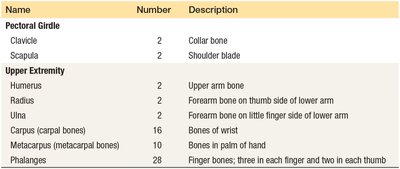
Pectoral Girdle: Clavicle (collar bone) and scapula (shoulder blade); attaches upper extremity to axial skeleton.
Upper Extremities: Arm bones (humerus, radius, ulna), wrist (carpus), hand (metacarpus), fingers (phalanges).
Pelvic Girdle: Ilium, ischium, pubis; attaches lower extremity to axial skeleton.
Lower Extremities: Leg bones (femur, patella, tibia, fibula), ankle (tarsus), foot (metatarsus), toes (phalanges).
Name | Number | Description |
|---|---|---|
Pectoral Girdle | ||
Clavicle | 2 | Collar bone |
Scapula | 2 | Shoulder blade |
Upper Extremity | ||
Humerus | 2 | Upper arm bone |
Radius | 2 | Forearm bone on thumb side of lower arm |
Ulna | 2 | Forearm bone on little finger side of lower arm |
Carpus (carpal bones) | 16 | Bones of wrist |
Metacarpus (metacarpal bones) | 10 | Bones in palm of hand |
Phalanges | 28 | Finger bones; three in each finger and two in each thumb |
Joints
Articulation: Where two bones meet.
Synovial Joints: Freely moving, lubricated by synovial fluid.
Cartilaginous Joints: Allow slight movement, held by cartilage.
Fibrous Joints: Almost no movement, joined by fibrous tissue.
Joint Capsule: Encloses synovial joints.
Synovial Membrane: Lines joint, secretes lubricating fluid.
Range of Motion (ROM): Maximum movement allowed at a joint.
Bursa: Saclike connective tissue structure in some joints (elbow, knee, shoulder).
Meniscus: Crescent-shaped cartilage pad in knee and jaw joints.
Muscular System
Key Terminology: Combining Forms, Suffixes, and Prefixes
Combining Forms: muscul/o, my/o, myos/o = muscle; ten/o, tend/o, tendin/o = tendon; kinesi/o = movement.
Suffixes: -algia = pain, -itis = inflammation, -plasty = surgical repair, -trophy = development.
Prefixes: a- = without, brady- = slow, hyper- = excessive, hypo- = insufficient.
Anatomy and Physiology of the Muscular System
Muscles are bundles, sheets, or rings of tissue that produce movement.
Muscle Fibers: Bundles of muscle cells that form muscle.
Types of Muscles
Skeletal Muscle: Voluntary, attached to bones by tendons; striated appearance.
Smooth Muscle: Involuntary, found in internal organs (visceral muscle).
Cardiac Muscle: Involuntary, found in the heart; responsible for pumping blood.
Skeletal Muscle Actions
Origin: Attachment to less movable bone.
Insertion: Attachment to more movable bone.
Action: Type of movement produced.
Antagonistic Pairs: Muscles arranged around a joint to produce opposite actions.
Muscle Actions and Terminology
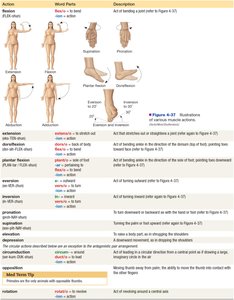
Action | Word Parts | Description |
|---|---|---|
Abduction | ab- = away from duct/o = to lead -ion = action | Act of leading a limb away from midline of the body |
Adduction | ad- = toward duct/o = to lead -ion = action | Act of leading a limb toward midline of the body |

Additional Muscle Actions
Action | Word Parts | Description |
|---|---|---|
Flexion | flex/o = to bend -ion = action | Act of bending a joint |
Extension | extens/o = to stretch out -ion = action | Act of straightening a joint |
Rotation | rot/o = to turn -ion = action | Act of moving around a central axis |
Supination | supin/o = to bend backward -ion = action | Turning palm or sole upward |
Pronation | pron/o = to bend forward -ion = action | Turning palm or sole downward |
Dorsiflexion | dorsi- = back flex/o = to bend -ion = action | Bending foot upward |
Plantar Flexion | plant/o = sole flex/o = to bend -ion = action | Bending foot downward |
Examples and Applications
Flexion: Bending the elbow or knee.
Extension: Straightening the arm or leg.
Abduction: Raising the arm sideways away from the body.
Adduction: Bringing the arm back toward the body.
Rotation: Turning the head side to side.
Supination/Pronation: Rotating the forearm to turn the palm up or down.
Additional info:
Muscle actions are essential for movement, posture, and joint stability.
Understanding terminology helps in clinical communication and documentation.
