Ch. 5 - Microbial Metabolism
Bauman - Microbiology with Diseases by Taxonomy 6th Edition
Bauman6th EditionMicrobiology with Diseases by TaxonomyISBN: 9780134832302Not the one you use?Change textbook
Chapter 5, Problem 13

Where specifically does the most significant production of ATP occur in prokaryotic and eukaryotic cells?

Verified step by step guidance
1
Understand that ATP production primarily occurs through cellular respiration, which involves glycolysis, the Krebs cycle, and the electron transport chain (ETC).
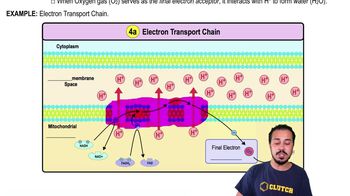
Identify that in eukaryotic cells, the most significant ATP production happens during oxidative phosphorylation, which takes place in the inner mitochondrial membrane where the electron transport chain is located.
Recognize that prokaryotic cells lack mitochondria, so their electron transport chain is located in the plasma membrane, where oxidative phosphorylation also occurs.
Note that in both cell types, the electron transport chain creates a proton gradient used by ATP synthase to generate ATP, making this step the major source of ATP.
Summarize that the key difference is the location: in eukaryotes, ATP is produced in the inner mitochondrial membrane, while in prokaryotes, it occurs at the plasma membrane.

Verified video answer for a similar problem:

This video solution was recommended by our tutors as helpful for the problem above.
Video duration:
4m
Was this helpful?

Key Concepts

Here are the essential concepts you must grasp in order to answer the question correctly.

ATP Production in Prokaryotic Cells

In prokaryotic cells, ATP is primarily produced in the plasma membrane through processes like oxidative phosphorylation and the electron transport chain, as they lack membrane-bound organelles such as mitochondria.
Recommended video:

ATP Production in Eukaryotic Cells

Eukaryotic cells generate most of their ATP in the mitochondria, specifically across the inner mitochondrial membrane, where the electron transport chain and chemiosmosis drive oxidative phosphorylation.
Recommended video:

Role of Electron Transport Chain in ATP Synthesis

The electron transport chain is a series of protein complexes that transfer electrons and pump protons to create a gradient, which powers ATP synthase to produce ATP, making it central to cellular energy production in both cell types.
Recommended video:
Guided course
07:41
Electron Transport Chain