Ch. 3 - Introduction to Prokaryotic Cells
Norman-McKay- Microbiology: Basic and Clinical Principles 2nd Edition
Norman-McKay2nd EditionMicrobiology: Basic and Clinical PrinciplesISBN: 9780137661619Not the one you use?Change textbook
Chapter 3, Problem 15

Prokaryotic flagella are made of a protein called _________________.

Verified step by step guidance
1
Understand that prokaryotic flagella are structures used for motility in bacteria.
Recall that flagella are composed of protein subunits that polymerize to form the filament.
Identify the specific protein that makes up the filament of prokaryotic flagella.
Recognize that this protein is called flagellin, which assembles into a helical filament.
Conclude that the answer to the question is the protein 'flagellin'.

Verified video answer for a similar problem:

This video solution was recommended by our tutors as helpful for the problem above.
Video duration:
1m
Was this helpful?

Key Concepts

Here are the essential concepts you must grasp in order to answer the question correctly.

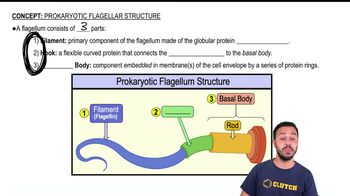
Prokaryotic Flagella Structure

Prokaryotic flagella are long, whip-like appendages that enable bacterial motility. They are composed of a filament, hook, and basal body, each playing a role in movement and attachment.
Recommended video:
Guided course
02:53
Prokaryotic Flagellar Structure

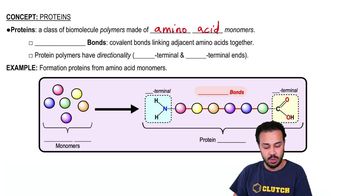
Flagellin Protein

Flagellin is the primary protein that makes up the filament of prokaryotic flagella. It polymerizes to form a helical structure, which rotates to propel the bacterium through its environment.
Recommended video:

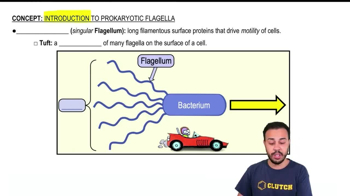
Function of Flagella in Prokaryotes

Flagella allow bacteria to move toward favorable conditions or away from harmful stimuli, a behavior known as chemotaxis. This motility is crucial for survival and colonization.
Recommended video:
Guided course
02:07
Introduction to Prokaryotic Flagella
Related Practice
Textbook Question

Which of the following characteristics regarding prokaryotic ribosomes supports the endosymbiotic theory?

a. Prokaryotic ribosomes are 80S just like eukaryotic ribosomes.

b. Prokaryotic ribosomes are 70S just like mitochondrial ribosomes.

c. Prokaryotic ribosomes make proteins in a similar manner to eukaryotic ribosomes.

d. Prokaryotic ribosomes have two subunits like eukaryotic ribosomes.

e. Prokaryotic ribosomes are intracellular structures like eukaryotic ribosomes.

1419
views
Textbook Question

Which of the following are true regarding osmosis? Select all that apply.

a. It is driven by differences in solute concentration.

b. It is the same as simple diffusion except it involves water.

c. It involves a selectively permeable membrane.

d. It requires energy to occur.

e. It requires specific channels.

f. Water moves from areas of high solute to areas of low solute.

g. Salt moves from high-water to low-water areas.

h. Water moves from areas of low solute to areas of high solute.

1600
views
Textbook Question

Describe what would occur if a cell with a damaged cell wall was placed in each of the following environments:

  • Isotonic environment
  • Hypertonic environment
  • Hypotonic environment
1213
views
Textbook Question

Certain bacteria can form endospores in order to __________________.

a. Reproduce

b. Survive harsh conditions

c. Cause recurrent infections

d. Adhere to host tissues

e. Avoid the immune system of a host

1520
views
Textbook Question

Which of the following are true regarding Mycoplasma bacteria? Select all that apply.

a. They have cholesterol in their plasma membranes.

b. They are among the largest bacteria characterized to date.

c. They are pleomorphic.

d. They are also called L-forms.

e. They were initially thought to be viruses.

f. Some can act as pathogens.

g. They are classified in domain Archaea.

h. They are prokaryotes.

i. They are sensitive to penicillin-based drugs.

1544
views