
Ch. 5 - Microbial Metabolism
Tortora - Microbiology: An Introduction 14th Edition
Tortora14th EditionMicrobiology: An IntroductionISBN: 9780138200398Not the one you use?Change textbook
Chapter 5, Problem 6

All of the energy-producing biochemical reactions that occur in cells, such as photophosphorylation and glycolysis, are ________ reactions.

Verified step by step guidance
1
Identify the type of reaction that involves the release of energy during biochemical processes such as photophosphorylation and glycolysis.
Recall that energy-producing reactions typically involve the breakdown of molecules and release energy, which are known as catabolic reactions.
Understand that catabolic reactions are characterized by the breakdown of complex molecules into simpler ones, releasing energy stored in chemical bonds.
Recognize that the opposite of catabolic reactions are anabolic reactions, which consume energy to build complex molecules.
Conclude that all energy-producing biochemical reactions like photophosphorylation and glycolysis are examples of catabolic reactions.

Verified video answer for a similar problem:

This video solution was recommended by our tutors as helpful for the problem above.
Video duration:
2m
Was this helpful?

Key Concepts

Here are the essential concepts you must grasp in order to answer the question correctly.

Metabolic Reactions

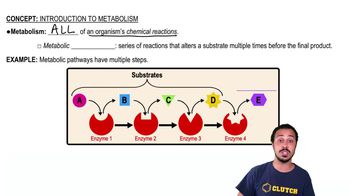
Metabolic reactions encompass all chemical processes that occur within a cell to maintain life, including energy production and synthesis of molecules. These reactions are broadly categorized into catabolic (breaking down molecules to release energy) and anabolic (building complex molecules using energy) pathways.
Recommended video:
Guided course
02:17
Introduction to Metabolism

Catabolic Reactions

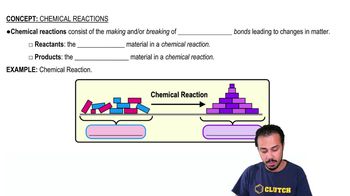
Catabolic reactions involve the breakdown of complex molecules into simpler ones, releasing energy stored in chemical bonds. Processes like glycolysis and photophosphorylation are catabolic because they generate ATP or other energy carriers by degrading substrates.
Recommended video:
Guided course
01:56
Chemical Reactions

Energy Coupling in Cells

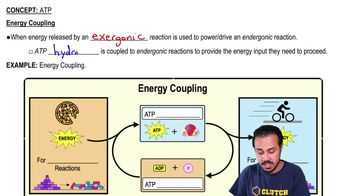
Energy coupling refers to the use of energy released from catabolic reactions to drive energy-requiring anabolic reactions. In cells, ATP produced during catabolism acts as an energy currency, linking energy-producing and energy-consuming processes to sustain cellular functions.
Recommended video:
Guided course
04:57
Energy Coupling
Related Practice
Textbook Question

Use the following choices to answer the question.

a. E. coli growing in glucose broth at 35℃ with O2 for 5 days

b. E. coli growing in glucose broth at 35℃ without O2 for 5 days

c. Both a and b

d. Neither a nor b


Which culture produces the most lactic acid?

1067
views
Textbook Question

Define oxidation-reduction, and differentiate the following terms:

a. Aerobic and anaerobic respiration

b. Respiration and fermentation

c. Cyclic and noncyclic photophosphorylation

1530
views
Textbook Question

Fill in the following table with the carbon source and energy source of each type of organism.

1486
views
Textbook Question

There are three mechanisms for the phosphorylation of ADP to produce ATP. Write the name of the mechanism that describes each of the reactions in the following table.

1617
views
Textbook Question

Which of the following is the best definition of cellular respiration?

a. A sequence of redox reactions with O2 as the final electron acceptor

b. A sequence of redox reactions with the final electron acceptor from the environment

c. A method of generating ATP

d. The complete oxidation of glucose to CO2 and H2O

e. A series of reactions in which pyruvic acid is oxidized to CO2 and H2O

1481
views
Textbook Question

Which of the following is the best definition of the Krebs cycle?

a. The oxidation of pyruvic acid

b. The way cells produce CO2

c. A series of chemical reactions in which NADH is produced from the oxidation of pyruvic acid

d. A method of producing ATP by phosphorylating ADP

e. A series of chemical reactions in which ATP is produced from the oxidation of pyruvic acid

1451
views