Ch. 20 - Antimicrobial Drugs
Tortora - Microbiology: An Introduction 14th Edition
Tortora14th EditionMicrobiology: An IntroductionISBN: 9780138200398Not the one you use?Change textbook
Chapter 20, Problem 9

A drug that intercalates into DNA has the following effects. Which one leads to the others?
a. It disrupts transcription
b. It disrupts translation
c. It interferes with DNA replication
d. It causes mutations
e. It alters proteins

Verified step by step guidance
1
Step 1: Understand what it means for a drug to intercalate into DNA. Intercalation involves the insertion of molecules between the base pairs of the DNA double helix, which can physically distort the DNA structure.
Step 2: Recognize that the primary effect of intercalation is on DNA itself, particularly on processes that directly involve DNA, such as replication and transcription, because the DNA structure is altered.
Step 3: Identify that disrupting DNA replication (option c) is the most direct consequence of DNA intercalation, since the replication machinery cannot properly read or copy the distorted DNA.
Step 4: Understand that disruption of replication can lead to mutations (option d) because errors may be introduced when the DNA is copied inaccurately due to the intercalation.
Step 5: Realize that mutations and disrupted transcription (option a) can subsequently affect translation (option b) and protein structure/function (option e), but these are downstream effects following the initial interference with DNA replication.

Verified video answer for a similar problem:

This video solution was recommended by our tutors as helpful for the problem above.
Video duration:
2m
Was this helpful?

Key Concepts

Here are the essential concepts you must grasp in order to answer the question correctly.

DNA Intercalation

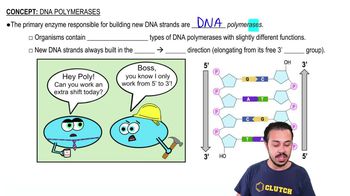
DNA intercalation involves the insertion of molecules between DNA base pairs, distorting the double helix structure. This physical disruption can block enzymes like DNA polymerase and RNA polymerase, affecting processes such as replication and transcription.
Recommended video:
Guided course
04:01
DNA Polymerases

DNA Replication and Transcription

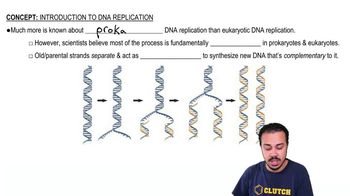
DNA replication is the process of copying the DNA before cell division, while transcription is the synthesis of RNA from DNA. Intercalation can hinder these processes by preventing proper enzyme binding or progression along the DNA strand.
Recommended video:
Guided course
03:37
Introduction to DNA Replication

Downstream Effects on Mutation and Protein Synthesis

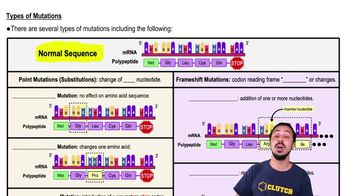
Disruption of replication can cause mutations due to errors or incomplete copying, while transcription disruption affects mRNA production, leading to altered translation and protein synthesis. Thus, initial DNA damage cascades into mutations and abnormal proteins.
Recommended video:
Guided course
08:44
Types of Mutations