Ch. 6 - Microbial Growth
Tortora - Microbiology: An Introduction 14th Edition
Tortora14th EditionMicrobiology: An IntroductionISBN: 9780138200398Not the one you use?Change textbook
Chapter 6, Problem 4

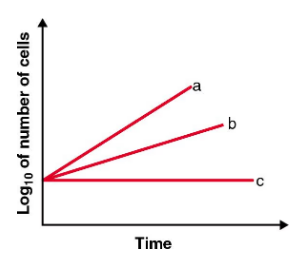
Which of the lines best depicts the log phase of Listeria monocytogenes growing in a human?
Graph showing three lines labeled a, b, and c depicting different bacterial growth rates over time on a log scale.

Verified step by step guidance
1
Understand that the log phase (also called the exponential phase) in bacterial growth is characterized by a period of rapid, exponential increase in the number of cells.
Look at the graph where the y-axis represents the logarithm (base 10) of the number of cells and the x-axis represents time. During the log phase, the number of cells increases exponentially, so the graph should show a straight line with a positive slope on this log scale.
Analyze each line: Line 'a' shows the steepest positive slope, indicating the fastest increase in cell number; line 'b' shows a positive slope but less steep than 'a'; line 'c' is flat, indicating no increase in cell number.
Since the log phase is the period of rapid growth, the line that best depicts this phase is the one with the steepest positive slope, which is line 'a'.
Therefore, line 'a' best represents the log phase of Listeria monocytogenes growing in a human.

Verified video answer for a similar problem:

This video solution was recommended by our tutors as helpful for the problem above.
Video duration:
1m
Was this helpful?

Key Concepts

Here are the essential concepts you must grasp in order to answer the question correctly.

Bacterial Growth Phases

Bacterial growth occurs in distinct phases: lag, log (exponential), stationary, and death. The log phase is characterized by rapid, exponential cell division, where the population size increases logarithmically over time. Understanding these phases helps interpret growth curves and bacterial behavior in different environments.
Recommended video:
Guided course
03:06
Bacterial Transformation

Logarithmic (Log) Phase Characteristics

During the log phase, bacteria multiply at their maximum rate under optimal conditions, leading to a straight, upward-sloping line on a logarithmic growth graph. This phase reflects active metabolism and cell division, making it critical for studying bacterial growth dynamics and antibiotic susceptibility.
Recommended video:
Guided course
05:09
Intro to Characteristics of Infectious Disease

Interpreting Growth Curves on a Log Scale

A logarithmic scale on the y-axis means equal distances represent tenfold changes in cell number. Lines with positive slopes indicate growth, with steeper slopes showing faster growth rates. A flat line indicates no growth, helping distinguish between lag, log, and stationary phases in bacterial populations.
Recommended video:
Guided course
08:59
Microbial Growth Curves in a Closed System