
Ch. 7 - Microbial Genetics
Bauman - Microbiology with Diseases by Taxonomy 6th Edition
Bauman6th EditionMicrobiology with Diseases by TaxonomyISBN: 9780134832302Not the one you use?Change textbook
Chapter 7, Problem 3

The drugs ddC and AZT are used to treat AIDS.


Based on their chemical structures, what is their mode of action?

Verified step by step guidance
1
Step 1: Identify the chemical nature of ddC and AZT by examining their structures. Both are nucleoside analogs, meaning they resemble natural nucleosides but have modifications—in ddC, the 2' and 3' hydroxyl groups are missing (dideoxy), and in AZT, there is an azido group (-N3) at the 3' position instead of a hydroxyl group.
Step 2: Understand the role of natural nucleosides in DNA synthesis. During DNA replication, nucleosides with a free 3'-OH group are incorporated into the growing DNA strand by DNA polymerase, allowing the addition of the next nucleotide via a phosphodiester bond.
Step 3: Analyze how the modifications in ddC and AZT affect DNA synthesis. Because both lack a 3'-OH group (ddC has none, AZT has an azido group instead), once incorporated into viral DNA by reverse transcriptase, they prevent the formation of the next phosphodiester bond, effectively terminating DNA chain elongation.
Step 4: Connect this mechanism to their use in AIDS treatment. HIV relies on reverse transcriptase to convert its RNA genome into DNA. ddC and AZT act as chain terminators by being incorporated into viral DNA, thereby inhibiting reverse transcriptase and blocking viral replication.
Step 5: Summarize the mode of action: ddC and AZT are nucleoside reverse transcriptase inhibitors (NRTIs) that mimic natural nucleosides but cause premature termination of viral DNA synthesis due to the absence of a 3'-OH group necessary for chain elongation.

Verified video answer for a similar problem:

This video solution was recommended by our tutors as helpful for the problem above.
Video duration:
1m
Was this helpful?

Key Concepts

Here are the essential concepts you must grasp in order to answer the question correctly.

Nucleoside Analog Reverse Transcriptase Inhibitors (NRTIs)

ddC and AZT are nucleoside analogs that mimic natural nucleosides but lack a 3' hydroxyl group, essential for DNA chain elongation. When incorporated into viral DNA by reverse transcriptase, they cause premature termination of DNA synthesis, inhibiting viral replication.
Recommended video:
Guided course
04:28
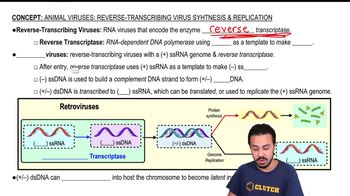
Animal Viruses: Reverse-Transcribing Virus Synthesis & Replication

Reverse Transcriptase Enzyme Function

Reverse transcriptase is an enzyme used by retroviruses like HIV to convert their RNA genome into DNA. This enzyme adds nucleotides to the growing DNA chain, requiring a 3' hydroxyl group on the sugar moiety to form phosphodiester bonds and extend the DNA strand.
Recommended video:
Guided course
02:32
Functions of Enzymes

Mechanism of Chain Termination

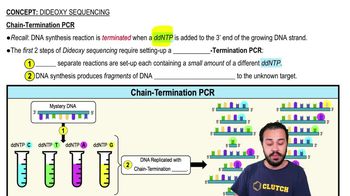
Both ddC and AZT lack the 3' hydroxyl group on their sugar ring, which is necessary for forming the next phosphodiester bond during DNA synthesis. Incorporation of these analogs into viral DNA halts elongation, effectively stopping viral replication and reducing viral load in AIDS patients.
Recommended video:
Guided course
07:37
Chain-Termination PCR