Ch. 7 - Microbial Genetics
Bauman - Microbiology with Diseases by Taxonomy 6th Edition
Bauman6th EditionMicrobiology with Diseases by TaxonomyISBN: 9780134832302Not the one you use?Change textbook
Chapter 7, Problem 1

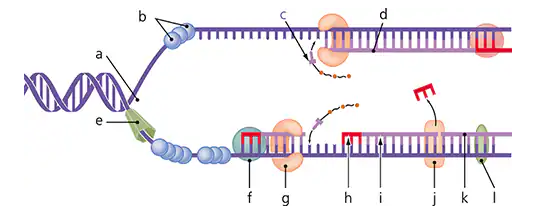
On the accompanying figure, label:
DNA polymerase I, DNA polymerase III, helicase, lagging strand, leading strand, ligase, nucleotide (triphosphate), Okazaki fragment, primase, replication fork, RNA primer, and stabilizing proteins.
Diagram of DNA replication showing helicase, leading and lagging strands, RNA primer, DNA polymerases I and III, ligase, primase, Okazaki fragments, and replication fork.

Verified step by step guidance
1
Identify the replication fork where the DNA strands are being separated; this is typically where the double helix is unwound. In the image, this corresponds to the area labeled 'a'.
Locate helicase, the enzyme responsible for unwinding the DNA double helix. It is usually positioned at the replication fork and appears as a ring-shaped structure encircling one strand of DNA. In the image, this is labeled 'b'.
Find the leading strand and lagging strand. The leading strand is synthesized continuously in the direction of the replication fork movement, while the lagging strand is synthesized discontinuously in Okazaki fragments. The leading strand is the strand where DNA polymerase III moves smoothly, and the lagging strand is where Okazaki fragments are visible. In the image, the leading strand is labeled 'c' and the lagging strand is labeled 'd'.
Identify RNA primers, which are short RNA sequences that initiate DNA synthesis. These are usually shown as short segments on the lagging strand. In the image, the RNA primer is labeled 'h'.
Locate DNA polymerase III, the main enzyme synthesizing new DNA strands, typically associated with the leading and lagging strands. DNA polymerase I, which replaces RNA primers with DNA, is usually near the Okazaki fragments. Ligase, which joins Okazaki fragments, is found near the lagging strand. Primase, which synthesizes RNA primers, is near the replication fork. Stabilizing proteins bind single-stranded DNA to prevent reannealing. In the image, DNA polymerase III is labeled 'f', DNA polymerase I is 'g', ligase is 'j', primase is 'e', and stabilizing proteins are 'l'. The nucleotide triphosphates, the building blocks for DNA synthesis, are labeled 'i'. The Okazaki fragment is the segment between RNA primers on the lagging strand, labeled 'k'.

Verified video answer for a similar problem:

This video solution was recommended by our tutors as helpful for the problem above.
Video duration:
2m
Was this helpful?

Key Concepts

Here are the essential concepts you must grasp in order to answer the question correctly.

DNA Replication Fork and Strand Orientation

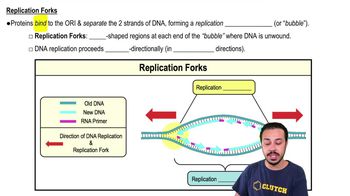
The replication fork is the Y-shaped region where DNA unwinds to allow replication. The leading strand is synthesized continuously toward the fork, while the lagging strand is synthesized discontinuously away from the fork in short Okazaki fragments. Understanding strand orientation is crucial for identifying enzyme functions.
Recommended video:
Guided course
04:00
Replication Forks

Role of Enzymes in DNA Replication

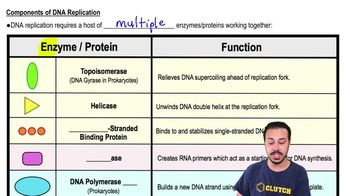
Key enzymes include helicase, which unwinds the DNA helix; primase, which synthesizes RNA primers; DNA polymerase III, which extends the new DNA strand; DNA polymerase I, which replaces RNA primers with DNA; and ligase, which joins Okazaki fragments. Each enzyme has a specific role in ensuring accurate and efficient replication.
Recommended video:
Guided course
04:47
Components of DNA Replication

Okazaki Fragments and RNA Primers

Okazaki fragments are short DNA segments synthesized on the lagging strand, initiated by RNA primers made by primase. These primers provide a starting point for DNA polymerase III. Later, DNA polymerase I removes RNA primers and fills gaps with DNA, and ligase seals the fragments, ensuring strand continuity.
Recommended video:
Guided course
04:19
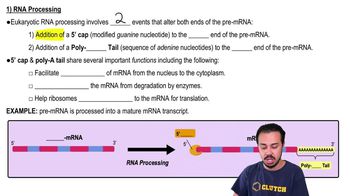
1) RNA Processing