Why is a person who produces a large amount of IgE more likely to experience anaphylactic shock than a person who instead produces a large amount of IgG?
Ch. 18 - Immune Disorders
Bauman6th EditionMicrobiology with Diseases by TaxonomyISBN: 9780134832302Not the one you use?Change textbook
Chapter 18, Problem 2
The major inflammatory mediator released by degranulating mast cells in type I hypersensitivity is:
a. Immunoglobulin
b. Complement
c. Histamine
d. Interleukin
e. Prostaglandin
Verified step by step guidance1
Understand the context: Type I hypersensitivity is an immediate allergic reaction involving mast cells and basophils.
Recall that mast cells, when activated during type I hypersensitivity, release various inflammatory mediators stored in their granules.
Identify the major mediator released upon mast cell degranulation, which causes symptoms like vasodilation, increased vascular permeability, and smooth muscle contraction.
Compare the options: immunoglobulin (antibody), complement (plasma proteins), histamine (a biogenic amine), interleukin (cytokine), and prostaglandin (lipid mediator).
Recognize that histamine is the primary and most immediate mediator released from mast cell granules during type I hypersensitivity.

Verified video answer for a similar problem:
This video solution was recommended by our tutors as helpful for the problem above.
Video duration:
2mWas this helpful?
Key Concepts
Here are the essential concepts you must grasp in order to answer the question correctly.
Type I Hypersensitivity
Type I hypersensitivity is an immediate allergic reaction mediated by IgE antibodies. Upon exposure to an allergen, IgE binds to mast cells, triggering their degranulation and release of inflammatory mediators, leading to symptoms like swelling, redness, and itching.
Recommended video:
Guided course
Types of Phosphorylation
Mast Cell Degranulation
Mast cells are immune cells that store inflammatory mediators in granules. When activated by allergens via IgE, they release these mediators rapidly, a process called degranulation, which initiates and amplifies allergic inflammation.
Recommended video:
Guided course
Cell Junctions
Histamine as an Inflammatory Mediator
Histamine is a key chemical released from mast cell granules during allergic reactions. It increases blood vessel permeability and causes smooth muscle contraction, leading to classic allergy symptoms such as swelling, redness, and bronchoconstriction.
Recommended video:
Guided course
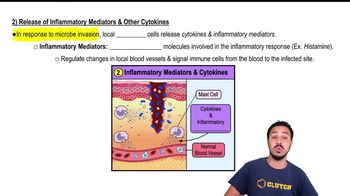
2) Release of Inflammatory Mediators & Other Cytokines
Related Practice
Textbook Question
1270
views
Textbook Question
Indicate whether each statement is true or false. If the statement is false, change the underlined word or phrase to make the statement true.
________ Cyclosporine is released by degranulating mast cells.
705
views
Textbook Question
Indicate whether each statement is true or false. If the statement is false, change the underlined word or phrase to make the statement true.
_____ Type III hypersensitivity reactions may lead to the development of glomerulonephritis.
737
views
Textbook Question
Why is a child born to an Rh+ mother not susceptible to Rh-related hemolytic disease of the newborn?
1454
views
Textbook Question
The immunoglobulin class that mediates type I hypersensitivity is:
a. IgA
b. IgM
c. IgG
d. IgD
e. IgE
1449
views
Textbook Question
Label the four types of grafts on the accompanying figure.
1606
views