
Textbook Question
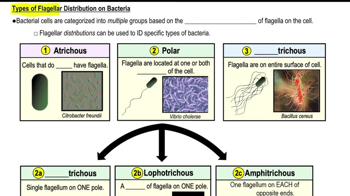
Label each type of flagellar arrangement.
a. __________ <IMAGE> b. __________ <IMAGE>
c. __________ <IMAGE> d. __________ <IMAGE>
1154
views

 Verified step by step guidance
 02:53
02:53
 05:22 05:22
Label each type of flagellar arrangement.
a. __________ <IMAGE> b. __________ <IMAGE>
c. __________ <IMAGE> d. __________ <IMAGE>
Match the terms with their descriptions following. Only one description is intended for each term.
____ Ribosome
____ Cytoskeleton
____ Centriole
____ Nucleus
____ Mitochondrion
____ Chloroplast
____ ER
____ Golgi body
____ Peroxisome
A. Site of protein synthesis
B. Contains enzymes to neutralize hydrogen peroxide
C. Functions as the transport system within a eukaryotic cell
D. Allows contraction of the cell
E. Site of most DNA in eukaryotes
F. Contains microtubules in "9 + 0" arrangement
G. Light-harvesting organelle
H. Packages large molecules for export from a cell
I. Its internal membranes are sites for ATP production
Label the structures of the following prokaryotic and eukaryotic cells. With a single word or short phrase, explain the function of each structure.
a.
b.
c.
d.
e.
f.
g.
h.
i.
j.
k.
l.
m.
n.
o.
p.
q.
A cell may allow a large or charged chemical to move across the cytoplasmic membrane, down the chemical’s electrical and chemical gradients, in a process called _________ . .
a. active transport
b. facilitated diffusion
c. endocytosis
d. pinocytosis
Match the structures with their descriptions following. A letter may be used more than once or not at all, and more than one letter may be correct for each blank.
____ Glycocalyx
____ Flagella
____ Axial filaments
____ Cilia
____ Fimbriae
____ Pili
____ Hami
A. Bristlelike projections found in quantities of 100 or more
B. Long whip
C. Responsible for conjugation
D. “Sweet cup” composed of polysaccharides and/or polypeptides
E. Numerous “grappling-hook” projections
F. Responsible for motility of spirochetes
G. Extensions not used for cell motility
H. Made of tubulin in eukaryotes
I. Made of flagellin in bacteria
Which of the following statements concerning growth and reproduction is false?
a. Growth and reproduction may occur simultaneously in living organisms
b. A living organism must reproduce to be considered alive
c. Living things may stop growing and reproducing yet still be alive
d. Normally, living organisms have the ability to grow and reproduce themselves