Ch. 8 - Microbial Genetics
Tortora - Microbiology: An Introduction 14th Edition
Tortora14th EditionMicrobiology: An IntroductionISBN: 9780138200398Not the one you use?Change textbook
Chapter 8, Problem 3

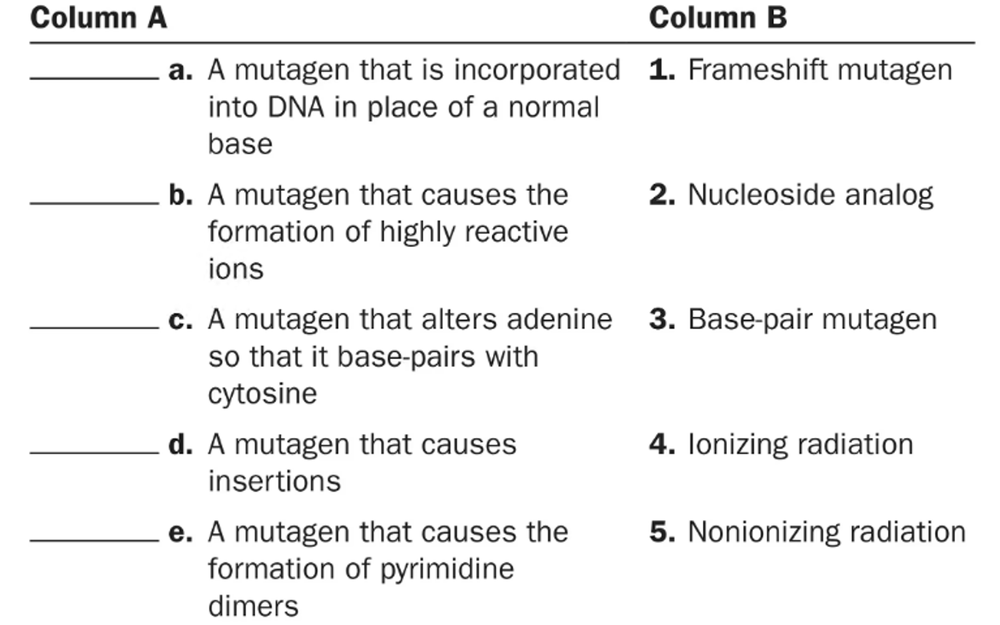
Match the following examples of mutagens.
Matching exercise listing mutagen descriptions in one column and mutagen types in another for pairing.

Verified step by step guidance
1
Identify the types of mutagens presented in the image or list. Mutagens can be physical (like UV light, X-rays), chemical (like base analogs, alkylating agents), or biological (like transposons or certain viruses).
For each example, determine the category it belongs to by recalling the characteristics of each mutagen type. For instance, UV light causes thymine dimers (physical mutagen), while alkylating agents add alkyl groups to DNA bases (chemical mutagen).
Match each example to its mutagen type by linking the mechanism of mutation it causes. For example, if the example is a chemical that inserts itself into DNA, it is an intercalating agent (chemical mutagen).
Use the process of elimination if some examples clearly fit one category, which helps narrow down the options for the remaining examples.
Review your matches by considering the biological effects of each mutagen, ensuring that the example and mutagen type logically correspond to the mutation mechanism described.

Verified video answer for a similar problem:

This video solution was recommended by our tutors as helpful for the problem above.
Video duration:
2m
Was this helpful?

Key Concepts

Here are the essential concepts you must grasp in order to answer the question correctly.

Mutagens and Their Types

Mutagens are agents that cause changes or mutations in the DNA sequence. They can be physical (like UV radiation), chemical (such as alkylating agents), or biological (like certain viruses). Understanding the type of mutagen helps in identifying how it alters genetic material.
Recommended video:
Guided course
02:55
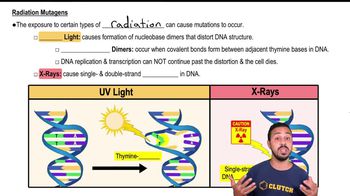
Radiation Mutagens

Mechanism of Mutation Induction

Different mutagens induce mutations through specific mechanisms, such as base substitution, frameshift mutations, or DNA strand breaks. Knowing these mechanisms is essential to match mutagens with their effects on DNA.
Recommended video:
Guided course
08:44
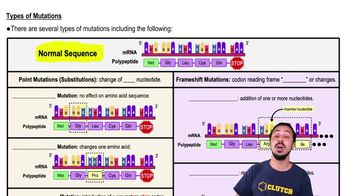
Types of Mutations

Examples of Common Mutagens

Familiarity with common mutagens like UV light, X-rays, mustard gas, and nitrous acid is crucial. Each has characteristic effects on DNA, which aids in correctly matching them to their mutagenic outcomes.
Recommended video:
Guided course
05:13
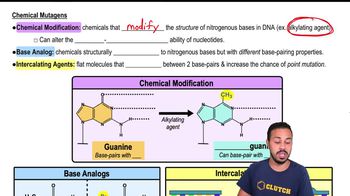
Chemical Mutagens
Related Practice
Textbook Question

Transfer of DNA from a donor to a recipient as naked DNA in solution.

a. Conjugation

b. Transcription

c. Transduction

d. Transformation

e. Translation

886
views

Textbook Question

The following is a code for a strand of DNA.

a. Using the genetic code provided in Figure 8.8, fill in the blanks to complete the segment of DNA shown.

b. Fill in the blanks to complete the sequence of amino acids coded for by this strand of DNA.

c. Write the code for the complementary strand of DNA completed in part (a).

d. What would be the effect if C were substituted for T at base 10?

e. What would be the effect if A were substituted for G at base 11?

f. What would be the effect if G were substituted for T at base 14?

g. What would be the effect if C were inserted between bases 9 and 10?

h. How would UV radiation affect this strand of DNA?

i. Identify a nonsense sequence in this strand of DNA.

1491
views
Textbook Question

Feedback inhibition differs from repression because feedback inhibition

a. Is less precise.

b. Is slower acting.

c. Stops the action of preexisting enzymes.

d. Stops the synthesis of new enzymes.

e. All of the above

1003
views
Textbook Question

Identify and mark each of the following on the portion of DNA undergoing replication: replication fork, DNA polymerase, RNA primer, parent strands, leading strand, lagging strand, the direction of replication on each strand, and the 5′ end of each strand.

1482
views
Textbook Question

Bacteria can acquire antibiotic resistance by all of the following except

a. mutation.

b. insertion of transposons.

c. conjugation.

d. snRNPs.

e. transformation.

1881
views
Textbook Question

Transfer of DNA from a donor to a recipient cell by a bacteriophage.

a. Conjugation

b. Transcription

c. Transduction

d. Transformation

e. Translation

1422
views