Ch. 27 - Microbial Ecology and Microbiomes
Bauman - Microbiology with Diseases by Taxonomy 6th Edition
Bauman6th EditionMicrobiology with Diseases by TaxonomyISBN: 9780134832302Not the one you use?Change textbook
Chapter 27, Problem 2

When examining the microbiome of the human intestine, you would expect to find how many bacterial species present?
a. One
b. Three
c. Hundreds
d. Thousands

Verified step by step guidance
1
Understand that the human intestinal microbiome is highly diverse, containing a vast number of bacterial species that contribute to digestion, immunity, and overall health.
Recall that studies using advanced sequencing techniques have revealed that the gut microbiome is not limited to just a few species but includes a wide variety of bacteria.
Recognize that the number of bacterial species in the human intestine typically ranges in the hundreds to thousands, reflecting a complex ecosystem.
Compare the answer choices: one species is too few, three species is still very limited, hundreds is plausible, but thousands is more accurate based on current scientific knowledge.
Conclude that the best answer corresponds to the largest diversity, which is thousands of bacterial species present in the human intestine.

Verified video answer for a similar problem:

This video solution was recommended by our tutors as helpful for the problem above.
Video duration:
1m
Was this helpful?

Key Concepts

Here are the essential concepts you must grasp in order to answer the question correctly.

Human Intestinal Microbiome Diversity

The human intestine hosts a highly diverse community of microorganisms, primarily bacteria, which play crucial roles in digestion, immunity, and overall health. This diversity includes thousands of different bacterial species, reflecting a complex ecosystem rather than a few dominant types.
Recommended video:
Guided course
03:25
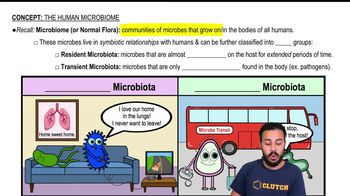
The Human Microbiome

Microbial Species Richness

Species richness refers to the number of different species present in a particular environment. In the human gut, species richness is very high, with studies identifying thousands of bacterial species, highlighting the complexity and variability of the microbiome among individuals.
Recommended video:
Guided course
04:43
Reactive Oxygen Species

Methods for Identifying Microbial Species

Modern techniques like 16S rRNA gene sequencing and metagenomics allow scientists to identify and quantify bacterial species in the gut without culturing them. These methods have revealed the vast number of bacterial species present, far exceeding earlier estimates based on culture-dependent methods.
Recommended video:
Guided course
03:59
Selecting a Method to Control Microbial Growth