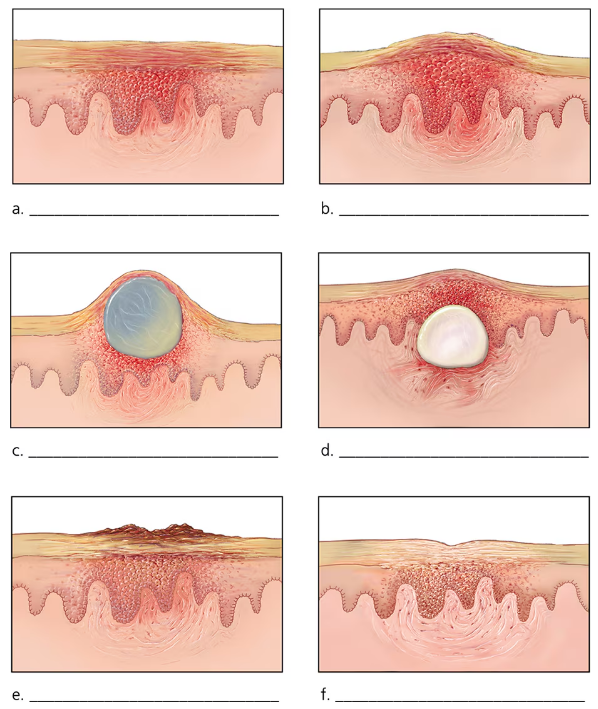
Label the successive stages of skin lesions as exemplified by smallpox.
Verified step by step guidance
1
Step 1: Identify the initial stage of the lesion, which is characterized by redness and inflammation of the skin without any raised bumps. This stage is called the 'Macule' stage.
Step 2: Observe the next stage where the lesion becomes raised and forms a small bump. This is known as the 'Papule' stage.
Step 3: Notice the formation of a fluid-filled blister on the raised bump, indicating the 'Vesicle' stage.
Step 4: See the progression to a larger, pus-filled blister, which is the 'Pustule' stage.
Step 5: Recognize the stage where the pustule begins to crust over and form a scab, called the 'Crust' or 'Scab' stage, followed by the final healing stage where the scab falls off and the skin begins to repair.
0 Comments
Key Concepts
Here are the essential concepts you must grasp in order to answer the question correctly.
Stages of Smallpox Skin Lesions
Smallpox lesions progress through distinct stages: macule (flat red spot), papule (raised bump), vesicle (fluid-filled blister), pustule (pus-filled blister), crust or scab (drying and hardening of lesion), and scar (healed skin). Recognizing these stages helps in diagnosis and understanding disease progression.
Smallpox lesions form due to viral replication in skin cells, causing inflammation and immune response. This leads to fluid accumulation (vesicles), pus formation (pustules), and eventual tissue necrosis and healing. Understanding this process explains the morphological changes seen in each lesion stage.
Immune Response and Healing in Viral Skin Infections
The immune system responds to viral infection by recruiting immune cells to the lesion site, causing redness and swelling. As the infection resolves, lesions crust over and heal, sometimes leaving scars. This healing process is critical for recovery and preventing secondary infections.