

Ch. 21 - Rickettsias, Chlamydias, Spirochetes, and Vibrios
Bauman - Microbiology with Diseases by Taxonomy 6th Edition
Bauman6th EditionMicrobiology with Diseases by TaxonomyISBN: 9780134832302Not the one you use?Change textbook
Chapter 21, Problem 1

Label the following stages and structures of the chlamydia life cycle: elementary body, endocytosis, vesicle, host cell, inclusion body, reticulate body. For B–D, indicate how many hours have typically transpired since infection. <IMAGE>

Verified step by step guidance
1
Step 1: Understand the two main forms of Chlamydia in its life cycle: the elementary body (EB), which is the infectious, extracellular form, and the reticulate body (RB), which is the non-infectious, intracellular replicative form.
Step 2: Identify the 'elementary body' as the small, infectious particle that attaches to and enters the host cell. This corresponds to the initial stage before or during endocytosis.
Step 3: Label 'endocytosis' as the process by which the host cell engulfs the elementary body, forming a membrane-bound vesicle inside the host cell.
Step 4: Recognize the 'vesicle' as the membrane-bound compartment inside the host cell that contains the elementary body after endocytosis. This vesicle will mature into an 'inclusion body' as the infection progresses.
Step 5: Label the 'host cell' as the larger cell that is infected by Chlamydia. The 'inclusion body' is the specialized vacuole inside the host cell where the reticulate bodies replicate. For stages B–D, estimate the typical hours post-infection based on known Chlamydia developmental timing: early (around 2–8 hours), mid (8–24 hours), and late (24–48 hours) stages.

Verified video answer for a similar problem:

This video solution was recommended by our tutors as helpful for the problem above.
Video duration:
1m
Was this helpful?

Key Concepts

Here are the essential concepts you must grasp in order to answer the question correctly.

Chlamydia Life Cycle Stages

Chlamydia has a unique biphasic life cycle involving two main forms: the infectious elementary body (EB) and the replicative reticulate body (RB). The EB attaches to and enters the host cell, then transforms into the RB inside an inclusion body where it replicates before converting back to EBs to infect new cells.
Recommended video:

Host Cell Entry and Inclusion Body Formation

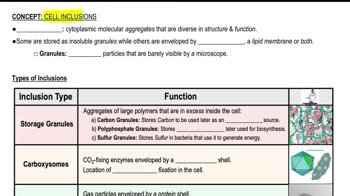
Elementary bodies enter the host cell via endocytosis, becoming enclosed in a membrane-bound vesicle called an inclusion body. This inclusion protects the bacteria from host defenses and provides a niche for reticulate bodies to multiply within the host cell cytoplasm.
Recommended video:
Guided course
05:20
Cell Inclusions

Timing of Chlamydia Developmental Stages

The chlamydial developmental cycle follows a timeline: EBs enter the host cell (0 hours), convert to RBs within a few hours (typically 6-8 hours), replicate inside the inclusion body, and then revert to EBs around 18-24 hours post-infection to be released and infect new cells.
Recommended video:
Guided course
02:54
Generation Times