Compare and contrast the processes of transformation, transduction, and conjugation.
Verified step by step guidance
1
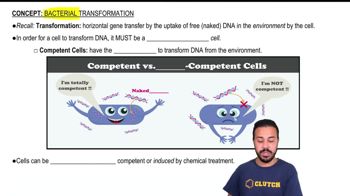
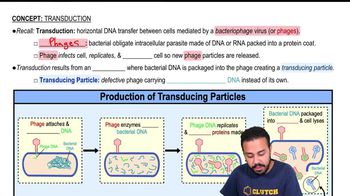
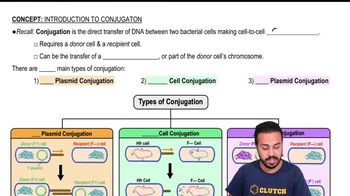
Start by defining each process clearly: Transformation is the uptake of free DNA from the environment by a bacterial cell; transduction is the transfer of DNA from one bacterium to another via a bacteriophage (a virus that infects bacteria); conjugation is the direct transfer of DNA between two bacterial cells through cell-to-cell contact, often involving a pilus.
Next, explain the source of genetic material in each process: In transformation, the DNA comes from lysed cells in the environment; in transduction, the DNA is packaged inside a bacteriophage during infection; in conjugation, the DNA is usually a plasmid or part of the bacterial chromosome transferred directly from donor to recipient.
Then, describe the mechanism of DNA transfer: Transformation involves the bacterial cell binding and internalizing naked DNA; transduction involves a bacteriophage injecting DNA into a new host; conjugation requires physical contact and formation of a conjugation pilus to transfer DNA.
Compare the types of genetic material transferred: Transformation and transduction can transfer chromosomal or plasmid DNA, while conjugation typically transfers plasmids but can also transfer chromosomal DNA in some cases.
Finally, discuss the biological significance and applications: All three processes contribute to horizontal gene transfer, increasing genetic diversity and potentially spreading traits like antibiotic resistance; understanding these mechanisms is crucial in microbiology for genetic engineering and controlling bacterial evolution.
Verified video answer for a similar problem:
This video solution was recommended by our tutors as helpful for the problem above
Video duration:
2m
Play a video:
0 Comments
Key Concepts
Here are the essential concepts you must grasp in order to answer the question correctly.
Transformation
Transformation is the process by which bacteria take up free, naked DNA fragments from their environment and incorporate them into their own genome. This natural genetic exchange allows bacteria to acquire new traits, such as antibiotic resistance, and is commonly used in molecular biology for genetic engineering.
Transduction involves the transfer of bacterial DNA from one cell to another via bacteriophages (viruses that infect bacteria). During this process, phages accidentally package host DNA and inject it into a new bacterial cell, facilitating horizontal gene transfer without direct cell-to-cell contact.
Conjugation is a direct cell-to-cell transfer of genetic material, typically plasmids, through a physical connection called a pilus. This mechanism allows bacteria to share genes, such as those for antibiotic resistance, rapidly spreading traits within a population and contributing to genetic diversity.