Which of the following structures have no electrical charge?
a. Protons b. Electrons c. Neutrons d. Ions
Verified step by step guidance
1
Understand the basic charges of subatomic particles: protons, electrons, and neutrons are fundamental components of atoms.
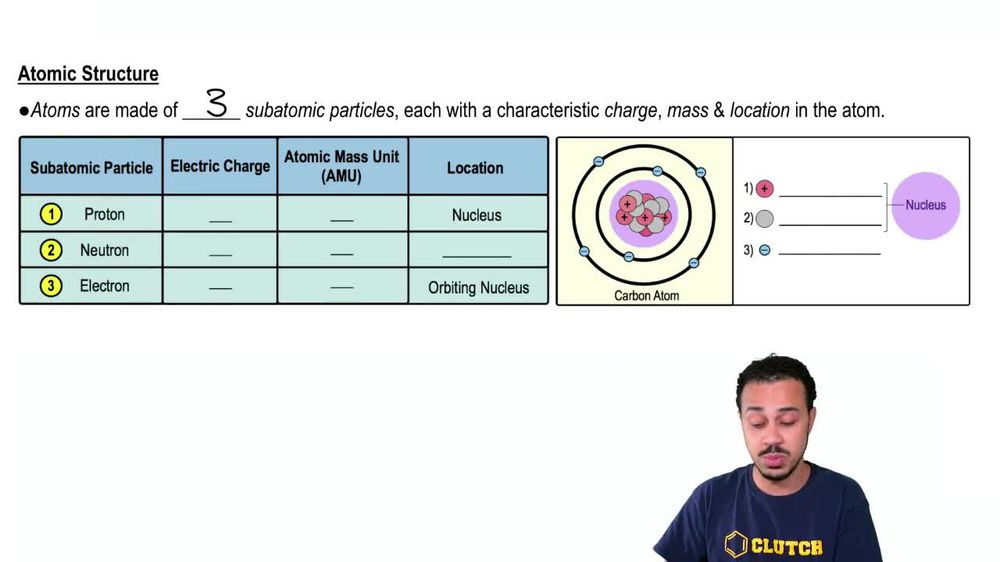
Recall that protons carry a positive electrical charge, electrons carry a negative electrical charge, and neutrons have no electrical charge.
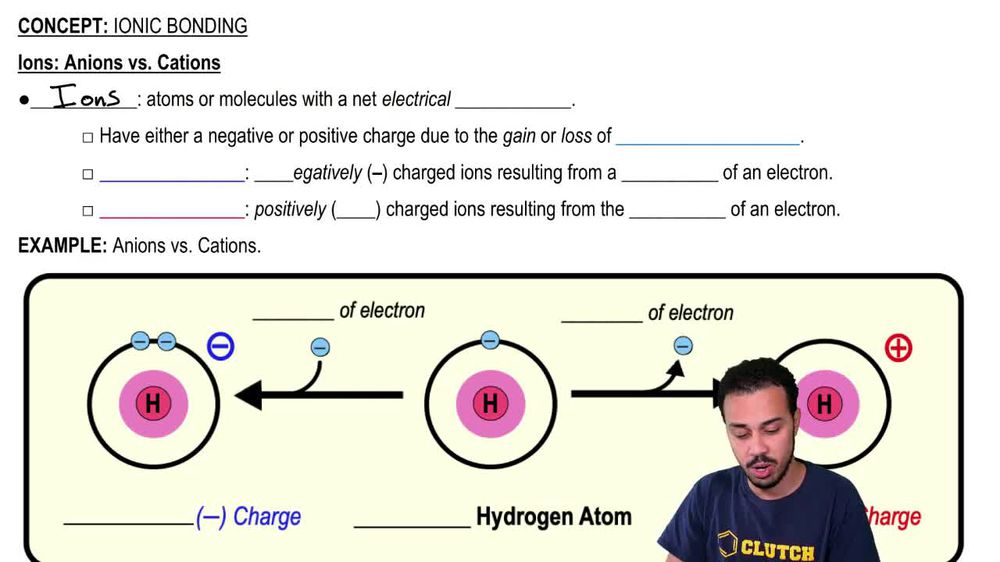
Recognize that ions are atoms or molecules that have gained or lost electrons, resulting in a net electrical charge (either positive or negative).
Identify which of the listed options have no electrical charge by comparing their charge properties.
Conclude that the structure with no electrical charge is the neutron, as it is electrically neutral.
Verified video answer for a similar problem:
This video solution was recommended by our tutors as helpful for the problem above
Video duration:
2m
Play a video:
0 Comments
Key Concepts
Here are the essential concepts you must grasp in order to answer the question correctly.
Atomic Particles and Their Charges
Atoms consist of protons, neutrons, and electrons. Protons carry a positive charge, electrons carry a negative charge, and neutrons have no electrical charge, making them neutral particles within the atom.
Neutrons are subatomic particles found in the nucleus of an atom that do not possess any electrical charge. Their neutrality helps stabilize the nucleus by offsetting the repulsive forces between positively charged protons.
Ions are atoms or molecules that have gained or lost electrons, resulting in a net electrical charge. Positively charged ions are called cations, while negatively charged ions are called anions, meaning ions always carry an electrical charge.