Using the periodic table, answer the following questions: a. What is the atomic number for lithium (Li)? b. What is the atomic mass of oxygen (O)? c. What is the chemical symbol for potassium? d. How many protons does nitrogen have? e. How many neutrons does lead have?
Verified step by step guidance
1
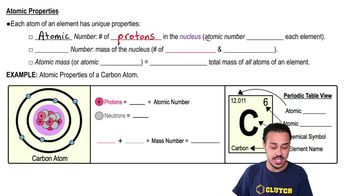
Identify the atomic number of lithium (Li) by locating lithium on the periodic table. The atomic number is the number of protons in the nucleus of an atom and is usually found above the element symbol.
Find the atomic mass of oxygen (O) on the periodic table. The atomic mass is typically displayed below the element symbol and represents the average mass of all isotopes of that element, measured in atomic mass units (amu).
Determine the chemical symbol for potassium by locating potassium on the periodic table. The chemical symbol is a one- or two-letter abbreviation of the element's name, with the first letter always capitalized.
To find how many protons nitrogen has, look up nitrogen on the periodic table and note its atomic number, which equals the number of protons in the atom.
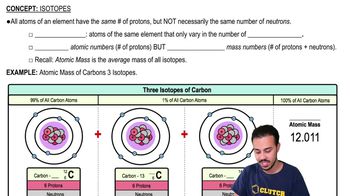
Calculate the number of neutrons in lead by subtracting the atomic number (number of protons) from the atomic mass (rounded to the nearest whole number). Use the formula: \(\text{Number of neutrons} = \text{Atomic mass (rounded)} - \text{Atomic number}\).
Verified video answer for a similar problem:
This video solution was recommended by our tutors as helpful for the problem above
Video duration:
2m
Play a video:
0 Comments
Key Concepts
Here are the essential concepts you must grasp in order to answer the question correctly.
Atomic Number
The atomic number represents the number of protons in an atom's nucleus and defines the element. It is unique to each element and determines its position on the periodic table. For example, lithium has an atomic number of 3, meaning it has 3 protons.
Atomic mass is the average mass of an element's atoms, measured in atomic mass units (amu), accounting for the relative abundance of isotopes. It roughly equals the sum of protons and neutrons in the nucleus. Oxygen’s atomic mass is approximately 16 amu.
Chemical symbols are one- or two-letter abbreviations representing elements, such as K for potassium. Understanding isotopes helps calculate neutrons by subtracting the atomic number from the atomic mass. For example, lead’s neutrons equal its atomic mass minus its atomic number.