Ch. 3 - Introduction to Prokaryotic Cells
Norman-McKay- Microbiology: Basic and Clinical Principles 2nd Edition
Norman-McKay2nd EditionMicrobiology: Basic and Clinical PrinciplesISBN: 9780137661619Not the one you use?Change textbook
Chapter 3, Problem 10

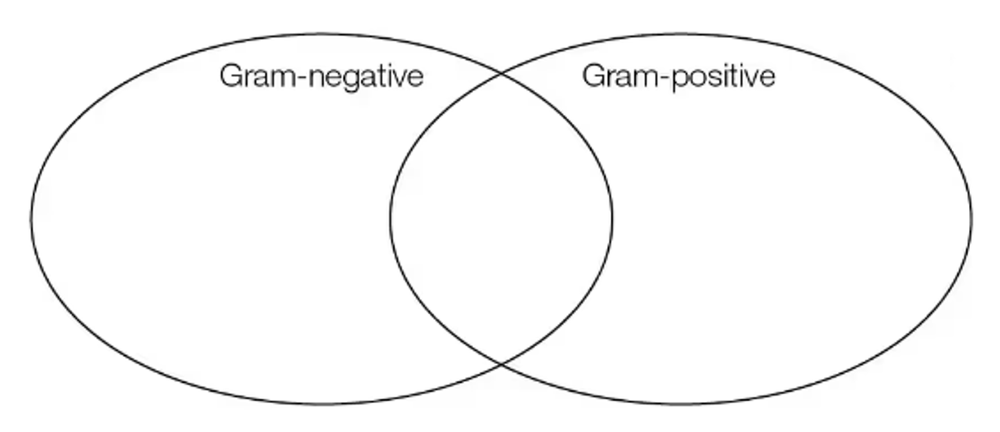
Complete the Venn diagram that compares and contrasts Gram-positive and Gram-negative bacteria.
Venn diagram with two overlapping circles labeled Gram-negative and Gram-positive for comparing bacterial cell wall features.

Verified step by step guidance
1
Step 1: Identify the key characteristics unique to Gram-positive bacteria, such as a thick peptidoglycan layer in their cell wall, presence of teichoic acids, and retention of the crystal violet stain during Gram staining.
Step 2: Identify the key characteristics unique to Gram-negative bacteria, including a thin peptidoglycan layer, an outer membrane containing lipopolysaccharides (LPS), and the inability to retain the crystal violet stain, instead taking up the counterstain (safranin) and appearing pink/red.
Step 3: Determine the shared characteristics between Gram-positive and Gram-negative bacteria, such as having a cell membrane, ribosomes, DNA, and the ability to reproduce by binary fission.
Step 4: Place the unique features of Gram-positive bacteria in one circle of the Venn diagram, the unique features of Gram-negative bacteria in the other circle, and the shared features in the overlapping section.
Step 5: Review the completed Venn diagram to ensure all relevant structural and staining differences, as well as common bacterial traits, are accurately represented.

Verified video answer for a similar problem:

This video solution was recommended by our tutors as helpful for the problem above.
Video duration:
4m
Was this helpful?

Key Concepts

Here are the essential concepts you must grasp in order to answer the question correctly.

Cell Wall Structure

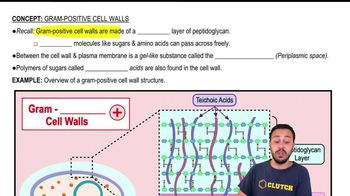
Gram-positive bacteria have a thick peptidoglycan layer in their cell walls, which retains the crystal violet stain, appearing purple under a microscope. In contrast, Gram-negative bacteria have a thin peptidoglycan layer and an outer membrane containing lipopolysaccharides, causing them to appear pink after Gram staining.
Recommended video:
Guided course
02:59
Gram-Positive Cell Walls

Gram Staining Technique

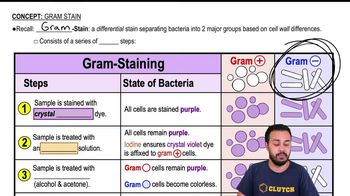
Gram staining differentiates bacteria based on their cell wall properties. The process involves staining with crystal violet, iodine treatment, alcohol decolorization, and counterstaining with safranin. Gram-positive bacteria retain the violet dye, while Gram-negative bacteria lose it and take up the pink counterstain.
Recommended video:

Physiological and Pathogenic Differences

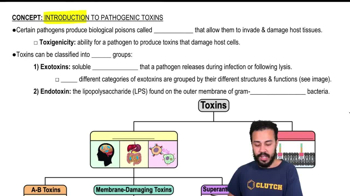
Gram-negative bacteria often have higher resistance to antibiotics due to their outer membrane, which acts as a barrier. They also tend to produce endotoxins from lipopolysaccharides. Gram-positive bacteria lack this outer membrane but may produce exotoxins and have different susceptibility to antibiotics.
Recommended video:
Guided course
03:40
Introduction to Pathogenic Toxins