
Ch. 15 - Innate Immunity
Bauman - Microbiology with Diseases by Taxonomy 6th Edition
Bauman6th EditionMicrobiology with Diseases by TaxonomyISBN: 9780134832302Not the one you use?Change textbook
Chapter 15, Problem 1

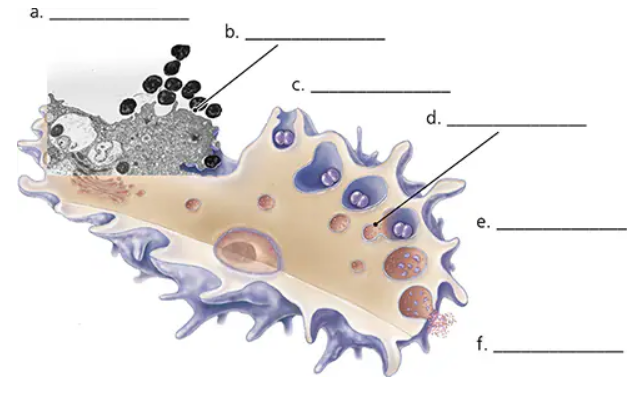
Label the steps of phagocytosis.
Diagram of a cell undergoing phagocytosis with six labeled steps indicated by blank lines.
a. ________
b. ________
c. ________
d. ________
e. ________
f. ________

Verified step by step guidance
1
Step a: Recognition and attachment - The phagocyte recognizes and attaches to the microorganism or particle. This is often mediated by receptors on the phagocyte surface that bind to molecules on the target.
Step b: Engulfment - The phagocyte extends its membrane around the particle, forming pseudopods that surround and engulf the microorganism, creating a phagosome.
Step c: Formation of the phagosome - The engulfed particle is enclosed within a membrane-bound vesicle inside the phagocyte called the phagosome.
Step d: Fusion with lysosome - The phagosome fuses with a lysosome, an organelle containing digestive enzymes, forming a phagolysosome.
Step e: Digestion - Enzymes within the phagolysosome break down the engulfed particle into smaller components.
Step f: Exocytosis of debris - The indigestible material is expelled from the phagocyte by exocytosis.

Verified video answer for a similar problem:

This video solution was recommended by our tutors as helpful for the problem above.
Video duration:
2m
Was this helpful?

Key Concepts

Here are the essential concepts you must grasp in order to answer the question correctly.

Chemotaxis and Recognition

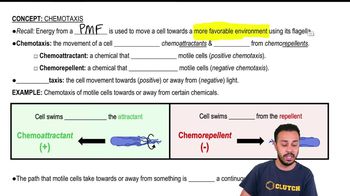
Chemotaxis is the movement of phagocytes toward chemical signals released by pathogens or damaged cells. Recognition involves the phagocyte identifying and binding to the target particle, often through receptors that detect microbial surface molecules or opsonins.
Recommended video:

Engulfment and Phagosome Formation

Engulfment is the process where the phagocyte's membrane extends around the particle, enclosing it within a vesicle called a phagosome. This internalization isolates the pathogen from the extracellular environment.
Recommended video:
Guided course
03:08
Formation & Breakdown of Polysaccharides

Phagolysosome Formation and Digestion

The phagosome fuses with lysosomes to form a phagolysosome, where enzymes and toxic reactive oxygen species degrade the engulfed material. This digestion neutralizes the pathogen, and residual debris is expelled by exocytosis.
Recommended video:
Guided course
03:08
Formation & Breakdown of Polysaccharides
Related Practice
Textbook Question

Write the letter of the description that applies to each of the following terms:

1. ___ Goblet cell

2. ___ Lysozyme

3. ___ Stem cell

4. ___ Dendritic cell

5. ___ Cell from sebaceous gland

6. ___ Bone marrow stem cell

7. ___ Eosinophil

8. ___ Alveolar macrophage

9. ___ Microglia

10. ___ Wandering macrophage

A. Leukocyte that primarily attacks parasitic worms

B. Phagocytic cell in lungs

C. Secretes sebum

D. Devours pathogens in epidermis

E. Breaks bonds in bacterial cell wall

F. Phagocytic cell in central nervous system

G. Generative cell with many types of offspring

H. Develops into formed elements of blood

I. Intercellular scavenger

J. Secretes mucus

1350
views
Textbook Question

Phagocytes of the epidermis are called:

a. Microglia

b. Goblet cells

c. Alveolar macrophages

d. Dendritic cells

1157
views
Textbook Question

Which line of defense first applies to each term?

1. ___ Inflammation

2. ___ Monocytes

3. ___ Lactoferrin

4. ___ Fever

5. ___ Dendritic cells

6. ___ Alpha interferon

7. ___ Mucous membrane of the digestive tract

8. ___ Neutrophils

9. ___ Epidermis

10. ___ Lysozyme

11. ___ Goblet cells

12. ___ Phagocytes

13. ___ Sebum

14. ___ T lymphocytes

15. ___ Antimicrobial peptides


A. First line of defense

B. Second line of defense

C. Third line of defense

1568
views
Textbook Question

Mucus-secreting membranes are found in:

a. The urinary system

b. The digestive cavity

c. The respiratory passages

d. All of the above

830
views
Textbook Question

Indicate which statements are true. Correct all false statements by changing the underlined words.

__________ The surface cells of the epidermis of the skin are alive.

1150
views