

Ch. 3 - Cell Structure and Function
Bauman - Microbiology with Diseases by Taxonomy 6th Edition
Bauman6th EditionMicrobiology with Diseases by TaxonomyISBN: 9780134832302Not the one you use?Change textbook
Chapter 3, Problem 2

Label each type of flagellar arrangement.
a. __________ <IMAGE> b. __________ <IMAGE>
c. __________ <IMAGE> d. __________ <IMAGE>

Verified step by step guidance
1
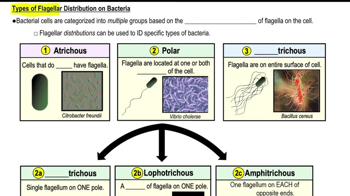
Step 1: Understand the common types of flagellar arrangements in bacteria. These include monotrichous (a single flagellum), lophotrichous (a tuft of flagella at one end), amphitrichous (flagella at both ends), and peritrichous (flagella all over the surface).
Step 2: Examine each image carefully to identify the number and location of flagella on the bacterial cell. Note whether the flagella are singular or in groups, and whether they are located at one end, both ends, or all around the cell.
Step 3: Match the observed flagellar pattern in each image to the correct term based on the definitions: monotrichous, lophotrichous, amphitrichous, or peritrichous.
Step 4: Label each image accordingly by writing the appropriate flagellar arrangement term next to each letter (a, b, c, d).
Step 5: Review your labels to ensure they correspond correctly to the visual characteristics of the flagella in each image.

Verified video answer for a similar problem:

This video solution was recommended by our tutors as helpful for the problem above.
Video duration:
1m
Was this helpful?

Key Concepts

Here are the essential concepts you must grasp in order to answer the question correctly.

Flagellar Arrangement Types

Flagellar arrangements describe how flagella are distributed on bacterial cells. Common types include monotrichous (single flagellum), lophotrichous (cluster of flagella at one pole), amphitrichous (flagella at both poles), and peritrichous (flagella all over the surface). Recognizing these patterns helps identify bacterial species and understand their motility.
Recommended video:
Guided course
05:22
Types of Flagellar Distribution on Bacteria

Function of Flagella in Bacteria

Flagella are whip-like structures that enable bacterial movement. Their arrangement affects the direction and efficiency of motility, allowing bacteria to navigate toward favorable environments or away from harmful stimuli. Understanding flagellar function is key to linking structure with bacterial behavior.
Recommended video:
Guided course
05:22
Types of Flagellar Distribution on Bacteria

Microscopic Identification Techniques

Visualizing flagella requires special staining methods, such as flagella stains, because flagella are thin and difficult to see under a light microscope. Knowledge of these techniques is essential for correctly identifying flagellar arrangements in lab settings.
Recommended video:
Guided course
03:46
Light Microscopy: Bright-Field Microscopes
Related Practice
Textbook Question

Match the terms with their descriptions following. Only one description is intended for each term.


 ____ Ribosome

 ____ Cytoskeleton

 ____ Centriole

 ____ Nucleus

 ____ Mitochondrion

 ____ Chloroplast

 ____ ER

 ____ Golgi body

 ____ Peroxisome


A. Site of protein synthesis

B. Contains enzymes to neutralize hydrogen peroxide

C. Functions as the transport system within a eukaryotic cell

D. Allows contraction of the cell

E. Site of most DNA in eukaryotes

F. Contains microtubules in "9 + 0" arrangement

G. Light-harvesting organelle

H. Packages large molecules for export from a cell

I. Its internal membranes are sites for ATP production

875
views
Textbook Question

Sketch, name, and describe three flagellar arrangements in bacteria.

1372
views
Textbook Question

Label the structures of the following prokaryotic and eukaryotic cells. With a single word or short phrase, explain the function of each structure.

a.

b.

c.

d.

e.

f.

g.

h.

i.

j.

k.

l.

m.

n.

o.

p.

q.

1187
views
Textbook Question

Define cytosol.

993
views
Textbook Question

A scientist who is studying passive movement of chemicals across the cytoplasmic membrane of Salmonella enterica serotype Typhi measures the rate at which two chemicals diffuse into a cell as a function of external concentration. The results are shown in the following figure. Chemical A diffuses into the cell more rapidly than does B at lower external concentrations, but the rate levels off as the external concentration increases. The rate of diffusion of chemical B continues to increase as the external concentration increases.


a. How can you explain the differences in the diffusion rates of chemicals A and B?

b. Why does the diffusion rate of chemical A taper off?

c. How could the cell increase the diffusion rate of chemical A?

d. How could the cell increase the diffusion rate of chemical B?

1310
views
Textbook Question

Which of the following statements concerning growth and reproduction is false?

a. Growth and reproduction may occur simultaneously in living organisms

b. A living organism must reproduce to be considered alive

c. Living things may stop growing and reproducing yet still be alive

d. Normally, living organisms have the ability to grow and reproduce themselves

1390
views