List three main types of chemical bonds, and give an example of each.
Verified step by step guidance
1
Identify the three main types of chemical bonds commonly discussed in microbiology and chemistry: ionic bonds, covalent bonds, and hydrogen bonds.
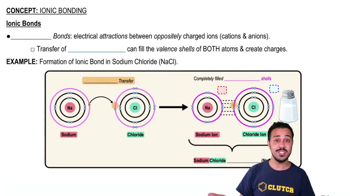
Explain that an ionic bond is formed when one atom donates an electron to another, resulting in oppositely charged ions that attract each other. An example is the bond between sodium (Na⁺) and chloride (Cl⁻) ions in sodium chloride (NaCl).
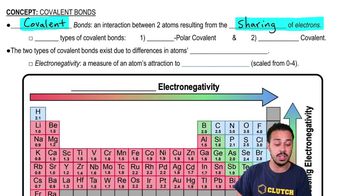
Describe a covalent bond as a bond where atoms share one or more pairs of electrons to achieve stability. An example is the bond between two hydrogen atoms (H) in a hydrogen molecule (H₂).
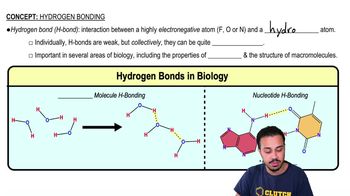
Clarify that a hydrogen bond is a weaker interaction that occurs when a hydrogen atom covalently bonded to an electronegative atom (like oxygen or nitrogen) is attracted to another electronegative atom. An example is the hydrogen bonding between water molecules (H₂O).
Summarize by listing each bond type alongside its example to reinforce understanding.
Verified video answer for a similar problem:
This video solution was recommended by our tutors as helpful for the problem above
Video duration:
3m
Play a video:
0 Comments
Key Concepts
Here are the essential concepts you must grasp in order to answer the question correctly.
Ionic Bonds
Ionic bonds form when one atom transfers electrons to another, creating positively and negatively charged ions that attract each other. This bond typically occurs between metals and nonmetals. An example is sodium chloride (NaCl), where sodium donates an electron to chlorine.
Covalent bonds involve the sharing of electron pairs between atoms, usually nonmetals, to achieve stability. These bonds can be single, double, or triple depending on the number of shared electron pairs. Water (H2O) is an example, where oxygen shares electrons with hydrogen atoms.
Hydrogen bonds are weak attractions between a hydrogen atom covalently bonded to an electronegative atom (like oxygen or nitrogen) and another electronegative atom. They are crucial in stabilizing structures like DNA and proteins. An example is the hydrogen bonding between water molecules.