Show where microbes ended up in Pasteur’s experiment.
Verified step by step guidance
1
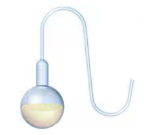
Observe the swan-neck flask in Pasteur's experiment, which contains broth inside the round bottom part of the flask.
Note that the unique curved neck of the flask allows air to enter but traps dust and microbes in the bend of the neck, preventing them from reaching the broth.
Identify that microbes end up trapped in the lower part of the curved neck, where gravity and the shape of the neck cause particles to settle.
Understand that because microbes cannot reach the broth, the broth remains sterile and free from microbial growth.
Conclude that this experiment demonstrated that microbes come from the environment (dust and air) and do not spontaneously generate in the broth.
Verified video answer for a similar problem:
This video solution was recommended by our tutors as helpful for the problem above
Video duration:
2m
Play a video:
0 Comments
Key Concepts
Here are the essential concepts you must grasp in order to answer the question correctly.
Pasteur's Swan-Neck Flask Experiment
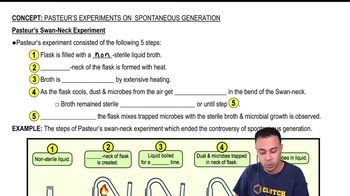
This experiment used a flask with a curved neck to demonstrate that microbes in the air are responsible for contamination. The design allowed air to enter but trapped dust and microbes in the bend, preventing them from reaching the sterile broth inside.
Microbial contamination occurs when microorganisms enter a sterile environment, causing growth and spoilage. Pasteur's experiment showed that without direct contact with microbes trapped in the flask's neck, the broth remained sterile, disproving spontaneous generation.
Air contains microbes attached to dust particles that can cause microbial growth when they settle in nutrient-rich environments. Pasteur's experiment demonstrated that microbes do not spontaneously arise but come from the environment, specifically airborne particles.