Which of the following favored the theory of spontaneous generation? a. Spallanzani b. Needham c. Pasteur d. Koch
Verified step by step guidance
1
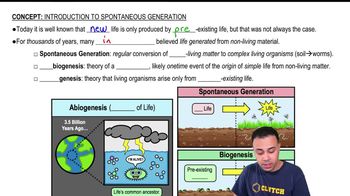
Understand the concept of spontaneous generation: it is the hypothesis that living organisms can arise from nonliving matter spontaneously.
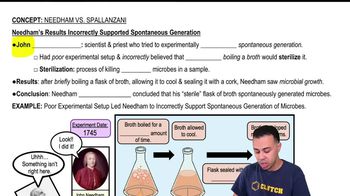
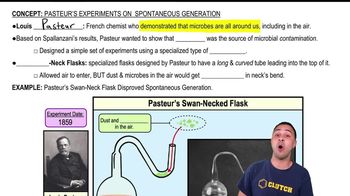
Recall the contributions of each scientist listed: Spallanzani conducted experiments that challenged spontaneous generation by boiling broth to kill microbes; Pasteur disproved spontaneous generation with his swan-neck flask experiment; Koch is known for his postulates related to germ theory; Needham performed experiments that seemed to support spontaneous generation by showing microbial growth in boiled broth.
Identify which scientist's work appeared to support or favor spontaneous generation rather than disproving it.
Focus on Needham's experiments where he boiled broth but still observed microbial growth, which was interpreted as evidence for spontaneous generation at the time.
Conclude that among the options, Needham's work favored the theory of spontaneous generation.
Verified video answer for a similar problem:
This video solution was recommended by our tutors as helpful for the problem above
Video duration:
4m
Play a video:
0 Comments
Key Concepts
Here are the essential concepts you must grasp in order to answer the question correctly.
Theory of Spontaneous Generation
This theory proposed that living organisms could arise spontaneously from non-living matter. It was widely accepted before the development of modern microbiology and was challenged by experiments demonstrating that life comes from pre-existing life.
Needham conducted experiments with boiled broths that he sealed, observing microbial growth afterward. He interpreted this as evidence supporting spontaneous generation, believing that life could arise from non-living fluids.
Opposition to Spontaneous Generation by Pasteur and Spallanzani
Spallanzani and Pasteur performed controlled experiments showing that sterilized broths remained free of microbes unless exposed to contamination. Their work disproved spontaneous generation by demonstrating that microorganisms come from other microorganisms.