Where specifically does the most significant production of ATP occur in prokaryotic and eukaryotic cells?
Ch. 5 - Microbial Metabolism
Bauman6th EditionMicrobiology with Diseases by TaxonomyISBN: 9780134832302Not the one you use?Change textbook
Chapter 5, Problem 11
Coenzymes are _______.
a. Types of apoenzymes
b. Proteins
c. Inorganic cofactors
d. Organic cofactors
Verified step by step guidance1
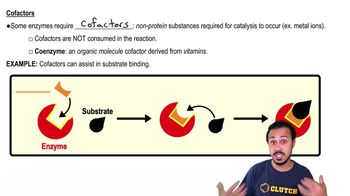
Understand the definition of coenzymes: Coenzymes are non-protein molecules that assist enzymes during the catalysis of reactions.
Recall that enzymes often require additional molecules called cofactors to be active; these cofactors can be inorganic ions or organic molecules.
Differentiate between apoenzymes and holoenzymes: apoenzymes are the protein part of an enzyme without its cofactor, while holoenzymes are the complete, active enzyme with its cofactor.
Identify that coenzymes are a specific type of cofactor that are organic molecules, often derived from vitamins, which temporarily bind to the enzyme to help in the reaction.
Conclude that coenzymes are organic cofactors, which corresponds to option d.

Verified video answer for a similar problem:
This video solution was recommended by our tutors as helpful for the problem above.
Video duration:
1mWas this helpful?
Key Concepts
Here are the essential concepts you must grasp in order to answer the question correctly.
Coenzymes
Coenzymes are organic molecules that bind to enzymes and assist in catalyzing reactions by transferring chemical groups. They are not proteins themselves but work closely with enzymes to enhance their activity.
Recommended video:
Guided course
Cofactors
Apoenzymes and Holoenzymes
An apoenzyme is the protein portion of an enzyme without its cofactor, while a holoenzyme is the complete, active enzyme including its cofactor or coenzyme. Coenzymes are distinct from apoenzymes as they are non-protein organic molecules.
Cofactors: Organic vs Inorganic
Cofactors are non-protein components required for enzyme activity. They can be inorganic ions like metal ions or organic molecules called coenzymes. Coenzymes often act as carriers for chemical groups during enzymatic reactions.
Recommended video:
Guided course
Cofactors
Related Practice
Textbook Question
1220
views
Textbook Question
Activation energy ______.
a. Is the amount of energy required during an activity such as flagellar motion
b. Requires the addition of nutrients in the presence of water
c. Is lowered by the action of organic catalysts
d. Results from the movement of molecules
1431
views
Textbook Question
What happens to the carbon atoms in sugar catabolized by Escherichia coli?
1002
views
Textbook Question
Why do cyanobacteria and algae take in carbon dioxide and give off oxygen?
1427
views
Textbook Question
How do yeast cells make alcohol and cause bread to rise?
1415
views
Textbook Question
Which of the following statements best describes ribozymes?
a. Ribozymes are proteins that aid in the production of ribosomes.
b. Ribozymes are nucleic acids that produce ribose sugars.
c. Ribozymes store enzymes in ribosomes.
d. Ribozymes process RNA molecules in eukaryotes.
1439
views