

Ch. 10 - Classification of Microorganisms
Tortora - Microbiology: An Introduction 14th Edition
Tortora14th EditionMicrobiology: An IntroductionISBN: 9780138200398Not the one you use?Change textbook
Chapter 10, Problem 5

You could identify an unknown bacterium by all of the following except
a. hybridizing a DNA probe from a known bacterium with the unknown’s DNA.
b. making a fatty acid profile of the unknown.
c. specific antiserum agglutinating the unknown.
d. ribosomal RNA sequencing.
e. percentage of guanine + cytosine.

Verified step by step guidance
1
Step 1: Understand the methods listed for identifying bacteria. Each method uses different biological or chemical characteristics to distinguish bacterial species.
Step 2: Review DNA probe hybridization (option a), which involves using a known DNA sequence to find complementary sequences in the unknown bacterium's DNA, a common molecular identification technique.
Step 3: Consider fatty acid profiling (option b), which analyzes the types and proportions of fatty acids in bacterial membranes; this method is used for bacterial identification based on biochemical composition.
Step 4: Examine the use of specific antiserum agglutination (option c), where antibodies bind to bacterial surface antigens causing clumping; this is a serological method for identifying bacteria.
Step 5: Evaluate ribosomal RNA sequencing (option d) and percentage of guanine + cytosine content (option e), both molecular methods that provide genetic information useful for bacterial classification and identification. Determine which method is least likely or not typically used for bacterial identification.

Verified video answer for a similar problem:

This video solution was recommended by our tutors as helpful for the problem above.
Was this helpful?

Key Concepts

Here are the essential concepts you must grasp in order to answer the question correctly.

DNA Probe Hybridization

DNA probe hybridization involves using a labeled DNA fragment from a known organism to detect complementary sequences in an unknown bacterium's DNA. This method helps identify bacteria by confirming genetic similarity or presence of specific genes.
Recommended video:
Guided course
04:01
DNA Polymerases

Fatty Acid Profiling

Fatty acid profiling analyzes the types and proportions of fatty acids in bacterial cell membranes. Since fatty acid composition varies among species, this biochemical method aids in bacterial identification and classification.
Recommended video:

Guanine + Cytosine Content

The percentage of guanine plus cytosine (G+C content) in bacterial DNA reflects the overall nucleotide composition. While useful for broad classification, G+C content alone is insufficient for precise identification of unknown bacteria.
Recommended video:
Guided course
07:21
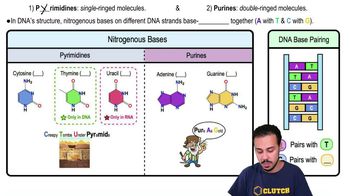
5 Nitrogenous Bases
Related Practice
Textbook Question

Which of the following is false about scientific nomenclature?

a. Each name is specific.

b. Names vary with geographical location.

c. The names are standardized.

d. Each name consists of a genus and specific epithet.

e. It was first designed by Linnaeus.

1652
views
Textbook Question

Use the following choices to answer questions 7 and 8.

a. Animalia

b. Fungi

c. Plantae

d. Bacillota (gram-positive bacteria)

e. Pseudomonadota (gram-negative bacteria)

Into which group would you place a multicellular organism that has a mouth and lives inside the human liver?

846
views
Textbook Question

Use the following choices to answer questions 7 and 8.

a. Animalia

b. Fungi

c. Plantae

d. Bacillota (gram-positive bacteria)

e. Pseudomonadota (gram-negative bacteria)

Into which group would you place a photosynthetic organism that lacks a nucleus and has a thin peptidoglycan wall surrounded by an outer membrane?

1464
views
Textbook Question

The wall-less mycoplasmas are considered to be related to gram-positive bacteria. Which of the following would provide the most compelling evidence for this?

a. They share common rRNA sequences.

b. Some gram-positive bacteria and some mycoplasmas produce catalase.

c. Both groups are prokaryotic.

d. Some gram-positive bacteria and some mycoplasmas have coccus-shaped cells.

e. Both groups contain human pathogens.

1539
views
Textbook Question

Use the key in the Clinical Focus box to identify the gram-negative, oxidase-positive rod causing pneumonia in a sea otter. It is H2S-positive, indole-negative, and urease-positive.

1452
views
Textbook Question

Use the information in the following table to complete the dichotomous key to these organisms. What is the purpose of a dichotomous key? Look up each genus in Chapter 11, and provide an example of why this organism is of interest to humans.

1502
views