
Ch. 10 - Classification of Microorganisms
Tortora - Microbiology: An Introduction 14th Edition
Tortora14th EditionMicrobiology: An IntroductionISBN: 9780138200398Not the one you use?Change textbook
Chapter 10, Problem 4

Which of the following is false about scientific nomenclature?
a. Each name is specific.
b. Names vary with geographical location.
c. The names are standardized.
d. Each name consists of a genus and specific epithet.
e. It was first designed by Linnaeus.

Verified step by step guidance
1
Step 1: Understand the concept of scientific nomenclature, which is the system used to name organisms universally to avoid confusion caused by local or common names.
Step 2: Review each statement carefully: (a) Each name is specific, meaning it uniquely identifies a species; (b) Names vary with geographical location, implying that names change depending on where you are; (c) The names are standardized, meaning they follow a universal set of rules; (d) Each name consists of a genus and specific epithet, which is the binomial nomenclature system; (e) It was first designed by Linnaeus, who established the modern system of naming organisms.
Step 3: Recall that scientific names do not vary with geographical location because the purpose of scientific nomenclature is to provide a consistent and universal naming system worldwide.
Step 4: Identify that the false statement is the one claiming that names vary with geographical location, as this contradicts the principle of standardization in scientific nomenclature.
Step 5: Conclude that option (b) is false, while the other options correctly describe aspects of scientific nomenclature.

Verified video answer for a similar problem:

This video solution was recommended by our tutors as helpful for the problem above.
Was this helpful?

Key Concepts

Here are the essential concepts you must grasp in order to answer the question correctly.

Scientific Nomenclature

Scientific nomenclature is a standardized system for naming organisms, ensuring each species has a unique and universally accepted name. This system avoids confusion caused by local or common names and allows clear communication among scientists worldwide.
Recommended video:
Guided course
06:29
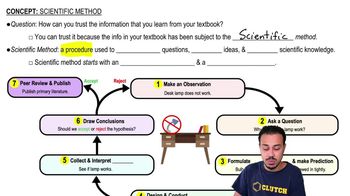
Scientific Method

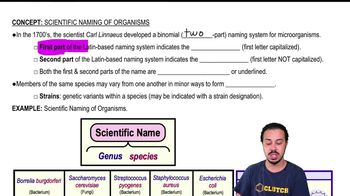
Binomial Nomenclature

Binomial nomenclature is the formal system of naming species using two parts: the genus name and the specific epithet. This two-part name uniquely identifies each species and was introduced by Carl Linnaeus in the 18th century.
Recommended video:
Guided course
05:22
Scientific Naming of Organisms

Standardization and Universality of Names

Scientific names are standardized and governed by international codes, such as the International Code of Nomenclature, to maintain consistency. These names do not vary by geographical location, ensuring that scientists globally use the same terms for the same organisms.
Recommended video:
Guided course
05:19
Properties of Water- The Universal Solvent
Related Practice
Textbook Question

Which of the following is used to classify organisms into the Kingdom Fungi?

a. Ability to photosynthesize; possess a cell wall

b. Unicellular; possess cell wall; prokaryotic

c. Unicellular; lacking cell wall; eukaryotic

d. Absorptive; possess cell wall; eukaryotic

e. Ingestive; lacking cell wall; multicellular; prokaryotic

1602
views
Textbook Question

Use the key in the Clinical Focus box to identify the gram-negative, oxidase-positive rod causing pneumonia in a sea otter. It is H2S-positive, indole-negative, and urease-positive.

1452
views
Textbook Question

You could identify an unknown bacterium by all of the following except

a. hybridizing a DNA probe from a known bacterium with the unknown’s DNA.

b. making a fatty acid profile of the unknown.

c. specific antiserum agglutinating the unknown.

d. ribosomal RNA sequencing.

e. percentage of guanine + cytosine.

1599
views
Textbook Question

Here is some additional information on the organisms in question 1:

Which of these organisms are most closely related? Compare this answer with your response to review question 1.

1279
views
Textbook Question

DRAW IT Use the following rRNA information to construct a cladogram for some of the organisms used in question 4. What is the purpose of a cladogram? How does your cladogram differ from a dichotomous key for these organisms?

1361
views
Textbook Question

Use the information in the following table to complete the dichotomous key to these organisms. What is the purpose of a dichotomous key? Look up each genus in Chapter 11, and provide an example of why this organism is of interest to humans.

1502
views