
Ch. 8 - Microbial Genetics
Tortora - Microbiology: An Introduction 14th Edition
Tortora14th EditionMicrobiology: An IntroductionISBN: 9780138200398Not the one you use?Change textbook
Chapter 8, Problem 5

Suppose you inoculate three flasks of minimal salts broth with E. coli. Flask A contains glucose. Flask B contains glucose and lactose. Flask C contains lactose. After a few hours of incubation, you test the flasks for the presence of ß-galactosidase. Which flask(s) do you predict will have this enzyme?
a. A
b. B
c. C
d. A and B
e. B and C

Verified step by step guidance
1
Understand the role of ß-galactosidase: This enzyme is responsible for breaking down lactose into glucose and galactose, and it is typically produced by E. coli when lactose is present and glucose is absent or low.
Recall the concept of catabolite repression: When glucose is available, E. coli preferentially uses it and represses the production of enzymes like ß-galactosidase that are involved in metabolizing other sugars such as lactose.
Analyze Flask A (glucose only): Since glucose is present, ß-galactosidase production is repressed, so it is unlikely to be produced in this flask.
Analyze Flask B (glucose and lactose): Because glucose is present, catabolite repression will likely inhibit ß-galactosidase production despite the presence of lactose.
Analyze Flask C (lactose only): With no glucose present, the lac operon is induced, leading to the production of ß-galactosidase to metabolize lactose.

Verified video answer for a similar problem:

This video solution was recommended by our tutors as helpful for the problem above.
Video duration:
2m
Was this helpful?

Key Concepts

Here are the essential concepts you must grasp in order to answer the question correctly.

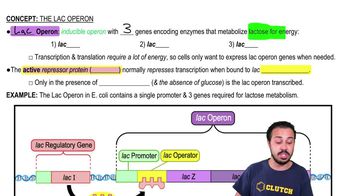
Lac Operon Regulation

The lac operon in E. coli controls the production of ß-galactosidase, an enzyme that breaks down lactose. It is activated only when lactose is present and glucose is absent or low, allowing the bacteria to utilize lactose as an energy source.
Recommended video:
Guided course
07:06
The Lac Operon

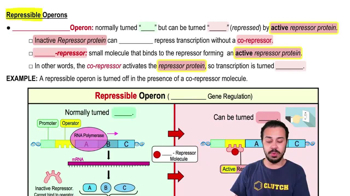
Catabolite Repression

Catabolite repression is a regulatory mechanism where the presence of glucose inhibits the expression of genes involved in metabolizing other sugars like lactose. When glucose is available, E. coli suppresses ß-galactosidase production to prioritize glucose metabolism.
Recommended video:
Guided course
03:42
Repressible Operons

Role of ß-galactosidase

ß-galactosidase is an enzyme encoded by the lacZ gene that hydrolyzes lactose into glucose and galactose. Its presence indicates that the lac operon is active, enabling E. coli to metabolize lactose when glucose is not the preferred sugar.
Recommended video:
Guided course
01:25
Importance of Microorganisms
Related Practice
Textbook Question

Identify when (before transcription, after transcription but before translation, after translation) each of the following regulatory mechanisms functions.

a. ATP combines with an enzyme, altering its shape.

b. A short RNA is synthesized that is complementary to mRNA.

c. Methylation of DNA occurs.

d. An inducer combines with a repressor.

1290
views
Textbook Question

The following is a code for a strand of DNA.

a. Using the genetic code provided in Figure 8.8, fill in the blanks to complete the segment of DNA shown.

b. Fill in the blanks to complete the sequence of amino acids coded for by this strand of DNA.

c. Write the code for the complementary strand of DNA completed in part (a).

d. What would be the effect if C were substituted for T at base 10?

e. What would be the effect if A were substituted for G at base 11?

f. What would be the effect if G were substituted for T at base 14?

g. What would be the effect if C were inserted between bases 9 and 10?

h. How would UV radiation affect this strand of DNA?

i. Identify a nonsense sequence in this strand of DNA.

1491
views
Textbook Question

Feedback inhibition differs from repression because feedback inhibition

a. Is less precise.

b. Is slower acting.

c. Stops the action of preexisting enzymes.

d. Stops the synthesis of new enzymes.

e. All of the above

1003
views
Textbook Question

Which sequence is the best target for damage by UV radiation: AGGCAA, CTTTGA, or GUAAAU? Why aren’t all bacteria killed when they are exposed to sunlight?

1621
views
Textbook Question

Plasmids differ from transposons in that plasmids

a. become inserted into chromosomes.

b. are self-replicated outside the chromosome.

c. move from chromosome to chromosome.

d. carry genes for antibiotic resistance.

e. none of the above

1457
views
Textbook Question

Bacteria can acquire antibiotic resistance by all of the following except

a. mutation.

b. insertion of transposons.

c. conjugation.

d. snRNPs.

e. transformation.

1881
views