
Ch. 4 - Functional Anatomy of Prokaryotic and Eukaryotic Cells
Tortora - Microbiology: An Introduction 14th Edition
Tortora14th EditionMicrobiology: An IntroductionISBN: 9780138200398Not the one you use?Change textbook
Chapter 4, Problem 5

Why is an endospore called a resting structure? Of what advantage is an endospore to a bacterial cell?

Verified step by step guidance
1
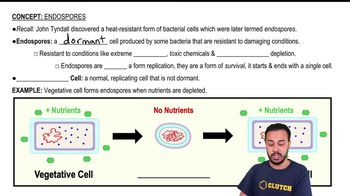
Understand that an endospore is called a resting structure because it is a dormant, non-reproductive form of the bacterial cell that can survive extreme environmental conditions.
Recognize that during unfavorable conditions such as nutrient depletion, heat, desiccation, or chemical exposure, the bacterial cell forms an endospore to protect its genetic material.
Note that the endospore has a tough outer coating made of keratin and other protective layers that make it highly resistant to physical and chemical damage.
Realize that the advantage of an endospore to a bacterial cell is that it allows the bacterium to survive harsh conditions that would normally kill the vegetative cell, ensuring the survival of the species.
Finally, understand that when conditions become favorable again, the endospore can germinate and return to its active, vegetative state, allowing the bacterium to grow and reproduce.

Verified video answer for a similar problem:

This video solution was recommended by our tutors as helpful for the problem above.
Video duration:
2m
Was this helpful?

Key Concepts

Here are the essential concepts you must grasp in order to answer the question correctly.

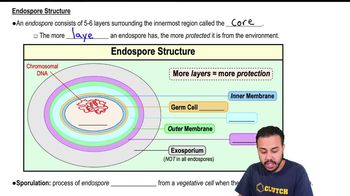
Endospore Structure and Formation

An endospore is a tough, dormant structure formed inside some bacterial cells during unfavorable conditions. It has multiple protective layers, including a thick cortex and spore coat, which shield the genetic material from heat, desiccation, chemicals, and radiation.
Recommended video:
Guided course
03:08
Endospore Structure

Resting or Dormant State

Endospores are called resting structures because they enter a metabolically inactive state, halting growth and reproduction. This dormancy allows bacteria to survive extreme environmental stresses until conditions improve.
Recommended video:
Guided course
04:09
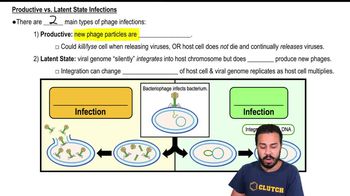
Productive vs. Latent State Infections

Survival Advantage of Endospores

The formation of endospores provides bacteria with a survival advantage by enabling them to withstand harsh environments such as nutrient depletion, heat, and toxins. Once favorable conditions return, the endospore can germinate back into a active bacterial cell.
Recommended video:
Related Practice
Textbook Question

Which of the following is false about fimbriae?

a. They are composed of protein.

b. They may be used for attachment.

c. They are found on gram-negative cells.

d. They are composed of pilin.

e. They may be used for motility.

1540
views
Textbook Question

Compare and contrast the following:

a. Simple diffusion and facilitated diffusion

b. Active transport and facilitated diffusion

c. Active transport and group translocation

1392
views
Textbook Question

Match the structures in column A to their functions in column B.

1630
views
Textbook Question

Use the following choices to answer the following question.

a. No change will result; the solution is isotonic.

b. Water will move into the cell.

c. Water will move out of the cell.

d. The cell will undergo osmotic lysis.

e. Sucrose will move into the cell from an area of higher concentration to one of lower concentration.


Which statement best describes what happens when a gram-negative bacterium is placed in distilled water and penicillin?

764
views
Textbook Question

Which of the following statements best describes what happens to a cell exposed to polymyxins that destroy phospholipids?

a. In an isotonic solution, nothing will happen.

b. In a hypotonic solution, the cell will lyse.

c. Water will move into the cell.

d. Intracellular contents will leak from the cell.

e. Any of the above might happen.

1392
views
Textbook Question

Use the following choices to answer the following question.

a. No change will result; the solution is isotonic.

b. Water will move into the cell.

c. Water will move out of the cell.

d. The cell will undergo osmotic lysis.

e. Sucrose will move into the cell from an area of higher concentration to one of lower concentration.


Which statement best describes what happens when a gram-positive bacterium is placed in an aqueous solution of lysozyme and 10% sucrose?

870
views