Ch. 6 - Viruses and Prions
Norman-McKay- Microbiology: Basic and Clinical Principles 2nd Edition
Norman-McKay2nd EditionMicrobiology: Basic and Clinical PrinciplesISBN: 9780137661619Not the one you use?Change textbook
Chapter 6, Problem 9

Which of the following could inform you if your patient had a previous infection with a nonpersistent virus and recovered? Select all that apply.
a. A PCR test
b. A plaque assay
c. An ELISA test
d. An agglutination assay

Verified step by step guidance
1
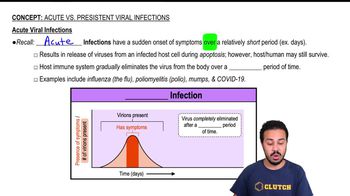
Step 1: Understand the nature of the virus and the tests. A nonpersistent virus is one that the immune system clears completely after infection, so the virus itself is no longer present in the body after recovery.
Step 2: Consider what each test detects. A PCR test detects viral genetic material, which would only be present if the virus is currently in the body, not after recovery from a nonpersistent virus.
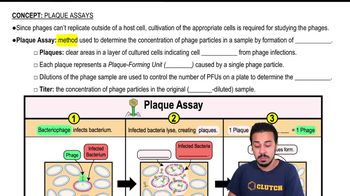
Step 3: A plaque assay measures active, infectious virus particles by counting plaques formed on a cell layer, so it also indicates current infection rather than past infection.
Step 4: An ELISA test detects antibodies produced by the immune system in response to the virus. Since antibodies can remain after the virus is cleared, ELISA can indicate previous infection and recovery.
Step 5: An agglutination assay also detects antibodies or antigens by clumping reactions, so it can be used to detect antibodies indicating past infection as well.

Verified video answer for a similar problem:

This video solution was recommended by our tutors as helpful for the problem above.
Video duration:
3m
Was this helpful?

Key Concepts

Here are the essential concepts you must grasp in order to answer the question correctly.

Nonpersistent Viral Infection and Immune Memory

Nonpersistent viruses cause infections that the immune system clears completely, leaving no ongoing infection. However, the body often retains immune memory through antibodies, which can be detected to indicate past exposure and recovery.
Recommended video:
Guided course
03:29
Acute Viral Infections

PCR Test for Viral Detection

Polymerase Chain Reaction (PCR) detects viral genetic material, indicating current infection. It cannot confirm past infections once the virus is cleared, as no viral DNA or RNA remains in the body.
Recommended video:
Guided course
06:59
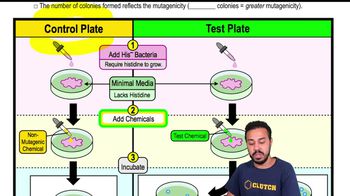
The Ames Test

Serological Tests (ELISA and Agglutination Assays)

Serological tests like ELISA and agglutination detect antibodies produced in response to infection. These antibodies persist after recovery, making these tests useful for identifying previous infections with nonpersistent viruses.
Recommended video:
Guided course
04:21
Plaque Assays