
Textbook Question
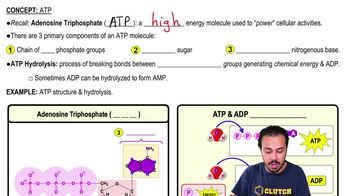
Which of the following compounds has the greatest amount of energy for a cell?
a. CO2
b. ATP
c. glucose
d. O2
e. lactic acid
1023
views

 Verified step by step guidance
 01:37
01:37
 07:51
07:51Which of the following compounds has the greatest amount of energy for a cell?
a. CO2
b. ATP
c. glucose
d. O2
e. lactic acid
All of the energy-producing biochemical reactions that occur in cells, such as photophosphorylation and glycolysis, are ________ reactions.
Use the following choices to answer the question.
a. E. coli growing in glucose broth at 35℃ with O2 for 5 days
b. E. coli growing in glucose broth at 35℃ without O2 for 5 days
c. Both a and b
d. Neither a nor b
Which culture produces the most lactic acid?
Define oxidation-reduction, and differentiate the following terms:
a. Aerobic and anaerobic respiration
b. Respiration and fermentation
c. Cyclic and noncyclic photophosphorylation
There are three mechanisms for the phosphorylation of ADP to produce ATP. Write the name of the mechanism that describes each of the reactions in the following table.
Which of the following is the best definition of cellular respiration?
a. A sequence of redox reactions with O2 as the final electron acceptor
b. A sequence of redox reactions with the final electron acceptor from the environment
c. A method of generating ATP
d. The complete oxidation of glucose to CO2 and H2O
e. A series of reactions in which pyruvic acid is oxidized to CO2 and H2O