Explain how the polarity of water molecules makes water an excellent solvent.
Verified step by step guidance
1
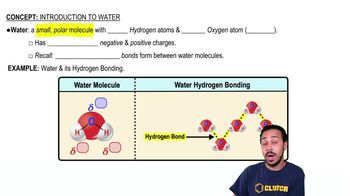
Understand that water molecules are polar because of the difference in electronegativity between oxygen and hydrogen atoms, where oxygen has a partial negative charge (δ-) and hydrogen atoms have partial positive charges (δ+).
Recognize that this polarity allows water molecules to interact with other charged or polar substances by surrounding and separating their ions or molecules.
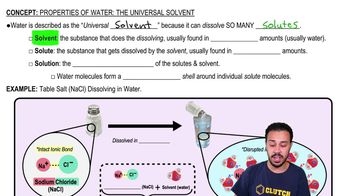
Explain that when an ionic compound dissolves in water, the positive ends of water molecules are attracted to the negative ions, and the negative ends are attracted to the positive ions, effectively pulling the ions apart.
Describe how this interaction between water molecules and solute particles prevents the solute from recombining, keeping it dispersed evenly throughout the solution.
Conclude that this ability to dissolve many ionic and polar substances makes water an excellent solvent, often called the 'universal solvent' in biological systems.
Verified video answer for a similar problem:
This video solution was recommended by our tutors as helpful for the problem above
Video duration:
3m
Play a video:
0 Comments
Key Concepts
Here are the essential concepts you must grasp in order to answer the question correctly.
Polarity of Water Molecules
Water molecules have a polar structure because oxygen is more electronegative than hydrogen, creating a partial negative charge near oxygen and partial positive charges near hydrogens. This uneven charge distribution allows water to interact with other charged or polar substances.
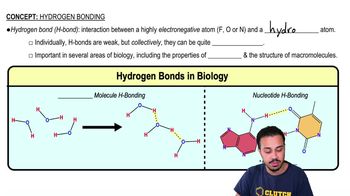
The polarity of water enables hydrogen bonds to form between water molecules and other polar molecules or ions. These bonds help break apart solutes by surrounding and separating their particles, facilitating dissolution.
Water’s polarity allows it to dissolve many ionic and polar substances by stabilizing their charged particles in solution. This makes water an excellent solvent, essential for biological processes where solutes must be transported or chemically reacted.