Ch. 5 - Microbial Metabolism
Tortora - Microbiology: An Introduction 14th Edition
Tortora14th EditionMicrobiology: An IntroductionISBN: 9780138200398Not the one you use?Change textbook
Chapter 5, Problem 1

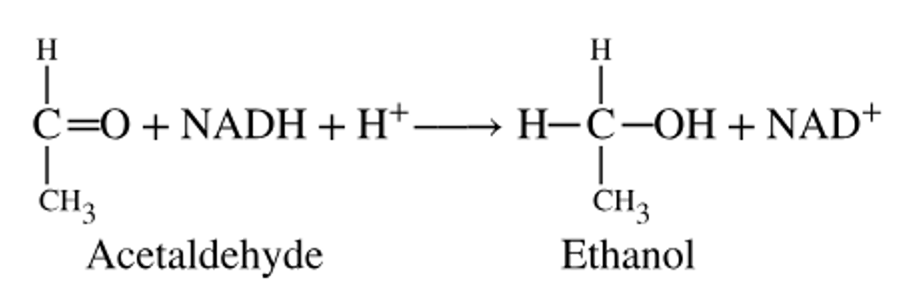
Which substance in the following reaction is being reduced?
Chemical reaction showing acetaldehyde converted to ethanol with NADH oxidized to NAD⁺ and H⁺ involved.
a. Acetaldehyde
b. NADH
c. Ethanol
d. NAD+

Verified step by step guidance
1
Identify the reactants and products involved in the reaction. Typically, in biochemical redox reactions involving NADH and NAD⁺, one molecule is oxidized and the other is reduced.
Recall the definitions: Reduction is the gain of electrons (or hydrogen atoms), and oxidation is the loss of electrons (or hydrogen atoms).
Determine which substance gains electrons or hydrogen atoms during the reaction. NADH usually acts as an electron donor (reducing agent), and NAD⁺ acts as an electron acceptor (oxidizing agent).
Look at the transformation of acetaldehyde and ethanol. Acetaldehyde can be reduced to ethanol by gaining hydrogen atoms, while ethanol can be oxidized to acetaldehyde by losing hydrogen atoms.
Conclude which substance is reduced by identifying the molecule that gains hydrogen atoms or electrons in the reaction, based on the roles of NADH/NAD⁺ and the conversion between acetaldehyde and ethanol.

Verified video answer for a similar problem:

This video solution was recommended by our tutors as helpful for the problem above.
Video duration:
1m
Was this helpful?

Key Concepts

Here are the essential concepts you must grasp in order to answer the question correctly.

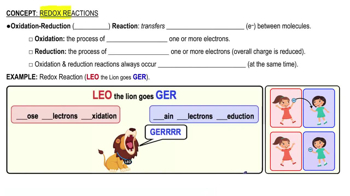
Oxidation-Reduction (Redox) Reactions

Redox reactions involve the transfer of electrons between molecules, where one substance is oxidized (loses electrons) and another is reduced (gains electrons). Identifying which molecule gains electrons helps determine the reduced substance.
Recommended video:
Guided course
04:47
Redox Reactions

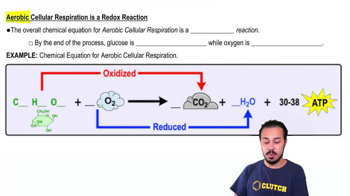
Role of NAD⁺/NADH in Cellular Reactions

NAD⁺ acts as an electron acceptor, becoming reduced to NADH by gaining electrons. Conversely, NADH can donate electrons and be oxidized back to NAD⁺. Understanding this cycle is key to identifying which molecule is reduced or oxidized.
Recommended video:
Guided course
04:18
Aerobic Cellular Respiration is a Redox Reaction

Reduction of Carbonyl Compounds to Alcohols

In biochemical reactions, aldehydes like acetaldehyde can be reduced to alcohols such as ethanol by gaining electrons (usually from NADH). Recognizing this transformation helps pinpoint the reduced substance in the reaction.
Recommended video: