

Why is cloning a practical technique for medical researchers?
Verified step by step guidance
1
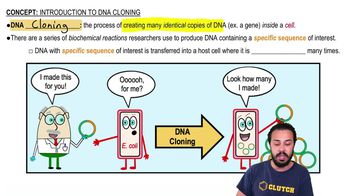
Understand that cloning in medical research refers to creating genetically identical copies of cells, tissues, or organisms, which allows researchers to study specific genes or biological processes in a controlled way.
Recognize that cloning enables the production of large quantities of identical cells or proteins, which is essential for experiments requiring consistency and reproducibility.
Consider that cloning helps in studying genetic diseases by allowing researchers to isolate and analyze the effects of particular genes without interference from genetic variability.
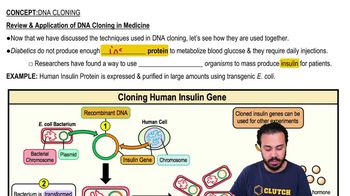
Note that cloning can be used to produce genetically modified organisms or cells that express therapeutic proteins, aiding in drug development and gene therapy research.
Appreciate that cloning provides a practical way to test medical treatments and understand disease mechanisms by using uniform biological material, reducing experimental variability.
Verified video answer for a similar problem:
This video solution was recommended by our tutors as helpful for the problem above
Video duration:
4m
Play a video:
0 Comments
Key Concepts
Here are the essential concepts you must grasp in order to answer the question correctly.
Cloning Definition and Types
Cloning is the process of producing genetically identical organisms or cells. It includes reproductive cloning, which creates a whole organism, and therapeutic cloning, which generates specific cells or tissues for research or treatment. Understanding these types helps clarify cloning's applications in medicine.
Cloning provides genetically identical cells or organisms, eliminating genetic variability. This consistency allows researchers to study diseases, drug effects, and biological processes under controlled conditions, improving the reliability and reproducibility of experimental results.
Cloning enables the production of specific cell types for regenerative medicine, drug testing, and understanding genetic diseases. It facilitates the development of personalized therapies and advances in stem cell research, making it a practical tool for medical breakthroughs.