Ch. 8 - Microbial Metabolism
Norman-McKay- Microbiology: Basic and Clinical Principles 2nd Edition
Norman-McKay2nd EditionMicrobiology: Basic and Clinical PrinciplesISBN: 9780137661619Not the one you use?Change textbook
Chapter 8, Problem 2

Indicate the true statements about ATP, and then reword the false statements so that they are true.
a. ATP is made using anabolic reactions.
b. Substrate-level phosphorylation converts ATP to ADP.
c. ATP is commonly used by cells to store energy.
d. ATP is used to jump-start cellular respiration.
e. Catabolic reactions are used to make ATP.
f. In cellular respiration, the most ATP is made by glycolysis.
g. ATP can be made by phosphorylating ADP.

Verified step by step guidance
1
Step 1: Analyze statement (a): 'ATP is made using anabolic reactions.' Understand that anabolic reactions build complex molecules and generally consume ATP rather than produce it. Therefore, ATP is typically produced by catabolic reactions, not anabolic ones.
Step 2: Analyze statement (b): 'Substrate-level phosphorylation converts ATP to ADP.' Recall that substrate-level phosphorylation is a process that generates ATP by transferring a phosphate group to ADP, so it actually converts ADP to ATP, not the other way around.
Step 3: Analyze statement (c): 'ATP is commonly used by cells to store energy.' Recognize that ATP is more of an energy currency used for immediate energy transfer rather than long-term energy storage; cells store energy in molecules like fats or glycogen.
Step 4: Analyze statement (d): 'ATP is used to jump-start cellular respiration.' Consider that cellular respiration produces ATP rather than requiring ATP to start; however, some initial ATP investment is needed in glycolysis, so clarify this point carefully.
Step 5: Analyze statements (e), (f), and (g): (e) 'Catabolic reactions are used to make ATP' is true because catabolism breaks down molecules to release energy for ATP synthesis; (f) 'In cellular respiration, the most ATP is made by glycolysis' is false since the majority of ATP is produced in the electron transport chain, not glycolysis; (g) 'ATP can be made by phosphorylating ADP' is true, as adding a phosphate group to ADP forms ATP.

Verified video answer for a similar problem:

This video solution was recommended by our tutors as helpful for the problem above.
Video duration:
3m
Was this helpful?

Key Concepts

Here are the essential concepts you must grasp in order to answer the question correctly.

ATP Synthesis and Energy Metabolism

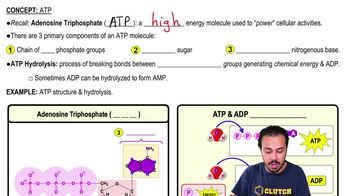
ATP (adenosine triphosphate) is primarily produced through catabolic reactions that break down molecules to release energy. This energy is then used to phosphorylate ADP, forming ATP. Anabolic reactions generally consume ATP rather than produce it.
Recommended video:

Substrate-Level Phosphorylation vs. Oxidative Phosphorylation

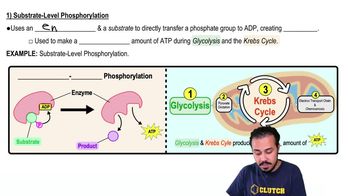
Substrate-level phosphorylation directly transfers a phosphate group to ADP to form ATP during glycolysis and the Krebs cycle. It does not convert ATP to ADP; rather, it synthesizes ATP. Oxidative phosphorylation, occurring in the mitochondria, produces the majority of ATP in cellular respiration.
Recommended video:
Guided course
03:00
Substrate-Level Phosphorylation

Role and Function of ATP in Cells

ATP serves as the main energy currency in cells, providing energy for various biological processes. It is not a long-term energy storage molecule; instead, cells store energy in molecules like fats and carbohydrates. ATP also helps initiate cellular respiration by providing energy for early metabolic steps.
Recommended video: