 Back
BackA Brief History of Microbiology: Foundations and Key Discoveries
Study Guide - Smart Notes
 Tailored notes based on your materials, expanded with key definitions, examples, and context.
The Early Years of Microbiology
What Does Life Really Look Like?
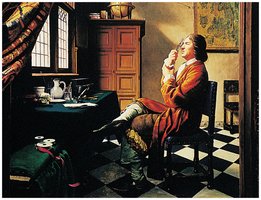
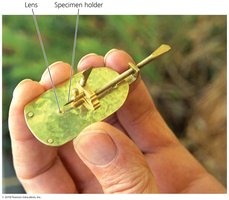
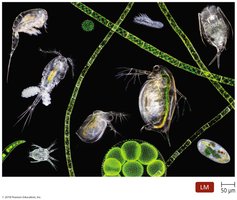
The field of microbiology began with the observation of microscopic life forms, which were previously unknown to science. Antoni van Leeuwenhoek was a pioneering figure who constructed simple microscopes and was the first to observe and describe microorganisms, which he called "animalcules." His work laid the foundation for the study of microbiology.
How Can Microbes Be Classified?
Classification of microbes is essential for understanding their diversity and relationships. Carolus Linnaeus developed a taxonomic system for naming and grouping organisms. Leeuwenhoek’s microorganisms are now classified into six major categories:
Bacteria
Archaea
Fungi
Protozoa
Algae
Small multicellular animals
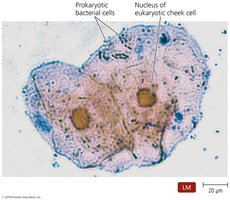
Bacteria and Archaea
Unicellular and lack nuclei (prokaryotic)
Smaller than eukaryotes
Found in diverse environments, including extreme conditions
Reproduce asexually
Bacterial cell walls contain peptidoglycan; archaeal cell walls are made of other polymers
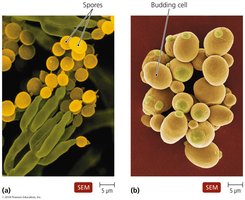
Fungi
Eukaryotic (contain a membrane-bound nucleus)
Obtain nutrients from other organisms
Possess cell walls
Types:
Molds: Multicellular, filamentous, reproduce by spores
Yeasts: Unicellular, reproduce by budding or spores
Protozoa
Single-celled eukaryotes
Similar to animals in nutrient needs and structure
Live in water or as parasites
Reproduce asexually (mostly) and sexually
Motility structures:
Pseudopods: Extensions of the cell for movement
Cilia: Short, numerous projections
Flagella: Long, whip-like extensions

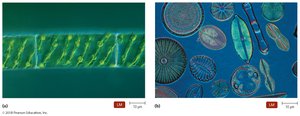
Algae
Unicellular or multicellular
Photosynthetic
Simple reproductive structures
Categorized by pigmentation and cell wall composition
Other Organisms of Importance
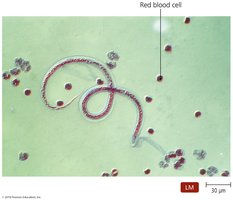
Parasites: Multicellular organisms, often with complex life cycles
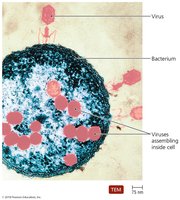
Viruses: Acellular entities, require host cells for replication
The Golden Age of Microbiology
Major Questions Addressed
During the Golden Age, scientists sought answers to four fundamental questions:
Is spontaneous generation of microbial life possible?
What causes fermentation?
What causes disease?
How can we prevent infection and disease?
Does Microbial Life Spontaneously Generate?
The theory of spontaneous generation (abiogenesis) proposed that living organisms could arise from nonliving matter. This idea was challenged through a series of experiments:
Redi’s experiments: Showed that maggots do not develop in meat isolated from flies, casting doubt on spontaneous generation.
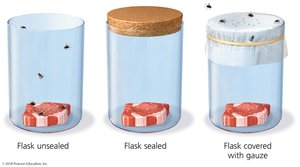
Needham’s experiments: Supported spontaneous generation for microbes, but were later found to have methodological flaws.
Spallanzani’s experiments: Contradicted Needham, showing that microbes do not arise spontaneously if contamination is prevented.
Pasteur’s experiments: Used swan-necked flasks to demonstrate that microbes come from the air and do not spontaneously generate.
The Scientific Method
The debate over spontaneous generation contributed to the development of the scientific method:
Observation leads to a question
Question generates a hypothesis
Hypothesis is tested by experiments
Results support or refute the hypothesis
Supported hypotheses become theories or laws; unsupported ones are rejected or modified

What Causes Fermentation?
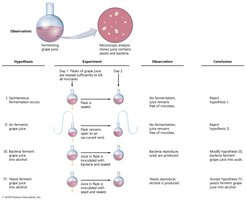
Fermentation was a critical process for industries such as winemaking. Competing theories suggested that air or living organisms caused fermentation. Pasteur’s experiments demonstrated that specific microbes are responsible for fermentation, leading to the development of pasteurization (heating to kill unwanted microbes) and the field of industrial microbiology.
Industrial Uses of Microbes
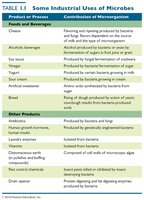
Microbes are used in the production of foods, beverages, and other products. The following table summarizes some industrial applications:
Product or Process | Contribution of Microorganisms |
|---|---|
Bread | Rising of dough by yeast fermentation |
Cheese | Flavoring and ripening by bacteria and fungi |
Alcoholic beverages | Fermentation by yeasts |
Antibiotics | Produced by fungi and bacteria |
Laundry enzymes | Isolated from bacteria |
Drain opener | Produced by bacteria for digesting organic matter |
Other products | Includes vitamins, pest control, and more |
Buchner’s Experiments and Biochemistry
Buchner demonstrated that fermentation does not require living cells but is driven by enzymes, leading to the field of biochemistry.
What Causes Disease?
Pasteur developed the germ theory of disease, proposing that specific diseases are caused by specific microorganisms (pathogens). Robert Koch further established the link between microbes and disease through his experiments and the development of Koch’s postulates:
The suspected agent must be found in every case of the disease and absent from healthy hosts.
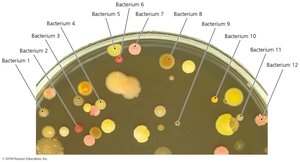
The agent must be isolated and grown outside the host.
When introduced to a healthy host, the agent must cause the disease.
The same agent must be found in the newly diseased host.
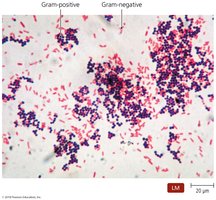
Gram’s Stain
The Gram stain is a differential staining technique that distinguishes between Gram-positive and Gram-negative bacteria, aiding in identification and classification.
How Can We Prevent Infection and Disease?
Several scientists contributed to infection control and disease prevention:
Semmelweis: Advocated handwashing
Lister: Developed antiseptic techniques
Nightingale: Advanced nursing and hygiene
Snow: Pioneered infection control and epidemiology
Jenner: Developed vaccination (immunology)
Ehrlich: Searched for "magic bullets" (chemotherapy)
Fields of Microbiology
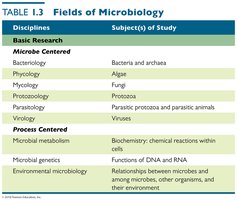
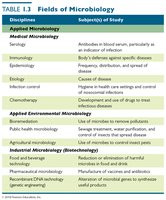
Microbiology has diversified into many fields, including:
Discipline | Subject(s) of Study |
|---|---|
Bacteriology | Bacteria and archaea |
Mycology | Fungi |
Virology | Viruses |
Immunology | Body’s defenses against pathogens |
Microbial genetics | Functions of DNA and RNA |
Industrial microbiology | Production of useful products |
The Modern Age of Microbiology
What Are the Basic Chemical Reactions of Life?
Biochemistry emerged from studies on fermentation and enzymes. Microbes serve as model systems for understanding biochemical reactions, with applications in medicine, agriculture, and industry.
How Do Genes Work?
Microbial genetics: Study of how genes control cell function and inheritance
Molecular biology: Explains cell function at the molecular level; gene sequences reveal evolutionary relationships
Recombinant DNA technology: Manipulation of genes for practical applications (e.g., production of human proteins in bacteria)
Gene therapy: Insertion or repair of genes in humans to treat diseases
What Role Do Microorganisms Play in the Environment?
Bioremediation: Use of microbes to detoxify polluted environments
Microbes recycle essential elements (carbon, nitrogen, sulfur)
Some microbes cause disease in plants and animals
How Do We Defend Against Disease?
Serology: Study of blood serum and immune responses
Immunology: Study of the body’s defenses against pathogens
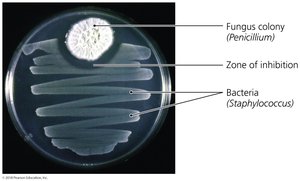
Chemotherapy: Use of chemicals to treat disease (e.g., antibiotics like penicillin)
The Future of Microbiology
Microbiology continues to evolve, with many modern questions focusing on genetics, molecular biology, and the application of microbes in health, industry, and the environment.
