 Back
BackAdaptive Immunity and Immunization: The Third Line of Host Defense
Study Guide - Smart Notes
 Tailored notes based on your materials, expanded with key definitions, examples, and context.
Adaptive Immunity: The Third and Final Line of Defense
Overview of Adaptive Immunity
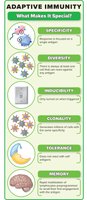
Adaptive immunity is a highly specialized and specific defense mechanism that develops after exposure to antigens through infection or vaccination. It is characterized by the ability to recognize and remember specific pathogens, providing long-lasting protection.
Immunocompetence: The ability of the immune system to respond to a vast array of foreign substances.
B and T lymphocytes: Undergo selection to react only with specific antigens.
Key Terms
Antigen: Any molecule recognized by the immune system; usually proteins or polysaccharides on cells or viruses.
Immunogen: An antigen that provokes an immune response.
Epitope: The specific part of an antigen recognized by immune cells.
Characteristics of Specific Immunity
Specificity: Immune responses are tailored to distinct antigens.
Memory: Lymphocytes retain information about previous encounters, enabling rapid responses upon re-exposure.
Stages of the Adaptive Immune Response
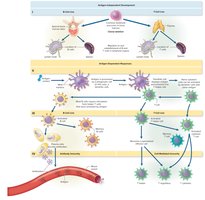
Four Stages
Lymphocyte development and clonal deletion
Antigen presentation and clonal selection
Challenge of B and T lymphocytes by antigens
Effector responses: T-cell mediated immunity and antibody production by B cells
Major Histocompatibility Complex (MHC) and Cell Markers
Role of Cell Markers
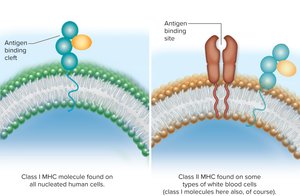
Cell surface markers are essential for detection, recognition, and communication between immune cells. The major histocompatibility complex (MHC) encodes glycoproteins that help the immune system distinguish self from non-self.
MHC Class I: Present on all nucleated cells; involved in self-recognition and regulation of immune responses.
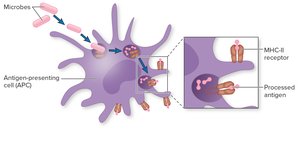
MHC Class II: Present on antigen-presenting cells (APCs) such as macrophages, dendritic cells, and B cells; present antigens to T cells.
MHC Class III: Encode components of the complement system.
CD Molecules
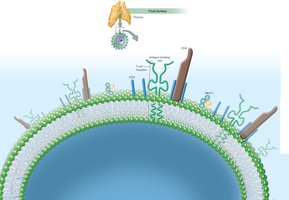
CD (Cluster of Differentiation): Naming system for cell surface markers; over 400 identified.
Key examples: CD3 (T-cell receptor complex), CD4 (T helper cells), CD8 (cytotoxic T cells).
Lymphocyte Development and Diversity
B and T Cell Maturation
B cells: Mature in the bone marrow.
T cells: Mature in the thymus.
Both migrate to lymphoid organs and recirculate throughout the body.
Surface Markers and Receptors
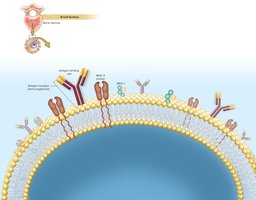
B-cell receptors (BCR): Bind directly to antigens.
T-cell receptors (TCR): Bind antigens presented with MHC molecules.
Generation of Diversity
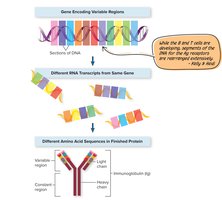
Each B and T cell is genetically programmed to recognize a unique antigen. Diversity is generated by gene rearrangement, allowing the immune system to recognize millions of different antigens.
Clonal Selection and Deletion
Clonal Selection
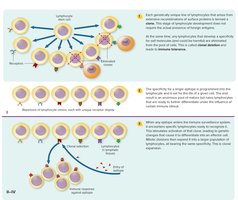
When an antigen enters the body, only the lymphocyte with the matching receptor is activated, proliferates, and differentiates into effector and memory cells.
Clonal Deletion
Lymphocytes that recognize self-antigens are eliminated during development to prevent autoimmunity.
Antigen Presentation and Immunogenicity
Antigen Presentation
Antigen-presenting cells (APCs) such as dendritic cells, macrophages, and B cells process and present antigens to T cells using MHC molecules. This step is crucial for initiating adaptive immune responses.
Immunogenicity
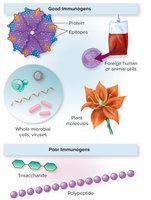
Good immunogens: Large, complex molecules such as proteins and polysaccharides.
Poor immunogens: Small, repetitive molecules like glycogen.
T Cell Responses
T Helper (CD4+) Cells
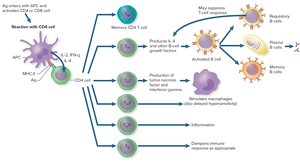
T helper cells regulate immune responses by activating macrophages, stimulating B cells, and secreting cytokines. They are essential for both humoral and cell-mediated immunity.
Cytotoxic T (CD8+) Cells
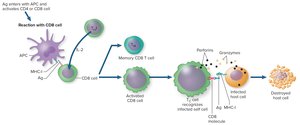
Cytotoxic T cells destroy infected or abnormal cells by recognizing antigens presented with MHC class I molecules. They release perforins and granzymes to induce apoptosis in target cells.
B Cell Responses and Antibody Production
B Cell Activation
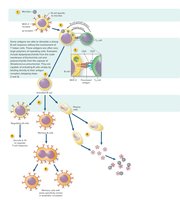
Upon encountering their specific antigen, B cells differentiate into plasma cells that secrete antibodies and memory B cells for long-term immunity.
Antibody Structure
Antibodies (immunoglobulins) are Y-shaped molecules composed of two heavy and two light chains. The variable regions form antigen-binding sites, while the constant region determines the antibody class and effector functions.
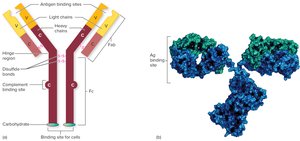
Antibody Functions
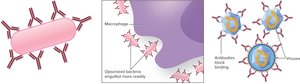
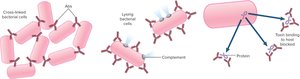
Neutralization: Block pathogen binding to host cells.
Opsonization: Enhance phagocytosis by marking pathogens.
Complement activation: Trigger lysis of pathogens.
Agglutination: Clump pathogens for easier clearance.
Classes of Immunoglobulins
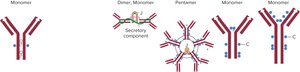
IgG: Most abundant; crosses placenta; long-term immunity.
IgA: Found in mucosal secretions; protects mucous membranes.
IgM: First antibody produced; effective in agglutination.
IgD: Functions mainly as a B-cell receptor.
IgE: Involved in allergic responses and defense against parasites.
Primary and Secondary Immune Responses
Antibody Titer and Memory
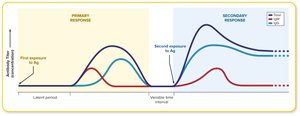
The primary response occurs upon first exposure to an antigen, with a lag phase before antibody production. The secondary response is faster and stronger due to memory cells.
Types of Acquired Immunity
Natural vs. Artificial Immunity
Natural immunity: Acquired through normal life events (e.g., infection, maternal antibodies).
Artificial immunity: Acquired through medical intervention (e.g., vaccination, immune serum).
Active vs. Passive Immunity
Active immunity: Host produces its own antibodies; long-lasting; develops after infection or vaccination.
Passive immunity: Host receives antibodies from another source; immediate but short-lived protection.
Type | Natural | Artificial |
|---|---|---|
Active | Infection | Vaccination |
Passive | Maternal antibodies | Immune serum |




Vaccination and Immunization
Principles of Vaccination
Vaccines stimulate a primary immune response and memory formation without causing disease.
Qualities of an ideal vaccine include safety, efficacy, long-lasting protection, and ease of administration.
Types of Vaccines
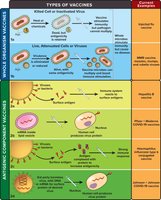
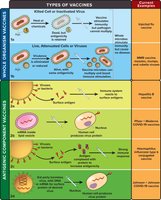
Whole cell/virus vaccines: Live attenuated or killed/inactivated pathogens.
Subunit vaccines: Purified components, recombinant proteins, or genetic material (DNA/mRNA).
Conjugate vaccines: Antigen linked to a protein carrier to enhance immunogenicity.
Viral vector vaccines: Use harmless viruses to deliver genetic material encoding antigens.
Example: mRNA Vaccines
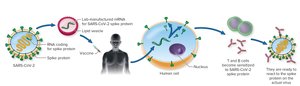
mRNA vaccines deliver genetic instructions for a microbial antigen, leading to in situ protein production and immune activation. This technology was used for COVID-19 vaccines.
Additional info: The notes above integrate foundational immunology concepts with current applications, such as mRNA vaccines, and provide a comprehensive overview suitable for college-level microbiology students.
