 Back
BackAntimicrobial Drugs: Mechanisms, Spectrum, and Resistance
Study Guide - Smart Notes
 Tailored notes based on your materials, expanded with key definitions, examples, and context.
Antimicrobial Drugs: Mechanisms, Spectrum, and Resistance
Introduction to Antimicrobial Drugs
Antimicrobial drugs are agents used to treat infections by inhibiting or killing pathogenic microorganisms. Their effectiveness depends on their spectrum of activity, mechanism of action, and the ability of pathogens to develop resistance. Understanding these aspects is crucial for effective clinical use and combating antimicrobial resistance.
Spectrum of Antimicrobial Activity
Classification by Target Organism
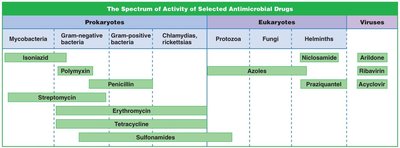
The spectrum of activity refers to the range of microbes an antimicrobial drug can affect. Drugs may be broad-spectrum (active against a wide variety of organisms) or narrow-spectrum (targeting specific groups).
Prokaryotes: Includes mycobacteria, Gram-positive bacteria, Gram-negative bacteria, and Chlamydias/Rickettsias.
Eukaryotes: Includes protozoa, fungi, and helminths.
Viruses: Targeted by antiviral drugs.
Drug | Target Organism(s) |
|---|---|
Isoniazid | Mycobacteria |
Polymyxin | Gram-negative bacteria |
Penicillin | Gram-positive bacteria |
Erythromycin, Tetracycline | Gram-positive and Gram-negative bacteria, Chlamydias/Rickettsias |
Sulfonamides | Broad spectrum (various bacteria) |
Azoles | Fungi |
Nicosamide, Praziquantel | Helminths |
Acyclovir, Ribavirin, Arildone | Viruses |
Mechanisms of Action of Antimicrobial Drugs
Overview of Major Mechanisms
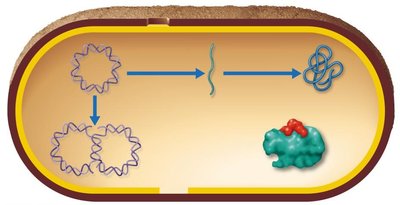
Antimicrobial drugs act by targeting essential structures or processes in microorganisms. The five primary mechanisms are:
Inhibition of cell wall synthesis
Inhibition of protein synthesis
Inhibition of nucleic acid replication and transcription
Injury to plasma membrane
Inhibition of essential metabolite synthesis
1. Inhibition of Cell Wall Synthesis
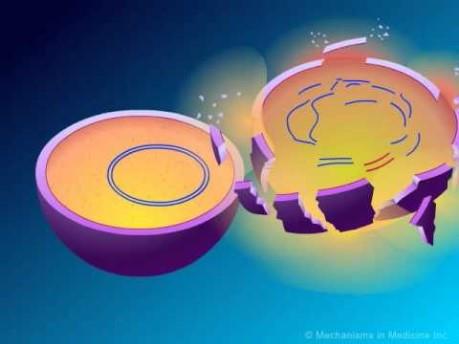
Many bacteria possess a cell wall containing peptidoglycan, which is essential for their structural integrity. Drugs that inhibit cell wall synthesis weaken the wall, leading to cell lysis and death.
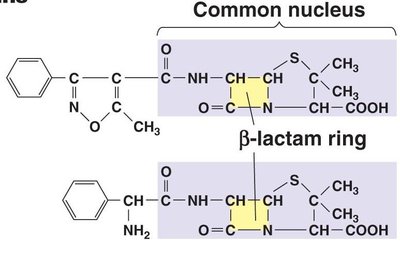
Beta-lactam antibiotics (e.g., penicillins, cephalosporins): Prevent cross-linkage of N-acetylmuramic acid (NAM) subunits by binding to transpeptidase enzymes. Their core structure is the beta-lactam ring.
Vancomycin and cycloserine: Interfere with bridges that link NAM subunits in Gram-positive bacteria.
Bacitracin: Blocks secretion of N-acetylglucosamine (NAG) and NAM from the cytoplasm.
Isoniazid and ethambutol: Disrupt mycolic acid formation in mycobacteria.
Example: Penicillins are effective against Gram-positive bacteria, while isoniazid targets mycobacteria.
Additional info: These drugs are most effective against actively growing cells, as they do not affect existing peptidoglycan.
2. Inhibition of Protein Synthesis
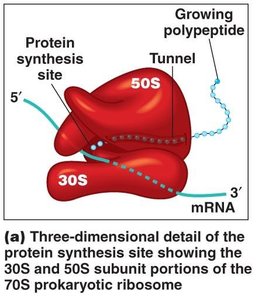
Protein synthesis inhibitors target the bacterial ribosome, which differs structurally from eukaryotic ribosomes, allowing selective toxicity. The bacterial ribosome consists of 30S and 50S subunits, forming the 70S ribosome.
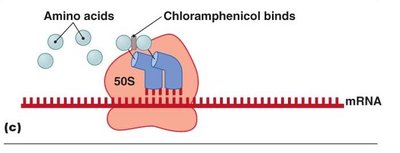
Chloramphenicol: Binds to the 50S subunit and inhibits peptide bond formation.
Macrolides (e.g., erythromycin): Bind to the 50S subunit and prevent translocation.
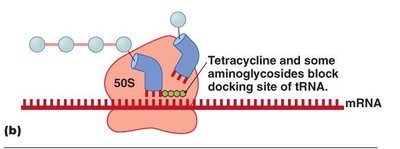
Tetracyclines: Interfere with the attachment of tRNA to the 30S subunit.
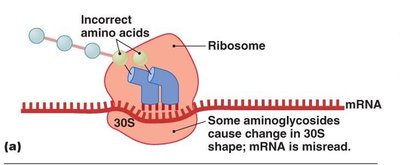
Aminoglycosides (e.g., streptomycin): Cause misreading of mRNA by changing the shape of the 30S subunit.
Oxazolidinones (e.g., linezolid): Prevent formation of the 70S initiation complex.
Example: Streptomycin, erythromycin, and tetracycline are commonly used protein synthesis inhibitors.
3. Injury to the Plasma Membrane
Some antimicrobial agents disrupt the integrity of the plasma membrane, causing leakage of cellular contents and cell death. These drugs are often more toxic to eukaryotic cells due to similarities in membrane structure.
Polymyxin B: Disrupts bacterial plasma membranes, mainly used topically due to toxicity.
Amphotericin B: Binds to ergosterol in fungal membranes, forming pores that disrupt membrane integrity.
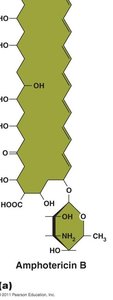
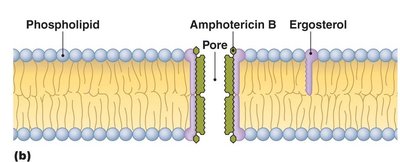
Example: Polymyxin B is used in combination with bacitracin and neomycin in topical preparations.
4. Inhibition of Nucleic Acid Synthesis
These drugs interfere with DNA replication or RNA transcription, processes essential for microbial survival and proliferation.
Quinolones and fluoroquinolones (e.g., ciprofloxacin): Inhibit DNA gyrase, preventing DNA replication in bacteria.
Rifamycins (e.g., rifampicin): Inhibit RNA polymerase, blocking transcription.
Nucleotide/nucleoside analogs: Mimic natural nucleotides, causing premature chain termination or faulty replication, especially in viruses.
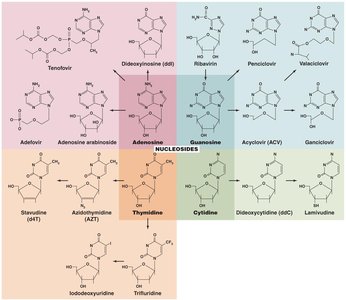
Example: Acyclovir is a nucleoside analog used to treat herpesvirus infections.
5. Inhibition of Essential Metabolite Synthesis
Some drugs act as competitive inhibitors of key enzymes in microbial metabolic pathways, blocking the synthesis of essential metabolites.
Sulfonamides (sulfa drugs): Inhibit dihydropteroate synthase, blocking folic acid synthesis in bacteria.
Trimethoprim: Inhibits dihydrofolate reductase, another enzyme in the folic acid pathway.
Antiviral agents (e.g., amantadine): Block viral uncoating or other unique viral metabolic steps.
Example: Sulfonamides are used to treat urinary tract infections by inhibiting bacterial folic acid synthesis.
Antimicrobial Drug Resistance
Development of Resistance
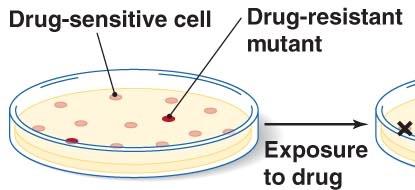
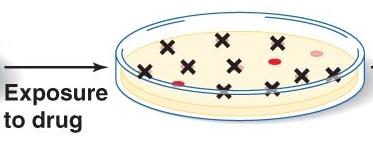
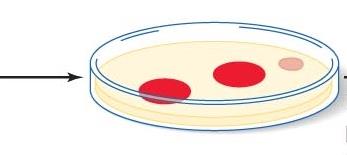
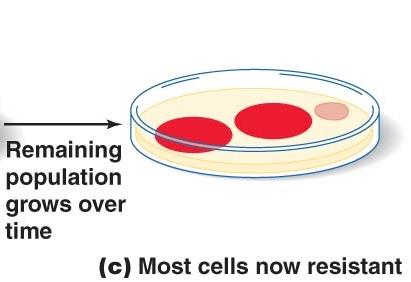
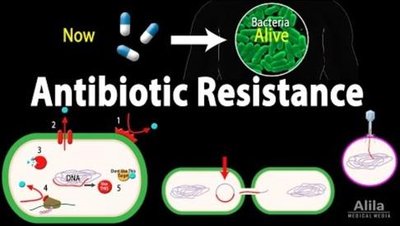
Microorganisms can develop resistance to antimicrobial drugs through genetic changes. Resistance may be intrinsic (natural) or acquired via mutations or horizontal gene transfer (e.g., R-plasmids).
Mutation: Spontaneous changes in chromosomal genes can confer resistance.
Gene transfer: Acquisition of resistance genes via transformation, transduction, or conjugation.
Mechanisms of Resistance
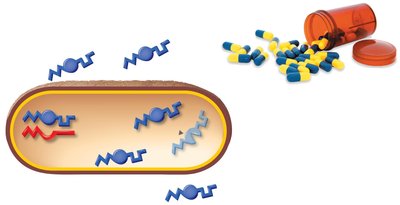
Bacteria employ several strategies to resist the effects of antimicrobial drugs:
Blocking entry: Alteration of porin proteins in the outer membrane prevents drug entry.
Inactivation by enzymes: Production of enzymes (e.g., beta-lactamase) that destroy or inactivate the drug.
Alteration of target molecule: Mutations in target sites (e.g., ribosomal proteins) reduce drug binding.
Efflux of antibiotic: Active transport of the drug out of the cell via efflux pumps.
Multiple and Cross Resistance
Pathogens may acquire resistance to multiple drugs (multidrug resistance) or develop cross-resistance to drugs with similar mechanisms. This is especially problematic in healthcare settings where antibiotic use is frequent.
Superbugs: Bacteria resistant to several classes of antibiotics.
Cross-resistance: Resistance to one drug confers resistance to related drugs.
Factors Promoting Resistance
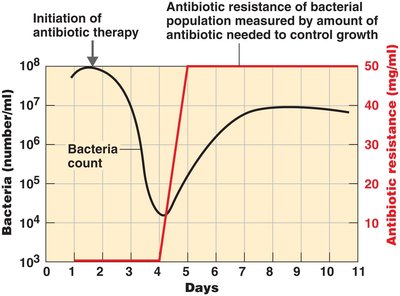
Misuse and overuse of antibiotics accelerate the selection of resistant strains. Key factors include:
Using outdated or weakened antibiotics
Using antibiotics for viral infections (e.g., common cold)
Adding antibiotics to animal feed
Failing to complete prescribed regimens
Using someone else's leftover prescription
Summary Table: Modes of Action and Examples
Mode of Action | Examples |
|---|---|
Inhibition of cell wall synthesis | Penicillins, cephalosporins, bacitracin, vancomycin |
Inhibition of protein synthesis | Chloramphenicol, erythromycin, tetracyclines, streptomycin |
Inhibition of nucleic acid synthesis | Quinolones, rifampicin |
Injury to plasma membrane | Polymyxin B, amphotericin B |
Inhibition of essential metabolite synthesis | Sulfonamides, trimethoprim |
Key Definitions
Beta-lactamase: Enzyme that hydrolyzes the beta-lactam ring, rendering penicillins inactive.
Superbug: Bacterial strain resistant to multiple antibiotics.
Antimetabolite: Compound that inhibits the use of a metabolite, often by mimicking its structure.
Conclusion
Understanding the mechanisms of action, spectrum, and resistance of antimicrobial drugs is essential for their effective use and for combating the growing threat of antimicrobial resistance. Rational use and stewardship of these drugs are critical in preserving their efficacy for future generations.
