 Back
BackChapter 9 - Biotechnology and DNA Technology: Study Notes for Microbiology
Study Guide - Smart Notes
 Tailored notes based on your materials, expanded with key definitions, examples, and context.
Biotechnology and DNA Technology
Introduction to Biotechnology
Biotechnology involves the use of microorganisms, cells, or cell components to produce useful products such as foods, antibiotics, vitamins, and enzymes. Modern biotechnology often utilizes recombinant DNA (rDNA) technology, which is the insertion or modification of genes to produce desired proteins or traits.
Biotechnology: Application of biological systems or organisms to technical and industrial processes.
Recombinant DNA technology: Manipulation of genetic material to produce new combinations of genes.
Applications: Production of insulin, genetically modified crops, industrial enzymes.
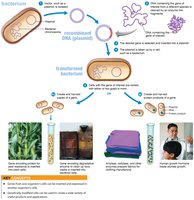
Overview of Recombinant DNA Procedures
Key Concepts
Vector: A self-replicating DNA molecule (e.g., plasmid or virus) used to transport foreign DNA into a host cell.
Clone: A population of genetically identical cells, each carrying the vector with the inserted gene.
Tools of Biotechnology
Selection, Mutation, and Site-Directed Mutagenesis
Biotechnologists use several tools to manipulate genetic material:
Selection: Identifying and isolating microbes that naturally produce a desired product.
Mutation: Using mutagens to induce genetic changes that may result in beneficial traits.
Site-directed mutagenesis: Introducing specific, targeted changes into a gene sequence.
Restriction Enzymes
Restriction enzymes are proteins that cut DNA at specific sequences, protecting bacteria from viral DNA and enabling genetic engineering. They can create either blunt ends or sticky ends, which are useful for joining DNA fragments from different sources.
Recognition sequence: Specific DNA sequence recognized and cut by the enzyme.
Sticky ends: Overhanging single-stranded DNA that can base pair with complementary sequences.
Blunt ends: Straight cuts with no overhangs.
Enzyme | Bacterial Source | Recognition Sequence |
|---|---|---|
BamHI | Bacillus amyloliquefaciens | G^GATCC |
EcoRI | Escherichia coli | G^AATTC |
HaeIII | Haemophilus aegyptius | GG^CC |
HindIII | Haemophilus influenzae | A^AGCTT |
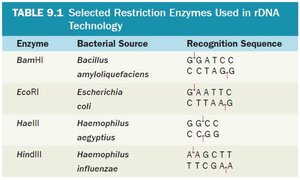
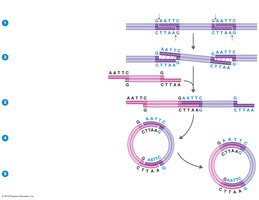
Vectors in Genetic Engineering
Vectors such as plasmids and viruses are essential for carrying new DNA into host cells. They must be able to self-replicate and may be designed as shuttle vectors to function in multiple species.
Plasmids: Small, circular DNA molecules found in bacteria.
Shuttle vectors: Vectors that can replicate in several different species.
Polymerase Chain Reaction (PCR)
Principle and Applications
PCR is a technique used to amplify small quantities of DNA for analysis. It is widely used in diagnostics, genetic testing, and pathogen detection. Reverse-transcription PCR uses mRNA as a template to study gene expression.
Steps: Denaturation, annealing, and extension.
Applications: Detection of genetic diseases, forensic analysis, research.
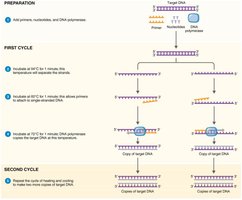
Inserting Foreign DNA into Cells
Methods
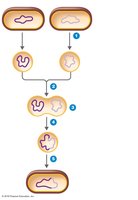
Transformation: Uptake of naked DNA from the environment by a cell.
Electroporation: Use of electrical current to create pores in cell membranes for DNA entry.
Protoplast fusion: Fusion of cells after removal of cell walls, allowing exchange of genetic material.
Gene gun: Physical delivery of DNA into cells using high-velocity microprojectiles.
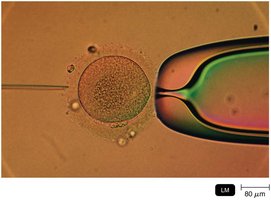
Microinjection: Direct injection of DNA into cells using a fine needle.
Genomic Libraries and cDNA
Genomic Libraries
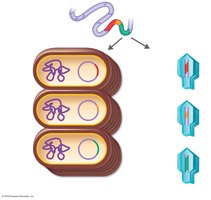
A genomic library is a collection of clones containing different DNA fragments from an organism. These libraries are created by digesting DNA and inserting fragments into vectors, ensuring that all genes are represented.
Plasmid library: Uses plasmids as vectors.
Phage library: Uses bacteriophage vectors.
Complementary DNA (cDNA)
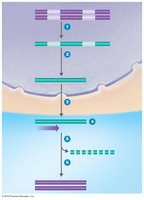
cDNA is synthesized from mRNA using reverse transcriptase. It is especially useful for cloning eukaryotic genes, as it lacks introns and represents only the coding sequence for proteins.
Steps: Transcription of gene, removal of introns, synthesis of cDNA from mRNA.
Selecting a Clone
Blue-White Screening
This method uses a plasmid vector with an ampicillin resistance gene and the lacZ gene encoding β-galactosidase. Bacteria are grown on media with ampicillin and X-gal. Colonies with recombinant plasmids (with foreign DNA inserted) appear white, while non-recombinant colonies are blue.
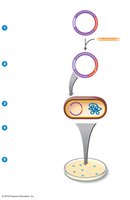
Colony Hybridization
Colony hybridization uses labeled DNA probes to identify colonies containing a gene of interest. The probe hybridizes with complementary DNA, allowing detection of specific clones.
Making a Gene Product
Host Systems
E. coli: Advantages include rapid growth and well-known genetics; disadvantages include endotoxin production and poor secretion of proteins.
Saccharomyces cerevisiae: Yeast that expresses eukaryotic genes efficiently and is easy to grow.
Plant and mammalian cells: Useful for expressing complex eukaryotic proteins, but mammalian cells are harder to grow.
Therapeutic Applications
Medical Uses of rDNA Technology
Human proteins: Production of insulin, growth hormones, and clotting factors.
Subunit vaccines: Vaccines made from pathogen proteins produced in genetically modified organisms.
Gene therapy: Replacement of defective or missing genes in patients.
Gene editing (CRISPR): Precise correction of genetic mutations.
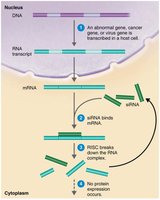
Gene silencing: Use of siRNAs to block expression of specific genes, potentially treating diseases.
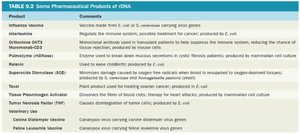
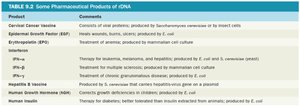
Product | Comments |
|---|---|
Cervical Cancer Vaccine | Consists of viral proteins, produced by Saccharomyces cerevisiae or by insect cells |
Epidermal Growth Factor (EGF) | Heals wounds, burns; produced by E. coli |
Erythropoietin (EPO) | Treatment of anemia; produced by mammalian cell culture |
Interferons (IFNs) | Therapy for leukemia, melanoma, hepatitis; produced by E. coli and S. cerevisiae |
Human Growth Hormone | Treatment for growth deficiencies; produced by E. coli |
Insulin | Treatment for diabetes; produced by E. coli |
Genome Projects and Scientific Applications
Genome Sequencing and Metagenomics
Shotgun sequencing: Sequencing small DNA fragments and assembling them computationally.
Metagenomics: Study of genetic material recovered directly from environmental samples.
Human Genome Project: Sequenced the entire human genome, providing a foundation for genetic research.
Bioinformatics and Proteomics
Bioinformatics: Use of computer technology to analyze genetic data and gene function.
Proteomics: Study of all proteins expressed by a cell or organism.
Reverse genetics: Determining gene function by analyzing the effects of specific gene sequences.
Southern Blotting and Genetic Testing
Southern blotting uses DNA probes to detect specific DNA fragments separated by gel electrophoresis. Genetic testing screens for inherited diseases using DNA analysis.
RFLPs (Restriction Fragment Length Polymorphisms): Variations in DNA fragment sizes produced by restriction enzyme digestion, used in genetic mapping and forensics.
Forensic Microbiology
DNA fingerprinting is used to identify pathogens and individuals in forensic investigations. PCR microarrays and DNA chips allow simultaneous screening for multiple pathogens. Forensic microbiology requires careful evidence collection and chain of custody, distinguishing it from clinical diagnostics.
