 Back
BackCell Structure and Function: Prokaryotic and Eukaryotic Cells
Study Guide - Smart Notes
 Tailored notes based on your materials, expanded with key definitions, examples, and context.
Cell Structure and Function
Major Processes of Living Cells
All living cells share fundamental processes that define life. These include growth, reproduction, responsiveness, metabolism, and cellular structure. Viruses, while often studied in microbiology, lack several of these processes and are considered acellular.
Growth: Increase in size; occurs in all living cells but not in viruses.
Reproduction: Increase in number; occurs in all living cells. Viruses replicate only within host cells.
Responsiveness: Ability to react to environmental stimuli; present in all living cells, viruses respond only in some cases.
Metabolism: Controlled chemical reactions; occurs in all living cells, viruses lack metabolism.
Cellular Structure: Membrane-bound structure capable of all life functions; present in all living cells, absent in viruses.

Prokaryotic vs. Eukaryotic Cells
Cells are classified as prokaryotic or eukaryotic based on structural features. Prokaryotes include Bacteria and Archaea, while Eukaryotes include animals, plants, fungi, algae, and protozoa.
Prokaryotic Cells: Lack a nucleus and membrane-bound organelles; DNA is located in a nucleoid region. Generally smaller and simpler.
Eukaryotic Cells: Have a true nucleus and membrane-bound organelles (e.g., mitochondria, ER, Golgi bodies). Larger and more complex.
External Structures of Cells
Glycocalyces
The glycocalyx is a sticky, carbohydrate-rich layer outside the cell wall, important for protection, attachment, and immune evasion. It is especially relevant in pathogenic bacteria.
Capsule: Well-organized, firmly attached; protects against phagocytosis.
Slime Layer: Loose, irregular; aids in adhesion.
Flagella, Fimbriae, and Pili
Flagella: Long, whip-like structures for motility. Arrangements include monotrichous, lophotrichous, amphitrichous, and peritrichous.
Fimbriae: Short, numerous appendages for attachment.
Pili: Longer, fewer; used for DNA transfer (conjugation).
Shapes and Arrangements of Bacterial Cells
Cocci: Spherical
Bacilli: Rod-shaped
Spirilla/Spirochetes: Spiral-shaped
Arrangements: Diplo- (pairs), Strepto- (chains), Staphylo- (clusters), Palisades, Tetrads
Bacterial Cell Walls
Bacterial cell walls are primarily composed of peptidoglycan, a mesh-like polymer of sugars and peptides. The structure and composition of the cell wall are critical for bacterial identification and antibiotic targeting.
Peptidoglycan: Alternating N-acetylglucosamine (NAG) and N-acetylmuramic acid (NAM) sugars, cross-linked by peptides.
Gram-Positive: Thick peptidoglycan, teichoic acids, stains purple.
Gram-Negative: Thin peptidoglycan, outer membrane with lipopolysaccharide (LPS), stains pink/red.
Acid-Fast: Waxy mycolic acids, resistant to staining and chemicals.

Cytoplasmic Membrane and Transport
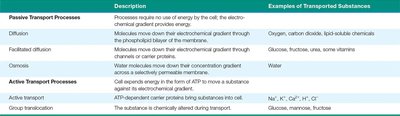
The cytoplasmic membrane is a phospholipid bilayer with embedded proteins, forming a selectively permeable barrier. Transport across the membrane can be passive or active.
Fluid Mosaic Model: Membrane proteins and lipids move laterally; proteins serve various functions.
Passive Transport: No energy required; includes diffusion, facilitated diffusion, and osmosis.
Active Transport: Requires ATP; includes uniport, antiport, symport, and group translocation.
Osmosis and Solution Effects
Osmosis: Movement of water across a selectively permeable membrane.
Isotonic: Equal solute concentration inside and outside.
Hypertonic: Higher solute outside; cell shrinks.
Hypotonic: Lower solute outside; cell swells.
Endocytosis and Exocytosis in Eukaryotes
Eukaryotic cells use endocytosis and exocytosis for bulk transport of materials.
Endocytosis: Uptake of substances via vesicle formation; includes phagocytosis (solids) and pinocytosis (liquids).
Exocytosis: Release of substances via vesicle fusion with the membrane.
Cytoplasm and Organelles
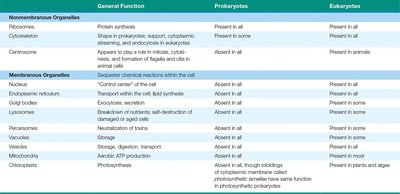
The cytoplasm contains water, enzymes, nutrients, ribosomes, plasmids, inclusions, and organelles (in eukaryotes). Organelles are specialized structures for cellular functions.
Ribosomes: Protein synthesis; 70S in prokaryotes, 80S in eukaryotes.
Cytoskeleton: Structural support, movement, and organization.
Inclusions: Storage granules (e.g., glycogen, polyphosphate).
Endospores: Highly resistant dormant structures formed by Bacillus and Clostridium.
Comparison of Organelles in Prokaryotes and Eukaryotes
Organelle | General Function | Prokaryotes | Eukaryotes |
|---|---|---|---|
Ribosome | Protein synthesis | Present in all | Present in all |
Cytoskeleton | Support, movement | Present in some | Present in all |
Centrosome | Cell division, flagella/cilia formation | Absent | Present in animals |
Nucleus | DNA storage | Absent | Present in all |
Endoplasmic Reticulum | Protein/lipid synthesis | Absent | Present in all |
Golgi Body | Modification, packaging | Absent | Present in some |
Lysosome | Digestion | Absent | Present in animals |
Peroxisome | Detoxification | Absent | Present in all |
Vacuole | Storage | Absent | Present in some |
Mitochondrion | ATP production | Absent | Present in all |
Chloroplast | Photosynthesis | Absent | Present in plants/algae |
Endosymbiotic Theory
The endosymbiotic theory explains the origin of mitochondria and chloroplasts in eukaryotic cells. It proposes that these organelles originated from prokaryotic cells engulfed by ancestral eukaryotes, leading to a symbiotic relationship.
Evidence: Presence of circular DNA, 70S ribosomes, double membranes, and independent replication in mitochondria and chloroplasts.
Summary Table: Transport Processes
Process | Description | Examples of Transported Substances |
|---|---|---|
Diffusion | Molecules move down their electrochemical gradient through the phospholipid bilayer | Oxygen, carbon dioxide, lipid-soluble chemicals |
Facilitated Diffusion | Molecules move down their electrochemical gradient through channels or carrier proteins | Glucose, fructose, urea, some vitamins |
Osmosis | Water molecules move down their concentration gradient across a selectively permeable membrane | Water |
Active Transport | ATP-dependent carrier proteins bring substances into cell | Na+, K+, Ca2+, H+, Cl- |
Group Translocation | The substance is chemically altered during transport | Glucose, mannose, fructose |
Summary Table: Endocytosis and Exocytosis
Process | Description | Examples of Transported Substances |
|---|---|---|
Endocytosis (Phagocytosis & Pinocytosis) | Substances are surrounded by pseudopods and brought into the cell | Bacteria, viruses, aged and dead cells, liquid nutrients in extracellular solutions |
Exocytosis | Vesicles containing substances fuse with cytoplasmic membrane, dumping their contents to the outside | Waste, secretions |
Summary Table: Characteristics of Life
Characteristic | Bacteria, Archaea, Eukaryotes | Viruses |
|---|---|---|
Growth | Occurs in all | Does not occur |
Reproduction | Occurs in all | Host cell replicates virus |
Responsiveness | Occurs in all | Reaction to host cells seen in some viruses |
Metabolism | Occurs in all | Viruses lack metabolism |
Cellular Structure | Present in all | Viruses lack cytoplasmic membrane or cellular structure |
Additional info:
Equations for osmosis and diffusion can be represented as: , where J is flux, D is diffusion coefficient, and dC/dx is concentration gradient.
ATP hydrolysis for active transport:
