 Back
BackCharacterizing and Classifying Eukaryotes: Protozoa, Fungi, Algae, and Parasitic Helminths
Study Guide - Smart Notes
 Tailored notes based on your materials, expanded with key definitions, examples, and context.
Characterizing and Classifying Eukaryotes
Overview of Eukaryotic Microorganisms
Eukaryotic microorganisms include protozoa, fungi, algae, slime molds, and water molds. These organisms are significant in both human health and ecological processes, as some are pathogens while others are essential for nutrient cycling and other vital functions.
General Characteristics of Eukaryotic Organisms
Reproduction in Eukaryotes
Eukaryotic reproduction is more varied and complex than in prokaryotes. They utilize a variety of asexual mechanisms such as binary fission, budding, fragmentation, spore formation, and schizogony. Many eukaryotes also undergo sexual reproduction. The nucleus may be haploid (one chromosome set) or diploid (two chromosome sets), depending on the organism.
Types of Nuclear Division
Eukaryotic cells divide their nucleus to ensure each descendant receives a copy of the genetic material. There are two main types of nuclear division:
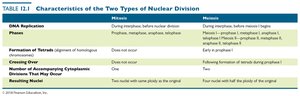
Mitosis: Replicated DNA is equally partitioned between two nuclei, maintaining the ploidy of the parent nucleus. It consists of four phases: Prophase, Metaphase, Anaphase, and Telophase.
Meiosis: Diploid nuclei produce haploid daughter nuclei through two sequential divisions (meiosis I and II), each with four phases. This process introduces genetic diversity.
Feature | Mitosis | Meiosis |
|---|---|---|
DNA Replication | During interphase before nuclear division | During interphase before meiosis begins |
Phases | Prophase, metaphase, anaphase, telophase (once each) | Prophase I, metaphase I, anaphase I, telophase I; prophase II, metaphase II, anaphase II, telophase II |
Formation of Tetrads | Does not occur | Occurs in prophase I |
Crossing Over | Does not occur | Occurs in prophase I |
Number of Daughter Cells | Two nuclei with same ploidy as original | Four nuclei with half the ploidy of original |
Cytokinesis
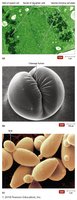
Cytokinesis is the division of the cytoplasm, typically occurring with telophase of mitosis. In some algae and fungi, cytokinesis may be delayed or absent, resulting in multinucleate cells called coenocytes.
Schizogony
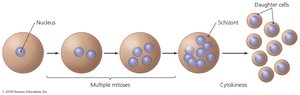
Some protozoa, such as Plasmodium, reproduce asexually by schizogony. Multiple mitoses produce a multinucleate cell (schizont), which then undergoes cytokinesis to release many uninucleate daughter cells.
Classification of Eukaryotic Organisms
Modern Taxonomy
Early classification was based on structural similarities, but modern taxonomy relies on nucleotide sequences and cell ultrastructure. The former "Protozoa" group is now divided into several kingdoms.
Protozoa
General Characteristics
Protozoa are a diverse group defined by being eukaryotic, unicellular, and lacking a cell wall. Most are motile via cilia, flagella, or pseudopods, except for apicomplexans.
Distribution and Morphology
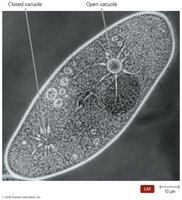
Protozoa require moist environments and are found in aquatic habitats, soil, and decaying matter. They are important members of plankton. Morphologically, protozoa may have two nuclei (macronucleus for metabolism and micronucleus for genetic exchange), various mitochondria, and contractile vacuoles. They exist as motile trophozoites and, in many cases, as dormant cysts for survival in harsh conditions.
Nutrition
Most protozoa are chemoheterotrophic, feeding on bacteria, organic matter, or host tissues. Some are photoautotrophic, such as dinoflagellates and euglenids.
Reproduction
Protozoa primarily reproduce asexually by binary fission or schizogony. Some also reproduce sexually, forming gametes that fuse to create a zygote, or by conjugation (reciprocal genetic exchange).
Classification of Protozoa
Modern classification divides protozoa into six major groups based on genetic and ultrastructural data:
Parabasala: Lack mitochondria, have a single nucleus and parabasal body. Example: Trichomonas.
Diplomonadida: Lack mitochondria, Golgi bodies, and peroxisomes; have two nuclei and multiple flagella. Example: Giardia.
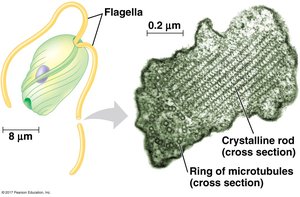
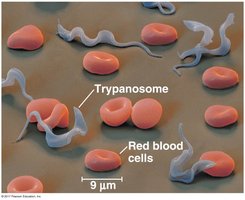
Euglenozoa: Characterized by a spiral or crystalline rod inside their flagella. Includes euglenids (photoautotrophs) and kinetoplastids (e.g., Trypanosoma).
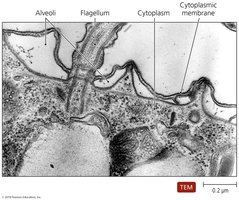
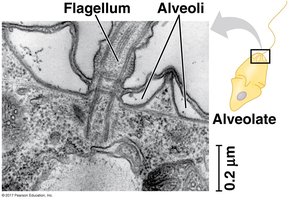
Alveolates: Possess alveoli beneath the membrane. Includes ciliates, apicomplexans, and dinoflagellates.
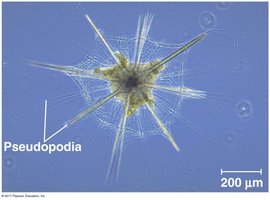
Rhizaria: Amoebas with threadlike pseudopods, such as foraminifera and radiolaria.
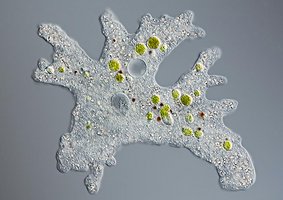
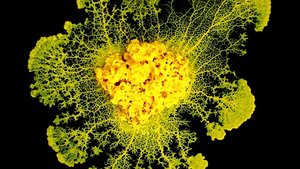
Amoebozoa: Amoebas with lobe-shaped pseudopodia, including slime molds.
Parabasala
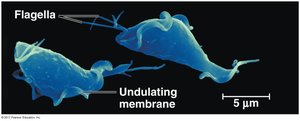
Parabasalids lack mitochondria and have a parabasal body. Trichomonas is a notable human pathogen causing trichomoniasis.
Diplomonadida
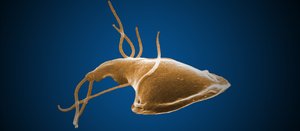
Diplomonads lack mitochondria, Golgi bodies, and peroxisomes. They have two nuclei and multiple flagella. Giardia is a common pathogen causing diarrhea.
Euglenozoa
Euglenozoa are distinguished by a spiral or crystalline rod inside their flagella. Euglenids are photoautotrophic and store food as paramylon. Kinetoplastids, such as Trypanosoma and Leishmania, are pathogenic.
Alveolates
Alveolates have membrane-bound alveoli. Subgroups include:
Ciliates: Move with cilia, have two nuclei. Example: Paramecium.
Apicomplexans: All are animal pathogens with specialized organelles for host cell penetration. Examples: Plasmodium, Cryptosporidium, Toxoplasma.
Dinoflagellates: Unicellular, photosynthetic, often motile with two flagella. Some cause red tides and produce neurotoxins.
Rhizaria
Rhizaria are amoebas with threadlike pseudopods. Foraminifera have calcium carbonate shells, while radiolaria have silica shells and radiating pseudopods.
Amoebozoa
Amoebozoa have lobe-shaped pseudopodia and lack shells. Some, like Naegleria and Acanthamoeba, cause diseases in humans. Entamoeba causes amebic dysentery. Slime molds, once considered fungi, are now classified as amoebozoa and differ from true fungi by lacking cell walls and being phagocytic.
Summary Table: Characteristics of Protozoa
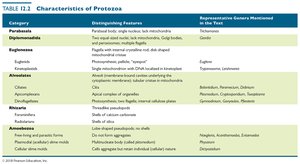
Category | Distinguishing Features | Representative Genera |
|---|---|---|
Parabasala | Parabasal body, single nucleus, lack mitochondria | Trichomonas |
Diplomonadida | Two equal-sized nuclei, multiple flagella, lack mitochondria, Golgi bodies, peroxisomes | Giardia |
Euglenozoa | Flagella with crystalline rod, disk-shaped mitochondria | Euglena, Trypanosoma, Leishmania |
Alveolates | Membrane-bound alveoli under cytoplasmic membrane | Paramecium, Plasmodium, Dinoflagellates |
Rhizaria | Threadlike pseudopodia, shells | Foraminifera, Radiolaria |
Amoebozoa | Lobe-shaped pseudopodia, no shells | Naegleria, Entamoeba, Slime molds |
Fungi
General Characteristics
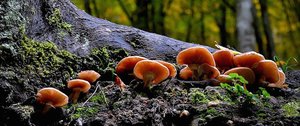
Fungi are chemoheterotrophic organisms with cell walls typically composed of chitin. They do not perform photosynthesis and lack chlorophyll. Genetic evidence shows fungi are more closely related to animals than plants.
Significance of Fungi
Decompose dead organisms and recycle nutrients
Assist plants in absorbing water and minerals
Used in food production, religious ceremonies, and manufacturing
Produce antibiotics and other drugs
Serve as research tools
Some cause mycoses (fungal diseases) and spoil food
Fungal Morphology
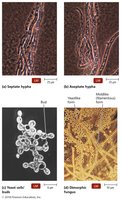
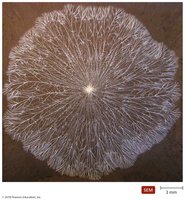
Fungi exist as molds (multicellular, filamentous hyphae) or yeasts (unicellular, globular). Some are dimorphic, switching forms based on environmental conditions. Hyphae may be septate or aseptate, and masses of hyphae form a mycelium.
Nutrition of Fungi
Fungi absorb nutrients from their environment. Most are saprobes, decomposing dead matter, while some are parasitic or predatory. Most fungi are aerobic, but many yeasts are facultative anaerobes.
Reproduction in Fungi
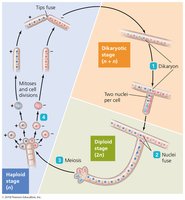
Fungi reproduce asexually (budding, spore formation) and sexually (spore formation). Yeasts bud to form new cells, sometimes creating pseudohyphae. Filamentous fungi produce asexual spores, and sexual reproduction involves fusion of mating types (+ and -).
Classification of Fungi
Fungi are classified based on sexual spore type:
Zygomycota
Ascomycota
Basidiomycota
Deuteromycetes (no known sexual stage; now abandoned)
Lichens
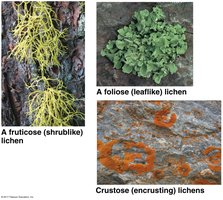
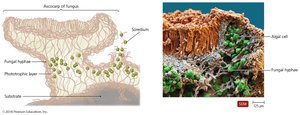
Lichens are symbiotic partnerships between fungi and photosynthetic microbes (algae or cyanobacteria). The fungus provides structure and protection, while the microbe supplies carbohydrates and oxygen. Lichens are important in soil formation and as ecological indicators.
Fungi as Parasites
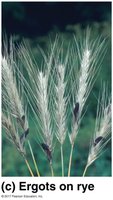
About 30% of fungi are parasitic, mainly on plants. Fungi can cause significant agricultural losses and produce toxins harmful to humans. For example, Claviceps purpurea causes ergotism, and Batrachochytrium dendrobatidis has led to amphibian declines. Human mycoses include ringworm, athlete’s foot, and systemic infections like coccidioidomycosis.

Practical Uses of Fungi
Food production (cheese, bread, alcohol)
Antibiotic production (e.g., Penicillium)
Biotechnology and genetic research (e.g., Saccharomyces cerevisiae)
Potential biofuel production (e.g., Gliocladium roseum)
Algae
General Characteristics
Algae are eukaryotic photoautotrophs with sexual reproductive structures. They are not a unified group and vary widely in morphology, reproduction, and biochemistry. Most are aquatic and possess accessory pigments for photosynthesis, allowing them to inhabit various depths.
Other Eukaryotes of Microbiological Interest: Parasitic Helminths and Vectors
Parasitic Helminths
Parasitic helminths (worms) have microscopic infective and diagnostic stages. They are important in medical microbiology due to their role as human pathogens.
Arthropod Vectors
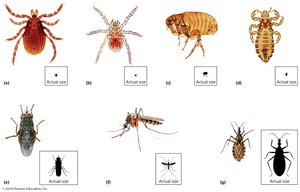
Arthropods such as ticks, mites, fleas, lice, flies, mosquitoes, and kissing bugs can transmit microbial pathogens. They are classified as:
Mechanical vectors: Carry pathogens externally.
Biological vectors: Serve as hosts for microbial pathogens.
Major classes include:
Arachnida: Ticks and mites (vectors); spiders (not vectors).
Insecta: Fleas, lice, flies, mosquitoes, and true bugs.
Additional info: This guide covers the main eukaryotic groups relevant to microbiology, focusing on their classification, structure, reproduction, and significance in health and ecology. Tables and images are included where they directly reinforce the text.
