 Back
BackChemistry of Life: Foundations for Microbiology
Study Guide - Smart Notes
 Tailored notes based on your materials, expanded with key definitions, examples, and context.
Chemistry of Life
Building Blocks of Molecules
The chemistry of life is fundamental to understanding microbiology, as all living organisms are composed of atoms and molecules. Matter is anything that has mass and takes up space, and it is made up of elements, which are pure substances containing only one type of atom. Atoms are the smallest units of elements, retaining all chemical properties, and are composed of subatomic particles: protons, neutrons, and electrons.
Protons: Positively charged, mass = 1 atomic mass unit (AMU).
Neutrons: No charge, mass = 1 AMU.
Electrons: Negatively charged, mass ≈ 0 AMU, orbit the nucleus.
Atomic Number: Number of protons in the nucleus.
Atomic Mass: Sum of protons and neutrons.
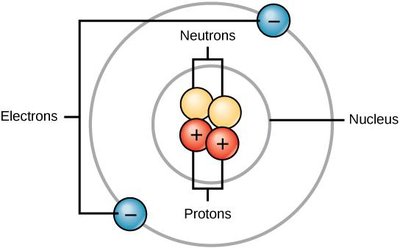
Atomic Structure and Isotopes
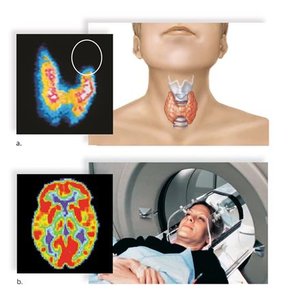
Atoms of the same element can have different numbers of neutrons, resulting in isotopes. Some isotopes are unstable and emit radiation, known as radioisotopes, which are useful in medical imaging and sterilization.
Isotopes: Same atomic number, different atomic mass.
Radioisotopes: Emit radiation, used in PET scans and cancer treatment.
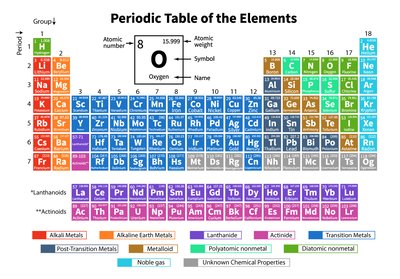
Periodic Table of Elements
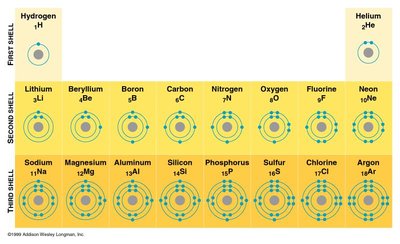
The periodic table organizes elements based on their atomic number and properties. Elements in the same group (column) have the same number of valence electrons, while elements in the same period (row) have the same number of electron shells. This organization helps predict how elements interact to form molecules.
Groups: Same number of valence electrons.
Periods: Same number of electron shells.
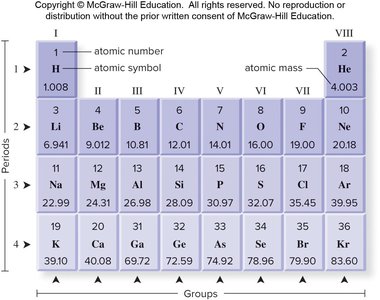
Electron Shells and Energy Levels
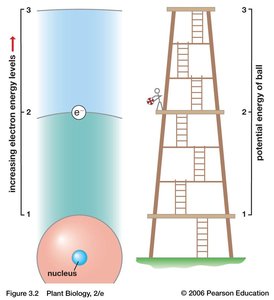
Electrons occupy shells around the nucleus, each with a specific energy level. The further the shell is from the nucleus, the higher the potential energy of the electrons. The arrangement of electrons determines the chemical properties of the atom.
First shell: Holds up to 2 electrons.
Octet Rule: Atoms are stable with 8 electrons in their outermost shell.
Valence Electrons: Electrons in the outermost shell, involved in chemical bonding.
Chemical Bonds
Types of Chemical Bonds
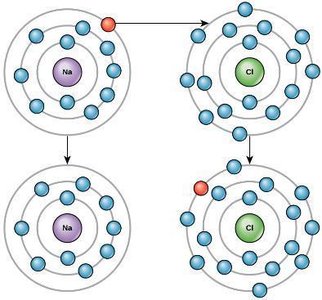
Chemical bonds are formed when atoms donate, accept, or share electrons to achieve stability. The main types of bonds are ionic, covalent, hydrogen, and van der Waals interactions.
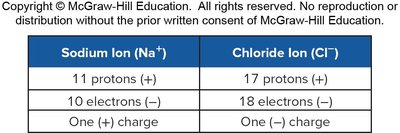
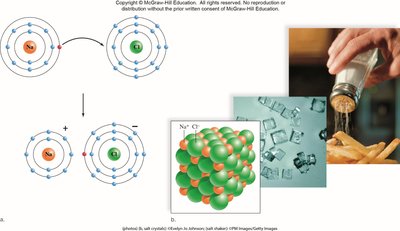
Ionic Bonds: Formed when atoms transfer electrons, resulting in charged ions (cations and anions) that attract each other.
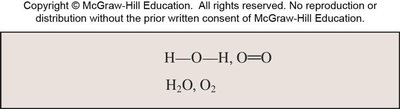
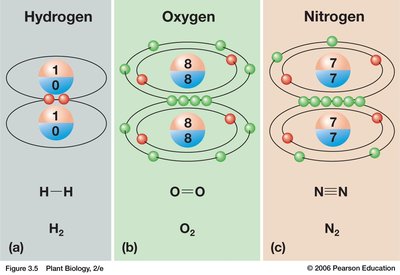
Covalent Bonds: Formed when atoms share pairs of electrons. Can be single, double, or triple bonds.
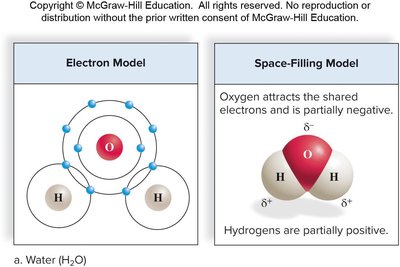
Polar Covalent Bonds: Unequal sharing of electrons, resulting in partial charges.
Nonpolar Covalent Bonds: Equal sharing of electrons.
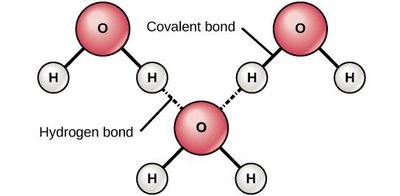
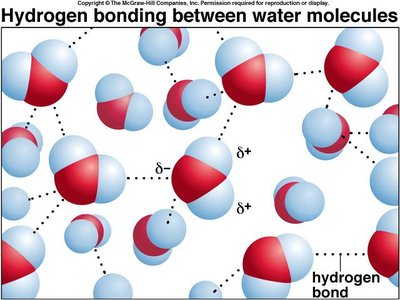
Hydrogen Bonds: Weak attraction between a slightly positive hydrogen and a slightly negative atom (often oxygen or nitrogen).
Van der Waals Interactions: Weak, temporary attractions between molecules.
Properties of Water
Water's Structure and Polarity
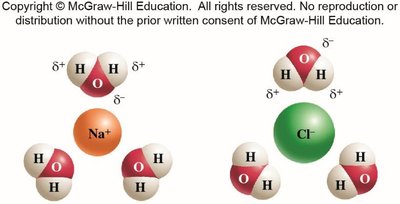
Water is a polar molecule, with a slightly positive charge on hydrogen atoms and a slightly negative charge on the oxygen atom. This polarity allows water molecules to form hydrogen bonds with each other and with other polar substances.
Hydrophilic: Substances that dissolve in water.
Hydrophobic: Substances that do not dissolve in water.
Thermal Properties of Water
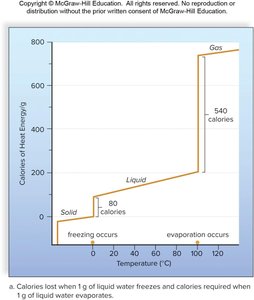
Water has a high heat capacity and heat of vaporization due to hydrogen bonding. This allows water to moderate temperature changes in organisms and environments.
Calorie: Amount of heat required to raise 1 gram of water by 1°C.
Evaporation: Process where water molecules escape from the surface, cooling the organism.
Density and Structure of Ice
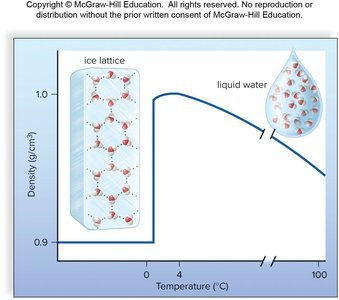
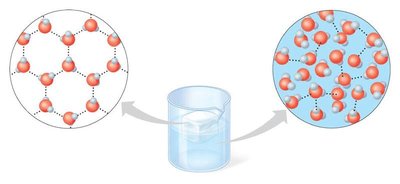
As water cools, hydrogen bonds form a rigid lattice structure, making ice less dense than liquid water. This is why ice floats.
Ice: Hydrogen bonds hold molecules farther apart.
Liquid Water: Hydrogen bonds constantly break and reform.
Cohesion, Adhesion, and Surface Tension
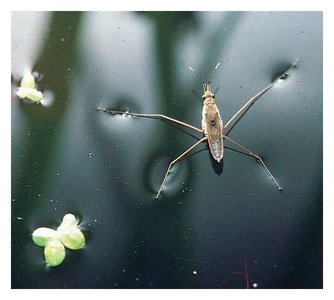
Water molecules are cohesive due to hydrogen bonding, creating surface tension. Water is also adhesive, allowing it to climb surfaces and move through plant tissues.
Cohesion: Water molecules stick together.
Surface Tension: Allows objects to float on water.
Adhesion: Water molecules stick to other polar substances.
Buffers, pH, Acids, and Bases
pH and Dissociation of Water
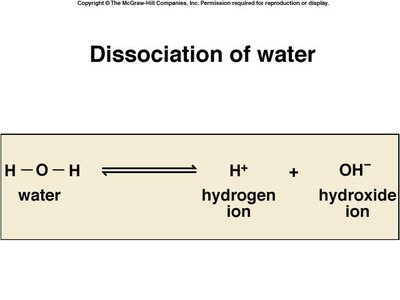
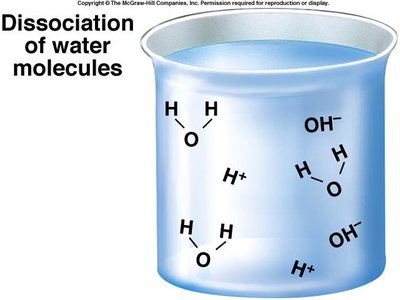
pH is a measure of the concentration of hydrogen ions in a solution. Water can dissociate into hydrogen ions (H+) and hydroxide ions (OH–), affecting the acidity or alkalinity of the solution.
Acids: Release H+ ions, lowering pH.
Bases: Release OH– ions, raising pH.
pH Scale: Ranges from 0 (acidic) to 14 (basic), with 7 being neutral.
Buffer Systems
Buffers are molecules that resist changes in pH by absorbing excess H+ or OH–. The carbonic acid-bicarbonate buffer system is crucial for maintaining pH homeostasis in living organisms.
Carbonic Anhydrase: Enzyme that regulates the conversion of CO2 and H2O to carbonic acid.
Buffer Reaction:
Macromolecules
Types of Macromolecules
Macromolecules are large, complex molecules essential for life. The four major types are carbohydrates, lipids, proteins, and nucleic acids. Each is composed of specific monomers and formed by dehydration reactions.
Carbohydrates: Monosaccharides, disaccharides, polysaccharides; energy and structural roles.
Lipids: Fatty acids, glycerol; energy storage, membrane structure.
Proteins: Amino acids; structure, enzymes, transport, defense.
Nucleic Acids: Nucleotides; genetic information storage and transfer.
Carbohydrates
Carbohydrates provide energy and structural support. Monosaccharides are simple sugars, disaccharides are formed by dehydration reactions, and polysaccharides are long chains for storage or structure.
Monosaccharides: Glucose, fructose, galactose (C6H12O6).
Disaccharides: Sucrose, lactose, maltose.
Polysaccharides: Starch (plants), glycogen (animals), cellulose (plants), chitin (arthropods).
Lipids
Lipids are hydrophobic molecules used for long-term energy storage, insulation, and membrane structure. Types include fats (triglycerides), phospholipids, steroids, and waxes.
Fats: Glycerol + fatty acids; saturated (solid) or unsaturated (liquid).
Phospholipids: Major component of cell membranes, with hydrophilic heads and hydrophobic tails.
Steroids: Four carbon rings; hormones and membrane components.
Proteins
Proteins are polymers of amino acids, with diverse functions including structure, enzymes, transport, and defense. Protein structure is determined by the sequence of amino acids and folding into primary, secondary, tertiary, and quaternary structures.
Amino Acids: 20 types, each with a unique R-group.
Peptide Bonds: Covalent bonds linking amino acids.
Denaturation: Loss of protein structure and function due to environmental changes.
Nucleic Acids
Nucleic acids store and transmit genetic information. DNA is double-stranded and forms a double helix, while RNA is single-stranded and involved in protein synthesis. Nucleotides are composed of a nitrogenous base, ribose sugar, and phosphate group.
DNA: Deoxyribonucleic acid; bases A, T, G, C.
RNA: Ribonucleic acid; bases A, U, G, C.
ATP: Adenosine triphosphate; energy currency of the cell.
Organic Molecule | Monomer | Functions |
|---|---|---|
Carbohydrates | Monosaccharides | Energy, structural molecules |
Proteins | Amino acids | Structure, enzymes, transport, defense |
Lipids | Fatty acids, glycerol | Energy storage, membrane components |
Nucleic acids | Nucleotides | Genetic information, energy carrier (ATP) |
Additional info: These foundational chemical principles are essential for understanding microbial cell structure, metabolism, genetics, and interactions with their environment, as covered in microbiology courses.
