 Back
BackControl of Microbial Growth in the Environment
Study Guide - Smart Notes
 Tailored notes based on your materials, expanded with key definitions, examples, and context.
Control of Microbial Growth in the Environment
Introduction to Microbial Control
Controlling microbial growth is essential in public health, healthcare, laboratories, and domestic environments to prevent infection and contamination. Various physical and chemical methods are employed to achieve sterilization, disinfection, and antisepsis, each with specific applications and limitations.
Key Terminology in Microbial Control
Sterilization: The complete removal or destruction of all microbes, including endospores and viruses. Example: Commercial sterilization of canned food targets Clostridium botulinum endospores.
Aseptic Technique: Procedures or environments free of contamination by pathogens, crucial in surgery and laboratory work.
Degerming: Removal of microbes by mechanical means, such as handwashing or preparing skin for injection.
Disinfection: Use of chemicals or physical agents to kill or inhibit pathogens on inanimate objects.
Antisepsis: Application of chemicals (antiseptics) to living tissue to reduce microbial load.
Sanitization: Disinfection of public places or objects to meet health standards (e.g., restaurant utensils, public toilets).
Pasteurization: Application of heat to kill pathogens and reduce spoilage organisms in food and beverages.
Microbial Control Suffixes
-stasis/-static: Inhibit microbial metabolism and growth without killing (e.g., bacteriostatic, fungistatic).
-cide/-cidal: Kill the target microbes (e.g., bactericide, fungicide, virucide).
Germicides: Chemical agents that kill pathogens.
Microbial Death Rates
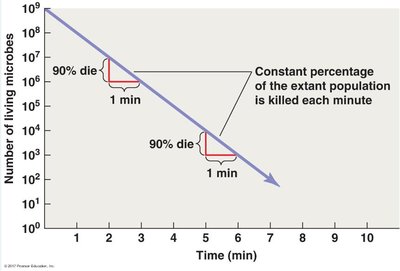
Microbial death is defined as the permanent loss of reproductive capability. The effectiveness of an antimicrobial agent is measured by the microbial death rate, which is typically constant under specific conditions. A microbicidal agent kills a constant percentage of cells over time, as shown by a straight line on a logarithmic graph.
Characteristics of an Ideal Antimicrobial Agent
Inexpensive, fast-acting, stable during storage
Effective against all types of microbes
Harmless to humans, animals, and objects
Every agent has limitations, advantages, and disadvantages
Factors Affecting the Selection of Antimicrobial Methods
Nature of the site/object (e.g., sensitivity to heat or chemicals)
Risk of infection (invasive vs. non-invasive instruments)
Number and susceptibility of microbes
Environmental conditions (temperature, pH, organic material)
Classification of Germicides
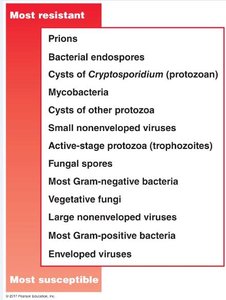
High-level germicides: Kill all microbes, including endospores (used for invasive instruments).
Intermediate-level germicides: Kill fungal spores, protozoan cysts, viruses, and pathogenic bacteria (used for non-invasive instruments).
Low-level germicides: Kill vegetative bacteria, fungi, protozoa, and some viruses (used for items contacting skin).
Biosafety Levels (BSL)
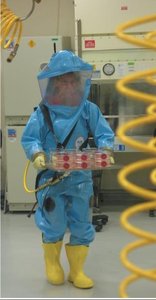
The CDC defines four biosafety levels for laboratory safety, based on pathogen risk:
BSL-1: Nonpathogenic microbes (e.g., nonpathogenic E. coli).
BSL-2: Moderate risk (e.g., Staphylococcus aureus).
BSL-3: High risk, airborne transmission (e.g., Mycobacterium tuberculosis).
BSL-4: Life-threatening, no treatment (e.g., Ebola virus).
Physical Methods of Microbial Control
Heat Treatment
Heat is a reliable, safe, and cost-effective method for controlling microbial growth. It includes moist heat (boiling, autoclaving, pasteurization) and dry heat (incineration, hot air ovens).
Thermal Death Point (TDP): Lowest temperature that kills all cells in 10 minutes.
Thermal Death Time (TDT): Time to sterilize a volume at a set temperature.
Decimal Reduction Time (D value): Time to kill 90% of microbes at a given temperature.
Commercial canning uses the D value to ensure safety from Clostridium botulinum endospores.
Moist Heat Methods
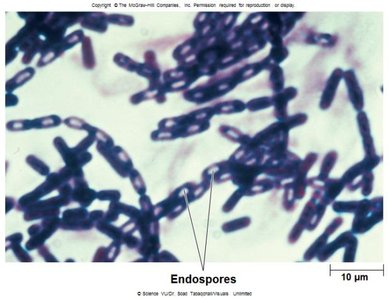
Boiling: Kills most microbes and viruses but not endospores.
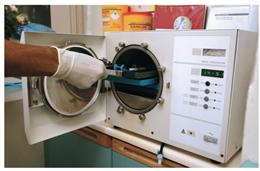
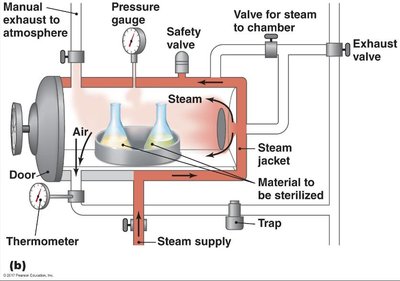
Autoclaving: Uses pressurized steam (121°C, 15 psi, 15-20 min) to sterilize and destroy endospores.
Pasteurization: Reduces pathogens and spoilage organisms in food and beverages.
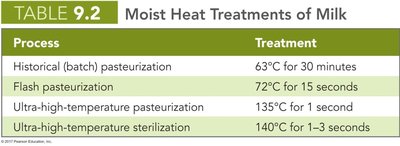
Process | Treatment |
|---|---|
Historical (batch) pasteurization | 63°C for 30 minutes |
Flash pasteurization | 72°C for 15 seconds |
Ultra-high-temperature pasteurization | 135°C for 1 second |
Ultra-high-temperature sterilization | 140°C for 1–3 seconds |
Dry Heat Methods
Incineration: Complete destruction of contaminated materials (e.g., medical waste).
Hot Air Ovens: Sterilization at higher temperatures for longer times than moist heat.
Other Physical Methods
Refrigeration & Freezing: Inhibit microbial growth (short-term storage); some pathogens can still grow at low temperatures.
Desiccation & Lyophilization: Removal of water to inhibit metabolism; used for preservation of food and microbial cultures.
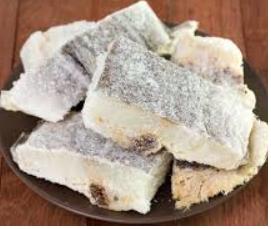
Osmotic Pressure: High concentrations of salt or sugar create hypertonic environments, causing plasmolysis in microbes.
Filtration: Physical removal of microbes from air or liquids using filters (e.g., HEPA filters, membrane filters for heat-sensitive solutions).
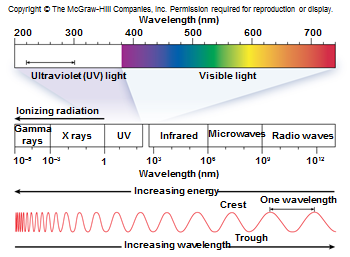
Radiation
Ionizing Radiation: (Gamma rays, X-rays) Remove electrons, create reactive oxygen species, damage DNA; used for sterilizing medical equipment and food.
Non-ionizing Radiation (UV): Causes thymine dimers in DNA, used for surface disinfection; poor penetration.
Chemical Methods of Microbial Control
Factors Affecting Chemical Effectiveness
Concentration of chemical
Temperature, pH, exposure time
Presence of organic material
Type and number of microbes
Nature of object/site
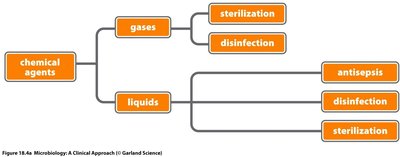
Major Classes of Chemical Agents
Phenolics: Disrupt cell membranes and denature proteins; effective in presence of organic matter (e.g., triclosan, Lister's phenol).
Alcohols: Denature proteins and disrupt membranes; 70–90% solutions are most effective; rapid evaporation is a limitation.
Halogens: Iodine, chlorine, bromine, fluorine; denature proteins and disrupt metabolism (e.g., Betadine, bleach).
Oxidizing Agents: High-level disinfectants (e.g., hydrogen peroxide, ozone, peracetic acid); damage cell components by oxidation.
Surfactants: Soaps and detergents; good for degerming, quaternary ammonium compounds (quats) are antimicrobial but inactivated by organic matter.
Heavy Metals: Silver, mercury, copper; denature proteins, used as low-level disinfectants (e.g., silver nitrate for newborns).
Aldehydes: Glutaraldehyde, formaldehyde; denature proteins and nucleic acids, used for sterilization of heat-sensitive equipment.
Gaseous Agents: Ethylene oxide, propylene oxide; sterilize heat-sensitive materials.
Enzymes: Lysozyme (breaks peptidoglycan), prionzyme (removes prions from instruments).
Method | Action(s) | Level of Activity | Some Uses |
|---|---|---|---|
Phenol | Denature proteins, disrupt membranes | Intermediate to low | Original surgical antiseptic |
Alcohols | Denature proteins, disrupt membranes | Intermediate | Disinfectants, antiseptics |
Halogens | Denature proteins by oxidation | Intermediate | Disinfectants, antiseptics, water purification |
Oxidizing agents | Denature proteins by oxidation | High | Disinfectants, sterilization of food processing equipment |
Surfactants | Decrease surface tension, disrupt membranes | Low | Soaps, detergents |
Heavy metals | Denature proteins | Low | Fungistats in paints, surgical dressings |
Aldehydes | Denature proteins | High | Sterilization of heat-sensitive equipment |
Gaseous agents | Denature proteins, DNA | High | Sterilization of heat- and water-sensitive objects |
Enzymes | Denature proteins | High against target | Removal of prions, food preservation |
Assessment of Antimicrobial Effectiveness
Methods such as the disk-diffusion assay are used to evaluate the efficacy of chemical agents against microbes.
Summary Table: Physical Methods of Microbial Control
Method | Conditions | Action | Representative Use(s) |
|---|---|---|---|
Moist heat (boiling) | 10 min at 100°C | Denatures proteins, destroys membranes | Disinfection of baby bottles, sanitization of tableware |
Autoclaving | 15 min at 121°C | Denatures proteins, destroys membranes | Sterilization of medical and laboratory supplies |
Pasteurization | Varies | Denatures proteins, destroys membranes | Destruction of pathogens and spoilage microbes in dairy, fruit juices, beer, wine |
Dry heat | Varies | Denatures proteins, oxidizes metabolic and structural chemicals | Sterilization of water-sensitive materials |
Refrigeration | 0–7°C | Inhibits metabolism | Preservation of food, drugs, cultures |
Freezing | Below 0°C | Inhibits metabolism | Long-term storage of bacterial cultures |
Filtration | Varies | Physically separates microbes from air/liquids | Sterilization of heat-sensitive solutions, air purification |
Ionizing radiation | Seconds to hours of exposure | Destroys DNA | Sterilization of medical and laboratory equipment, preservation of food |
Non-ionizing radiation | Seconds to hours of exposure | Formation of thymine dimers inhibits DNA transcription and replication | Disinfection and sterilization of surfaces and of transparent fluids and gases |
Conclusion
Effective microbial control is achieved by selecting appropriate physical or chemical methods based on the nature of the object, the type of microbes present, and the intended use. Understanding the mechanisms and limitations of each method is essential for ensuring safety in clinical, laboratory, and public health settings.
