 Back
BackEpidemiology and Patterns of Infectious Disease
Study Guide - Smart Notes
 Tailored notes based on your materials, expanded with key definitions, examples, and context.
Epidemiology
Introduction to Epidemiology
Epidemiology is the study of how diseases spread, their patterns, and their impact on populations. It is essential for understanding, controlling, and preventing infectious diseases.
Disease Transmission and Reservoirs
Symbiosis
Symbiosis means "to live together" and describes the close association between different species, including humans and microbes.
Mutualism: Both organisms benefit from the relationship.
Commensalism: One organism benefits, the other is unaffected.
Amensalism: One organism is harmed, the other is unaffected.
Parasitism: One organism benefits at the expense of the other.
Normal microbiota are microorganisms that colonize body surfaces without causing disease, often forming mutualistic or commensal relationships. They are acquired during birth, first breath, first meals, and throughout life.
Resident microbiota: Present throughout life on skin, mucous membranes, etc.
Transient microbiota: Present temporarily, do not persist.
Opportunistic pathogens are normal microbiota or environmental organisms that cause disease under certain conditions (e.g., immunosuppression).
Pathogen: Causes disease under normal conditions.
Opportunistic pathogen: Causes disease only under specific circumstances.
Reservoirs of Infection
A reservoir is any source where a pathogen survives and acts as a source of infection.
Animal reservoir: Pathogens maintained in animals (zoonoses).
Human carriers: Infected individuals without symptoms can transmit disease.
Nonliving reservoir: Soil, water, or other environmental sources.
Zoonoses are diseases transmitted from animals to humans. Eradication is difficult due to persistent animal reservoirs.
Modes of Transmission
Person-to-person: Direct (touch, handshake) or indirect (fomites).
Vehicle transmission: Non-living sources (water, food, air, soil).
Vector transmission: Arthropods/insects as mechanical (no colonization) or biological (pathogen grows in vector) vectors.
Healthcare-Associated Infections (HAIs)
HAIs, or nosocomial infections, occur in healthcare settings and are often associated with antibiotic-resistant pathogens. Prevention includes handwashing, disinfection, and infection control policies.
Epidemiologic Investigations
Emerging and Reemerging Diseases
Emerging diseases: Increasing in prevalence.
Reemerging diseases: Previously controlled, now increasing again.
Contributing factors include genetic recombination, evolution of new strains, and environmental changes.
Fields of Epidemiology
Descriptive epidemiology: Data collection and analysis (e.g., John Snow and cholera).
Analytical epidemiology: Determines probable cause (e.g., Florence Nightingale and antiseptic techniques).
Experimental epidemiology: Hypothesis testing and controlled experiments (e.g., Semmelweis and handwashing).
The CDC in the US collects and analyzes epidemiological data.
Epidemiological Concepts
Mortality: Incidence of death.
Morbidity: Incidence of disease.
DALY (Disability-Adjusted Life Year): Measures disease burden, considering life quality and productivity.
Pathology, Etiology, Infection, and Disease
Pathology: Study of disease.
Etiology: Cause of disease (e.g., pathogen).
Pathogenesis: Development of disease.
Infection: Invasion or colonization by pathogens.
Disease: Abnormal state with altered body function.
Koch’s Postulates
Pathogen must be present in every case of the disease.
Pathogen must be isolated and grown in pure culture.
Pure culture must cause disease in a healthy host.
Pathogen must be recoverable from the experimentally infected host.
Some diseases (e.g., those caused by viruses or prions) do not fit all postulates.
Classifying Infectious Diseases
Symptoms: Felt by the patient (e.g., pain).
Signs: Observable or measurable (e.g., fever).
Syndrome: Group of signs and symptoms.
Communicable disease: Spread from host to host.
Contagious disease: Easily and rapidly spread.
Noncommunicable disease: Not spread between hosts.
Stages of Disease
Chronic infection: Slow development, long duration (e.g., HIV, tuberculosis).
Acute infection: Rapid onset, short duration (e.g., influenza, food poisoning).
Infection: Pathogen invades and colonizes.
Incubation period: Time before symptoms appear.
Prodromal period: Mild symptoms.
Acute/illness period: Severe symptoms.
Decline period: Symptoms subside.
Convalescent period: Recovery to normal health.
Herd Immunity
Herd immunity occurs when a significant portion of a population is immune, reducing disease spread. The basic reproduction number () is the expected number of secondary cases from one case in a susceptible population.
Higher requires a higher percentage of immune individuals to prevent outbreaks.
Factors affecting include pathogen characteristics, population density, and social behavior.
Patterns of Disease and Outbreaks/Epidemics
Describing Disease Occurrence
Incidence: Number of new cases per population over a period.
Prevalence: Total number of cases (new + existing) per population over a period.
Outbreak: Sudden rise in incidence in a specific location.
Sporadic: Occasional cases in a location.
Endemic: Constant presence at expected levels.
Epidemic: Sudden increase above expected levels in multiple locations.
Pandemic: Widespread epidemic across continents.
Constant incidence in acute diseases leads to stable prevalence; in chronic diseases, prevalence increases over time.
Types of Epidemics
Common-source epidemic: Many cases arise from a single source (e.g., contaminated water).
Host-to-host epidemic: Disease spreads from person to person (e.g., influenza).
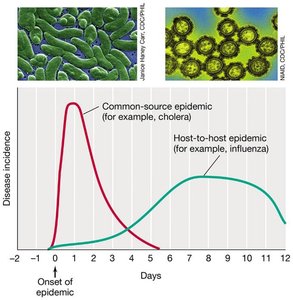
Example: The graph above shows that common-source epidemics (e.g., cholera) have a sharp, rapid rise and fall in cases, while host-to-host epidemics (e.g., influenza) have a slower, progressive increase and decline.
Additional info: Understanding these patterns helps public health officials implement appropriate control measures and predict disease spread.
