 Back
BackChapter Nine
Study Guide - Smart Notes
 Tailored notes based on your materials, expanded with key definitions, examples, and context.
Genetics of Bacteria and Archaea
Introduction
The genetics of bacteria and archaea encompasses the study of mutations, mechanisms of genetic variation, and horizontal gene transfer. These processes are fundamental to microbial evolution, adaptation, and the spread of traits such as antibiotic resistance.
Mutations and Mutants
Definition and Types of Mutations
A mutation is a heritable change in the nucleotide sequence of an organism's genome. Mutations can result in altered phenotypes and are a primary source of genetic diversity.
Wild-type: The standard or reference genotype/phenotype found in nature.
Mutant: An organism with a heritable change in its DNA sequence, resulting in a different phenotype from the wild-type.
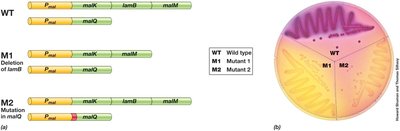
Classes of Mutants
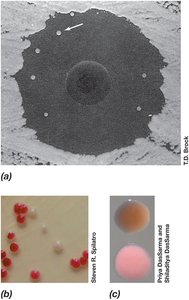
Mutants are classified based on their phenotypic changes and how they are detected:
Phenotype | Nature of Change | Detection |
|---|---|---|
Auxotroph | Loss of enzyme in biosynthetic pathway | Cannot grow on medium lacking the nutrient |
Temperature-sensitive | Altered essential protein, heat-sensitive | Cannot grow at high temperature |
Drug-resistant | Altered drug target or permeability | Grows on medium with inhibitory drug |
Nonmotile | Loss of flagella or function | Lack of motility, compact colonies |
Pigmentless | Loss of pigment biosynthesis | Different or absent colony color |
Virus-resistant | Loss of virus receptor | Grows in presence of virus |
Rough colony | Altered lipopolysaccharide layer | Granular, irregular colonies |
Selectable and Nonselectable Mutants
Selectable mutants confer a growth advantage under certain conditions (e.g., antibiotic resistance), while nonselectable mutants do not provide an obvious advantage and require screening to identify.
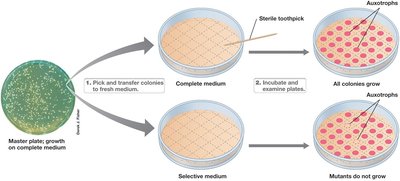
Screening for Nutritional Auxotrophs
Auxotrophs are mutants that have lost the ability to synthesize a particular nutrient. They are detected by replica plating onto selective media lacking the nutrient.
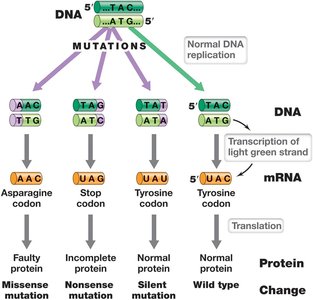
Types of Mutations
Point Mutations
Point mutations involve a single base pair change in DNA. They can be classified as:
Missense mutation: Changes a codon, resulting in a different amino acid and a faulty protein.
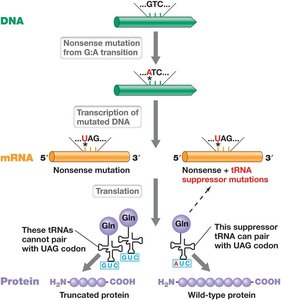
Nonsense mutation: Converts a codon to a stop codon, producing a truncated, incomplete protein.
Silent mutation: Alters a codon but does not change the amino acid due to redundancy in the genetic code.
Frameshift Mutations
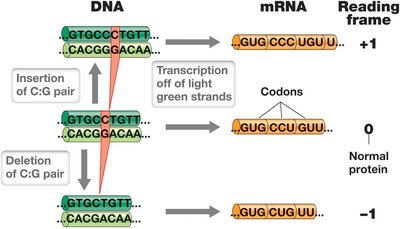
Frameshift mutations result from insertions or deletions of base pairs, altering the reading frame of the gene and usually producing nonfunctional proteins.
Suppression of Nonsense Mutations
Some nonsense mutations can be suppressed by mutations in tRNA genes, allowing the translation machinery to read through stop codons and produce full-length proteins.
Mutation Rates and Mutagenesis
Mutation Rates
Spontaneous mutation rates in bacteria are typically to per kilobase per generation.
DNA viruses have higher error rates; RNA viruses have the highest due to lack of proofreading.
Most single base changes result in missense or silent mutations; nonsense mutations are less common.
Mutagenesis: Chemical and Physical Mutagens
Mutagenesis is the process of inducing mutations using physical or chemical agents called mutagens.
Agent | Action | Result |
|---|---|---|
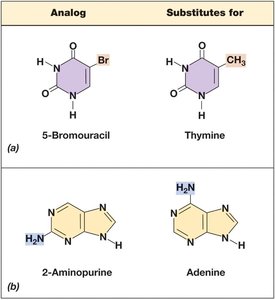
Base analogs (e.g., 5-bromouracil, 2-aminopurine) | Incorporated into DNA in place of normal bases | Faulty base pairing, point mutations |
Nitrous acid, hydroxylamine | Deaminates bases | Base substitutions |
Alkylating agents | Add alkyl groups to bases | Base substitutions, deletions |
Intercalating agents (e.g., acridines) | Insert between base pairs | Insertions, deletions (frameshifts) |
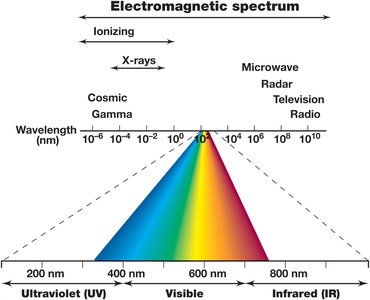
Radiation (UV, X-rays) | Damages DNA | Pyrimidine dimers, strand breaks |
Horizontal Gene Transfer (HGT)
Overview of HGT Mechanisms
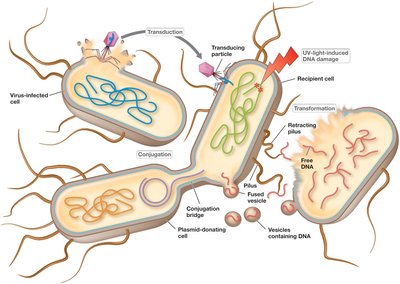
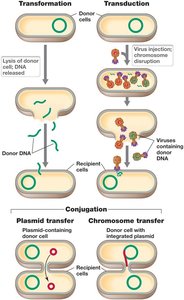
Horizontal gene transfer is the movement of genetic material between organisms other than by vertical transmission (parent to offspring). The three main mechanisms are transformation, transduction, and conjugation.
Transformation
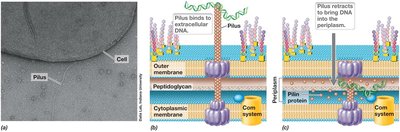
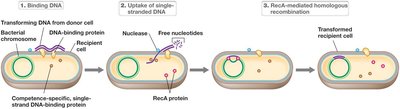
Transformation is the uptake of free DNA from the environment by a competent bacterial cell, followed by integration into the genome.
Competence is the physiological state allowing cells to take up DNA.
DNA is incorporated by homologous recombination.
Transduction
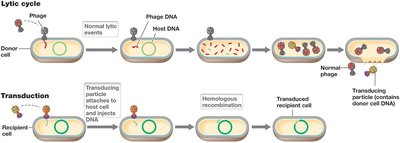
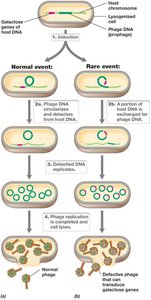
Transduction is the transfer of bacterial genes by bacteriophages (viruses that infect bacteria).
Generalized transduction: Any bacterial gene can be transferred by a lytic phage.
Specialized transduction: Only specific genes near the prophage insertion site are transferred by a lysogenic phage.
Conjugation
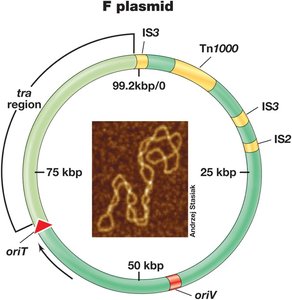
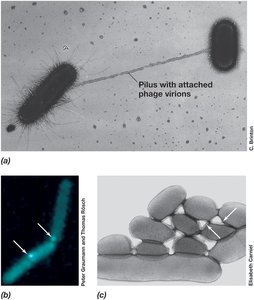
Conjugation is the direct transfer of DNA from a donor to a recipient cell via cell-to-cell contact, typically mediated by a plasmid (e.g., F plasmid in Escherichia coli).
Requires a conjugative pilus (sex pilus) for DNA transfer.
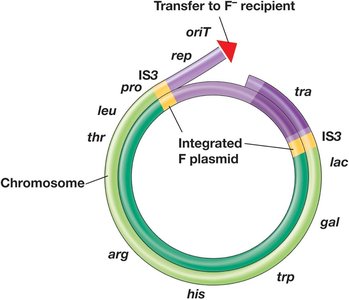
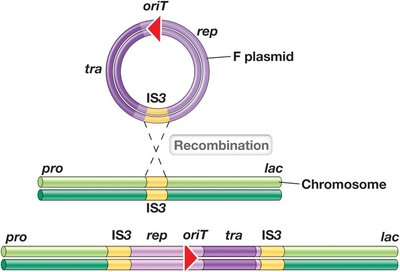
Can transfer plasmids or chromosomal DNA (in Hfr strains).
Hfr Strains and Chromosome Mobilization
High-frequency recombination (Hfr) strains have the F plasmid integrated into the chromosome, allowing transfer of chromosomal genes during conjugation.
Mobile DNA: Transposable Elements
Types of Transposable Elements
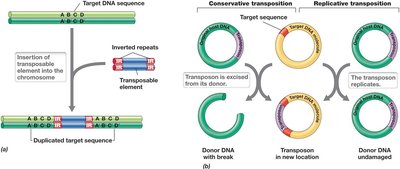
Transposable elements are DNA sequences that can move within the genome. They include:
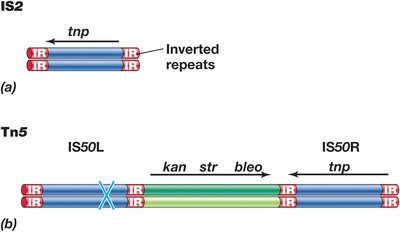
Insertion sequences (IS): Simple elements with only the genes required for transposition.
Transposons (Tn): Larger elements that carry additional genes, such as antibiotic resistance.
Preserving Genomic Integrity: CRISPR
CRISPR-Cas System
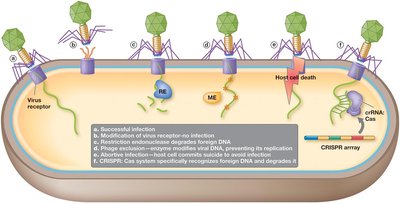
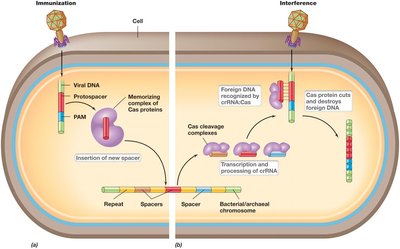
The CRISPR-Cas system is an adaptive immune mechanism in bacteria and archaea that provides resistance to foreign genetic elements such as phages and plasmids.
CRISPR loci contain short repeats and spacers derived from foreign DNA.
Cas proteins use crRNA to recognize and cleave matching foreign DNA.
Summary Table: Key Mechanisms of Genetic Variation in Bacteria and Archaea
Mechanism | Description | Biological Significance |
|---|---|---|
Mutation | Heritable change in DNA sequence | Source of genetic diversity |
Transformation | Uptake of free DNA from environment | Acquisition of new traits |
Transduction | Gene transfer by bacteriophages | Spread of genes between bacteria |
Conjugation | Direct DNA transfer via cell contact | Rapid dissemination of plasmids |
Transposition | Movement of DNA within genome | Genome rearrangement, gene inactivation |
CRISPR-Cas | Adaptive immunity to foreign DNA | Protection from phages and plasmids |
